
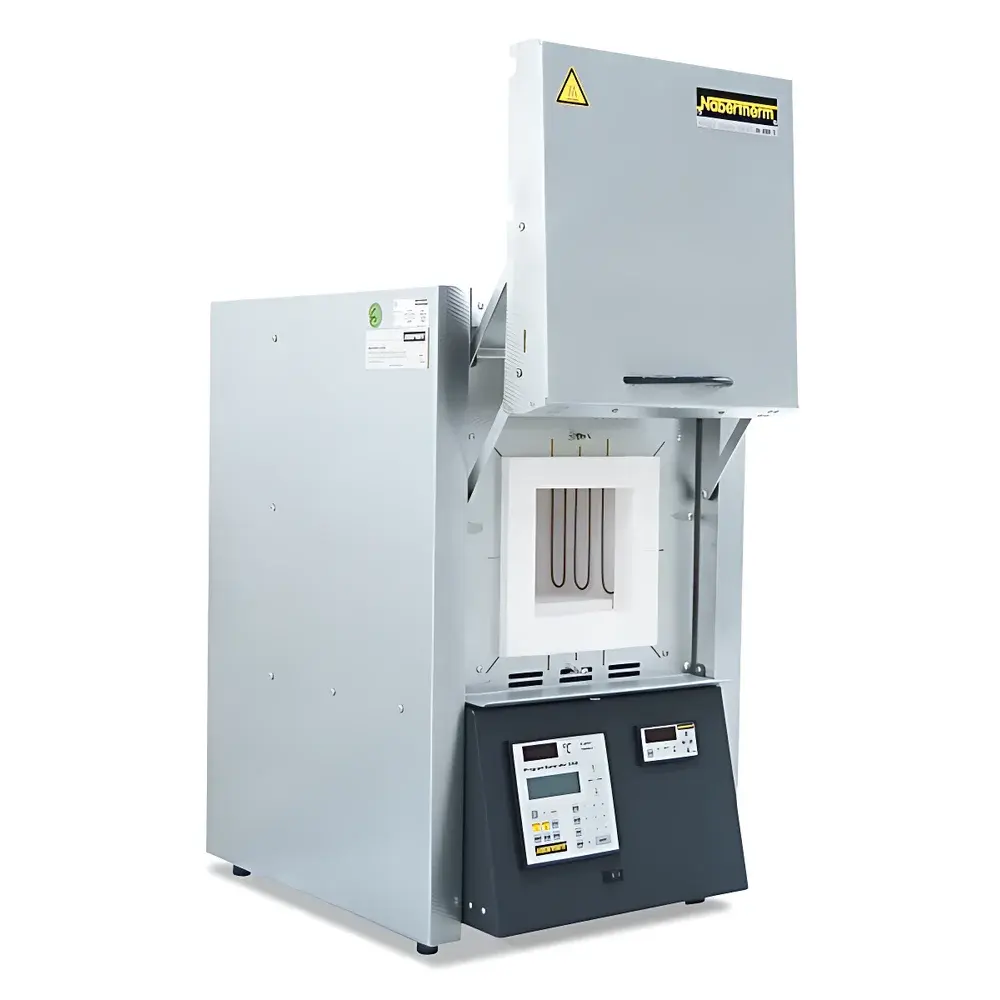
Nabertherm LHT Series High-Temperature Benchtop Muffle Furnace with MoSi₂ Heating Elements
| Brand | Nabertherm |
|---|---|
| Origin | Germany |
| Model Range | LHT 02/16 to LHT 08/18 |
| Maximum Temperature | 1800 °C |
| Temperature Uniformity | ±1 °C |
| Heating Element | Molybdenum Disilicide (MoSi₂) |
| Internal Dimensions | 150×150×90 mm to 150×300×150 mm |
| Chamber Volume | 2–8 L |
| Power Input | 3.0–9.0 kW |
| Ramp Time to Max Temp | ≤75 min |
| Cooling System | Dual-wall housing with integrated cooling fan |
| Thermocouple Type | Type B (Pt/Pt–Rh 30/6) |
| Safety Compliance | EN 60519-2 Class 2 overtemperature protection |
| Gas Inlet | Rear-mounted for inert or reducing atmosphere control |
| Door Type | Top-hinged lift door with adjustable air inlet and roof-mounted exhaust port |
Overview
The Nabertherm LHT Series represents a class of precision-engineered benchtop high-temperature muffle furnaces designed for demanding thermal processing in research laboratories, materials science facilities, and quality control environments. Built upon decades of German engineering heritage, these furnaces operate on resistive heating principles using silicon molybdenum (MoSi₂) heating elements—known for exceptional stability, oxidation resistance, and long service life at temperatures up to 1800 °C in air. Unlike traditional resistance wire or graphite-based systems, MoSi₂ elements maintain consistent emissivity and thermal output across repeated thermal cycles, enabling reproducible sintering, annealing, ashing, and calcination protocols. The furnace chamber is lined with high-purity, low-density ceramic fiber insulation (Al₂O₃–SiO₂), minimizing thermal mass while ensuring rapid heat-up and excellent temperature homogeneity. Its compact benchtop footprint—designed for integration into fume hood workflows or dedicated thermal processing stations—does not compromise structural integrity: the double-walled stainless steel housing incorporates active forced-air cooling to limit external surface temperature to <60 °C during continuous operation at maximum setpoint.
Key Features
- MoSi₂ heating elements rated for continuous operation up to 1800 °C in ambient air, with proven longevity exceeding 2,000 h under standard cycling conditions
- Ceramic fiber-lined hot zone engineered for ±1 °C temperature uniformity across the working volume (per DIN 17007 and IEC 60068-2-2)
- Lift-type top-hinged door with ergonomic counterbalance mechanism—eliminates direct hand exposure to radiant heat during loading/unloading
- Adjustable primary air inlet on door and roof-mounted exhaust port for controlled oxidative or semi-closed atmosphere management
- Dual-wall construction with integrated axial cooling fan maintains outer casing temperature below 60 °C even at 1800 °C internal setpoint
- Type B thermocouple (Pt–30%Rh / Pt–6%Rh) with cold-junction compensation, certified traceable to national standards (e.g., PTB or NIST)
- SCR-based power controller with digital PID algorithm, supporting ramp-soak profiles and programmable multi-step sequences
- Independent overtemperature protection circuit per EN 60519-2 Class 2—mechanically actuated limit switch cuts power if main controller fails
- Rear-mounted gas inlet port compatible with standard 6 mm OD stainless steel tubing for nitrogen, argon, or forming gas purging
Sample Compatibility & Compliance
The LHT Series accommodates diverse sample geometries and material classes—including technical ceramics (e.g., zirconia, alumina, silicon carbide), dental prosthetics (ceramic bridges, crowns), battery cathode precursors, catalyst supports, and refractory metal powders. Its inert-atmosphere capability—when used with optional manual or automated gas mixing modules—enables controlled reduction (e.g., NiO → Ni), carburization, or nitridation without contamination. All models comply with EU Machinery Directive 2006/42/EC, Electromagnetic Compatibility Directive 2014/30/EU, and Low Voltage Directive 2014/35/EU. Electrical safety certification includes VDE 0113-1 and EN 61000-6-3. For regulated environments (GMP/GLP labs), optional audit-trail-enabled controllers support 21 CFR Part 11 compliance when paired with validated software packages.
Software & Data Management
While base models feature front-panel digital controllers with intuitive keypad navigation and real-time display of setpoint, actual temperature, and elapsed time, optional TC400 or TCU400 controllers provide expanded functionality: USB and RS485 interfaces enable remote monitoring via PC-based software (Nabertherm LabView-compatible drivers available); data logging resolution down to 1 s with timestamped CSV export; user-defined alarm thresholds for deviation, rate-of-change, or dwell time violations; and password-protected parameter locking for SOP enforcement. All recorded thermal profiles include metadata (operator ID, batch number, furnace ID) and are cryptographically signed to satisfy ALCOA+ data integrity requirements.
Applications
- Sintering of advanced ceramics and bioceramics (ISO 13356, ASTM C1161)
- Thermal gravimetric analysis (TGA) pre-treatment and residue quantification (ASTM E1131)
- Heat treatment of dental alloys and CAD/CAM-milled oxide frameworks
- Calcination of catalyst precursors and metal-organic frameworks (MOFs)
- Ashing of polymer composites and biological tissues (AOAC 942.05)
- Pre-oxidation of SiC fiber coatings and diffusion barrier layers
- Calibration of high-temperature reference materials (e.g., SrTiO₃, Al₂O₃)
FAQ
What atmosphere options are supported?
Standard operation is in ambient air; optional inert gas purging (N₂, Ar) or reducing atmospheres (5% H₂/95% N₂) can be implemented using the rear gas inlet and optional flow controllers.
Is the furnace suitable for vacuum applications?
No—these models are not vacuum-rated. For vacuum or low-pressure sintering, consider Nabertherm’s VHT or VHT-V series.
Can multiple LHT units be stacked vertically?
Yes—units are mechanically designed for safe vertical stacking with included alignment guides and load-distribution feet; consult the installation manual for maximum stack height (typically ≤3 units).
What maintenance is required for MoSi₂ elements?
No periodic replacement is needed under normal use; however, avoid thermal shock (ΔT > 150 °C/min), mechanical abrasion, or contact with halogen-containing compounds or heavy metal vapors.
Does the furnace meet GLP documentation requirements?
With TC400/TCU400 controller + Nabertherm Validation Package (IQ/OQ), full traceability, electronic signatures, and audit trails compliant with ISO/IEC 17025 and FDA 21 CFR Part 11 are achievable.



