
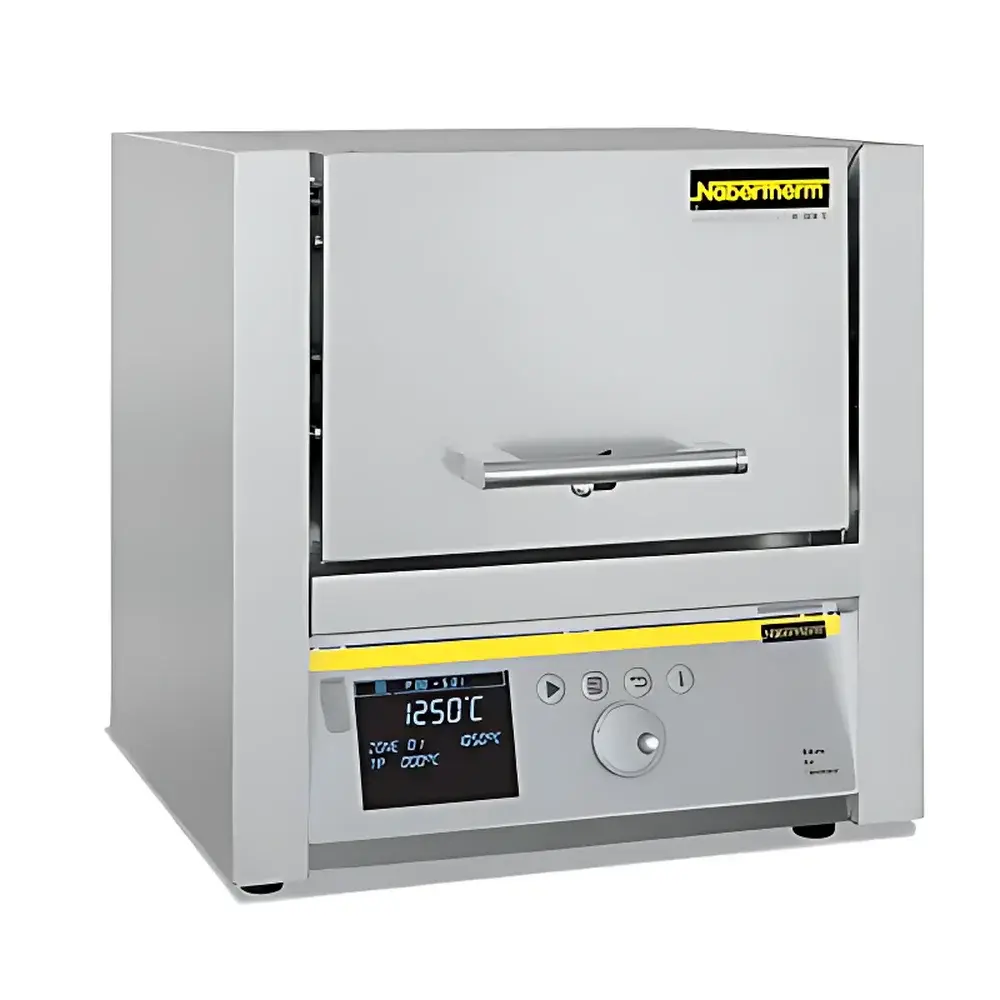
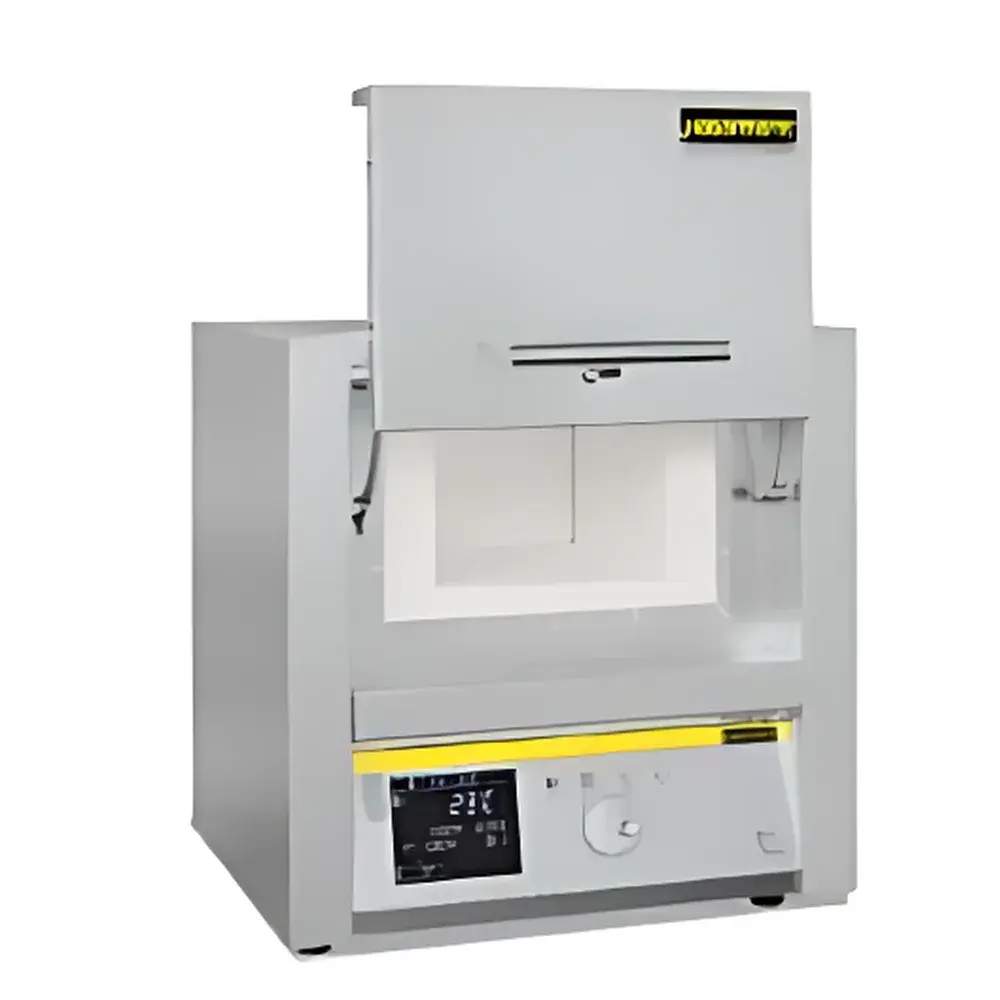
Nabertherm LT15/11 B410 Benchtop Muffle Furnace
| Brand | Nabertherm |
|---|---|
| Origin | Germany |
| Model | LT15/11 B410 |
| Type | Box-type Muffle Furnace |
| Max. Temperature | 1100 °C |
| Temperature Uniformity | ±3 °C |
| Rated Power | 3.5 kW |
| Heating Time to Max. Temp. | 90 min |
| Internal Dimensions (W×D×H) | 230 × 340 × 170 mm |
| Chamber Volume | 3 L |
| External Dimensions (W×D×H) | 415 × 555 × 755 mm (incl. base height) |
| Weight | 40 kg |
| Heating Method | Electric, Dual-sided Ceramic Heating Plates with Embedded Resistance Wire |
| Insulation | High-purity Alumina-Silica Fiber |
| Housing | Double-walled Stainless Steel (Brushed Finish) |
| Controller | B410 Programmable 4-Stage PID Controller with NTLog Data Logging via USB |
| Safety | EN 60519-2 Compliant Overtemperature Protection (Class 2 Thermal Cut-off), Adjustable Air Inlet, Rear Exhaust Port, Optional Catalytic Converter or Flare System |
Overview
The Nabertherm LT15/11 B410 is a precision-engineered benchtop muffle furnace designed for reproducible high-temperature thermal processing in research laboratories, quality control environments, and academic institutions. Operating on the principle of radiant heat transfer within an electrically heated, gas-tight ceramic chamber, it isolates samples from direct contact with heating elements—ensuring contamination-free thermal treatment essential for ashing, calcination, sintering, and heat-treatment protocols. Its dual-sided ceramic heating plates embed resistance wire in a chemically inert matrix, eliminating surface oxidation and enabling uniform temperature distribution across the 3 L chamber. The furnace complies with EN 60519-2 for industrial electroheating equipment safety, incorporating redundant thermal protection including a Class 2 independent overtemperature limiter that physically interrupts power at a preset cut-off threshold—critical for unattended operation during extended thermal cycles.
Key Features
- Robust double-walled stainless steel housing with brushed finish minimizes external surface temperature rise (<60 °C at ambient conditions), enhancing operator safety and lab ergonomics.
- Ceramic heating plates mounted on both front and rear walls provide symmetrical radiant heating—reducing thermal gradients and improving process repeatability across the full 230 × 340 × 170 mm working zone.
- High-purity alumina-silica fiber insulation ensures low thermal mass and rapid cooldown, while resisting degradation up to 1100 °C and maintaining structural integrity under repeated thermal cycling.
- B410 programmable controller supports four-stage ramp-soak profiles with real-time setpoint adjustment, manual override, and integrated alarm monitoring for deviation, fault, or overtemperature events.
- NTLog data logging functionality records time-stamped temperature, setpoint, and status parameters directly to USB flash media—enabling traceable process documentation aligned with GLP and ISO/IEC 17025 requirements.
- Modular exhaust interface allows seamless integration of optional accessories: catalytic converter (for VOC abatement at ~600 °C), forced-air exhaust chimney, or propane-fueled flare system—each controlled via dedicated B410 output channels with configurable activation logic.
Sample Compatibility & Compliance
The LT15/11 B410 accommodates crucibles, boats, and trays made from alumina, silicon carbide, quartz, or high-purity graphite—compatible with standard ASTM E1529 (fire-test-response), ISO 1171 (ash content determination), and USP (residue on ignition) methodologies. Its sealed muffle design prevents cross-contamination during ashing of pharmaceutical excipients, food matrices, or environmental samples. All electrical components meet CE marking requirements under the Low Voltage Directive (2014/35/EU) and EMC Directive (2014/30/EU). The furnace supports inert or reactive atmosphere purging via dedicated gas inlet ports (non-interchangeable with exhaust configurations), facilitating controlled oxidation/reduction studies per ISO 8501-1 or ASTM G151 protocols.
Software & Data Management
Process supervision is enabled through Nabertherm’s VCD (Virtual Control Device) software suite—a Windows-based application supporting remote monitoring, multi-furnace synchronization, and automated report generation in PDF or CSV format. VCD implements audit-trail functionality compliant with FDA 21 CFR Part 11 when used with user authentication and electronic signature modules. Logged datasets include timestamped temperature readings sampled at 1-second intervals, controller status flags, and event logs (e.g., door open detection, power interruption, alarm triggers). Data export conforms to ASTM E2500-07 Annex A1 for validation documentation frameworks.
Applications
- Residue-on-ignition testing in pharmaceutical QC labs (USP , EP 2.4.15)
- Organic matter removal and mineralization of biological, botanical, or soil samples prior to ICP-OES/MS analysis
- Pre-sintering of ceramic green bodies and glass frit densification studies
- Heat treatment of metal alloys for microstructural homogenization (annealing, stress relieving)
- Thermogravimetric pre-conditioning of catalysts and battery electrode materials
- Calibration verification of thermocouples and RTDs per ISO/IEC 17025 Clause 6.4.10
FAQ
What safety certifications does the LT15/11 B410 hold?
It conforms to EN 60519-2 for electroheating equipment, carries CE marking under EU Low Voltage and EMC Directives, and meets IP20 ingress protection requirements.
Can the furnace operate under nitrogen or argon atmosphere?
Yes—dedicated gas inlet ports support inert or reactive gas purging; however, gas lines must be isolated from exhaust pathways per manufacturer installation guidelines.
Is the B410 controller compatible with third-party SCADA systems?
No native Modbus or Ethernet interface is provided; integration requires analog signal emulation via optional relay or 4–20 mA output modules (sold separately).
What is the expected service life of the ceramic heating plates?
Under normal laboratory use (≤8 h/day, ≤1100 °C), heating plates typically exceed 5,000 operating hours before replacement—verified by periodic thermal mapping per ISO/IEC 17025 internal calibration procedures.
Does the furnace support automatic door interlock shutdown?
No mechanical or magnetic door interlock is integrated; safe operation relies on procedural adherence and optional external safety relays configured per risk assessment (e.g., ISO 13857).



