
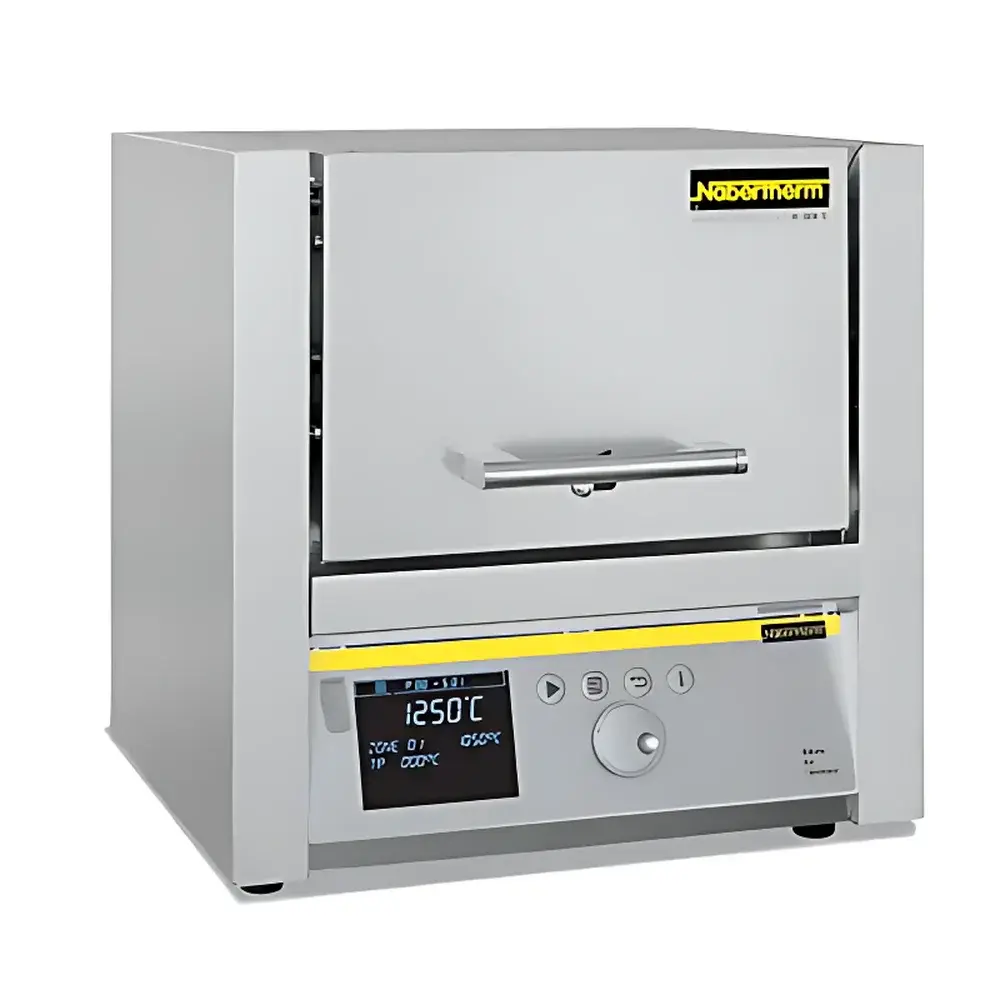
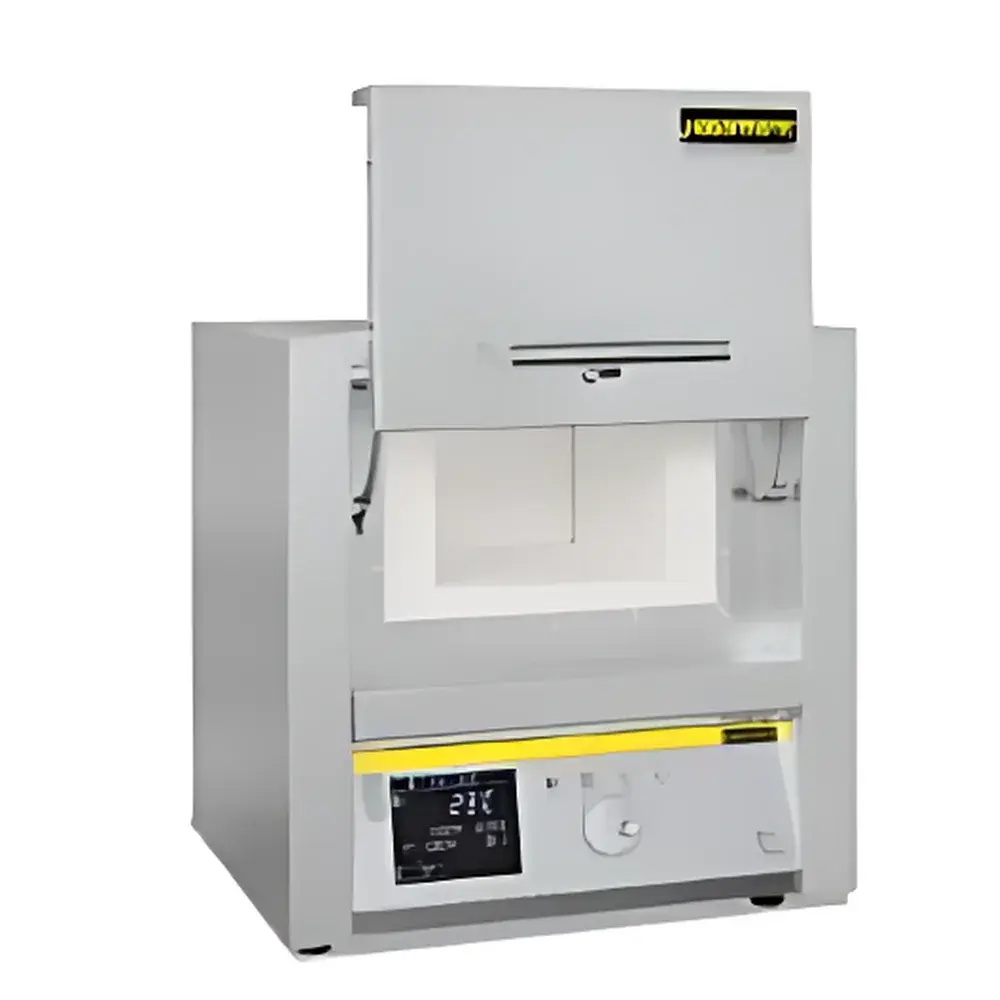
Nabertherm LT40/11 B410 Benchtop Muffle Furnace
| Brand | Nabertherm |
|---|---|
| Origin | Germany |
| Model | LT40/11 B410 |
| Type | Box-type Muffle Furnace |
| Max. Temperature | 1100 °C |
| Temperature Uniformity | ±3 °C |
| Rated Power | 6 kW |
| Heating Time to 1100 °C | 95 min |
| Internal Dimensions (W×D×H) | 320 × 490 × 250 mm |
| Chamber Volume | 3 L |
| External Dimensions (W×D×H) | 530 × 705 × 900 mm (incl. optional top-hinged door) |
| Weight | 65 kg |
| Heating Method | Electric, Triple-Sided Ceramic Heating Panels with Embedded Resistance Wire |
| Insulation | High-Density Ceramic Fiber |
| Housing | Dual-Layer Stainless Steel (Brushed Finish) |
| Controller | B410 Programmable 4-Stage PID Controller with USB Data Logging (NTLog Basic), Solid-State Relay Output |
| Safety Compliance | EN 60519-2 Class 2 Thermal Protection, Overtemperature Cut-off, Gas Purge Interface (Inert/Reactive), Optional Exhaust Chimney, Catalytic Oxidizer, or Gas Torch Integration |
Overview
The Nabertherm LT40/11 B410 is a precision-engineered benchtop muffle furnace designed for routine laboratory thermal processing where reproducibility, safety, and long-term operational stability are critical. Based on resistive heating via triple-sided ceramic panels—each embedding high-stability resistance wire—the furnace achieves uniform thermal distribution across its 3 L chamber without direct exposure of heating elements to process atmospheres. This architecture prevents contamination from volatile residues or splashes, significantly extending service life and reducing maintenance frequency. The muffle design isolates the sample chamber from external air and combustion byproducts, enabling controlled oxidative, inert, or mildly reactive thermal treatments up to 1100 °C. Its dual-layer stainless steel housing minimizes surface temperature rise during operation, while the optional top-hinged door (L-type) eliminates operator contact with hot front surfaces—a key ergonomic enhancement for high-throughput labs handling frequent sample loading/unloading.
Key Features
- Triple-sided ceramic heating panels with embedded resistance wire ensure homogeneous temperature distribution and protection against chemical attack from volatiles.
- Ceramic fiber insulation provides low thermal mass and high thermal efficiency, contributing to energy savings and consistent ramp/soak performance.
- B410 programmable controller supports up to four independent heating/cooling segments, real-time setpoint adjustment, and automatic shutdown logic based on time or temperature thresholds.
- Integrated NTLog Basic software enables process data acquisition via USB flash drive—recording temperature, time, and controller status for traceability and audit readiness.
- EN 60519-2-compliant Class 2 thermal protection includes redundant overtemperature cut-off (OTC) circuitry that physically interrupts power when preset limit is exceeded, safeguarding both equipment and samples.
- Dual-layer brushed stainless steel housing maintains structural rigidity and reduces outer surface temperature to <50 °C under full-load operation.
- Standard gas purge interface allows connection of inert (e.g., N₂, Ar) or reactive (e.g., forming gas) atmospheres—compatible with GLP/GMP workflows requiring atmosphere documentation.
Sample Compatibility & Compliance
The LT40/11 B410 accommodates crucibles, boats, and trays up to 320 mm wide × 490 mm deep × 250 mm high, supporting standard ceramic, alumina, quartz, and metallic substrates. It meets essential regulatory expectations for laboratories operating under ISO/IEC 17025, USP , ASTM E1137/E1138, and FDA 21 CFR Part 11 environments—particularly when paired with VCD process control software and audit-trail-enabled logging. Optional catalytic oxidizers (operating at ~600 °C) or propane-fueled exhaust torches enable compliant abatement of organic effluents, satisfying local emissions requirements in academic, pharmaceutical, and food testing facilities. All safety interlocks—including door-open detection and OTC activation—are documented in accordance with IEC 61508 functional safety principles.
Software & Data Management
Process monitoring and archival are supported through two complementary platforms: NTLog Basic (included) and the optional VCD software suite. NTLog records timestamped temperature profiles directly to USB media in CSV format—suitable for basic validation and internal QA review. VCD extends functionality with remote supervision, multi-furnace synchronization, electronic signature support, and 21 CFR Part 11-compliant user access controls, audit trails, and data integrity safeguards. Both systems interface natively with the B410 controller’s RS485 port; no third-party drivers or middleware are required. Data export formats include PDF reports, Excel-compatible logs, and XML for integration into LIMS or MES infrastructure.
Applications
This furnace serves core thermal preparation tasks across multiple regulated sectors: ashing of food, feed, and pharmaceutical matrices per AOAC 943.01 and EPA Method 3050B; calcination of catalyst precursors and ceramic powders; heat treatment of metallurgical samples prior to SEM/EDS analysis; sintering trials for dental and biomedical ceramics; pre-firing of glass frits and enamel coatings; and thermal gravimetric conditioning of polymer composites. Its precise 1100 °C capability and ±3 °C uniformity make it suitable for ASTM C114 cement analysis, ISO 562 coal char determination, and ISO 1171 ash content protocols—where repeatability between runs is mandated.
FAQ
What is the recommended maintenance interval for the ceramic fiber insulation?
Ceramic fiber integrity should be visually inspected annually; replacement is advised only if cracking, compression, or visible fiber shedding occurs—typically after >5,000 hours of cumulative operation at ≤1100 °C.
Can the B410 controller be upgraded to support Ethernet or Wi-Fi connectivity?
No—B410 is a standalone 4-segment PID unit with USB and RS485 interfaces only. For networked operation, integrate via VCD software running on an external PC connected to the furnace’s serial port.
Is the gas purge interface compatible with vacuum applications?
No—the inlet is designed for positive-pressure inert or reactive gas flow only; vacuum sealing requires custom modifications not covered under warranty or CE certification.
Does the furnace include a calibration certificate?
Factory calibration is performed per DIN EN ISO/IEC 17025; a traceable certificate (including as-found/as-left data) is available upon request at time of order—subject to additional lead time and fee.
Are replacement heating panels field-serviceable?
Yes—panels are modular and accessible via rear service panel; full replacement can be completed by trained personnel using standard tools and Nabertherm’s documented procedure (Service Manual LT40/11 Rev. 4.2).



