
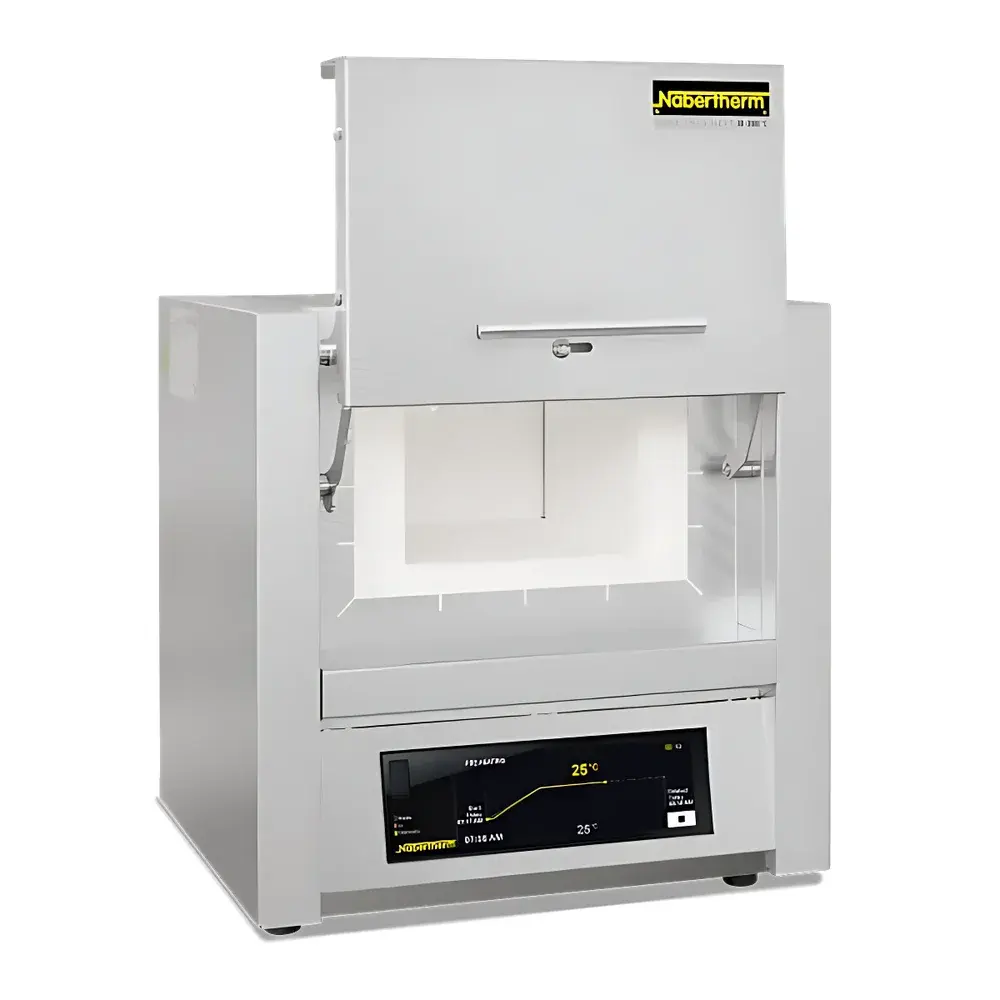
Nabertherm LT5/11HA – LT15/11HA High-Uniformity Muffle Furnace with Integrated Air Circulation
| Brand | Nabertherm |
|---|---|
| Origin | Germany |
| Model Range | LT5/11HA, LT9/11HA, LT15/11HA |
| Max Temperature | 1100 °C |
| Chamber Dimensions (W×D×H) | 200×160×130 mm (LT5), 230×230×170 mm (LT9), 230×330×170 mm (LT15) |
| Chamber Volume | 5 L, 9 L, 15 L |
| External Dimensions (W×D×H) | 470×520×540 mm (LT5), 550×570×480 mm (LT9), 650×570×480 mm (LT15) |
| Electrical Connection | 230 V, 1-phase |
| Power Rating | 2.4 kW (LT5), 3.0 kW (LT9), 3.6 kW (LT15) |
| Net Weight | 66 kg (LT5/LT9), 75 kg (LT15) |
| Heating System | Dual-sided ceramic heating plates with embedded resistance wire |
| Insulation | Vacuum-reinforced fiber modules |
| Door Type | Top-opening (lift-up) |
| Air Circulation | Integrated low-noise centrifugal fan |
| Exhaust | Rear wall vent port + optional chimney assembly with fan or catalytic converter |
| Overtemperature Protection | EN 60519-2 compliant thermal limiter (Class 2), independent cut-off at preset safety threshold |
Overview
The Nabertherm LT5/11HA – LT15/11HA series comprises high-precision muffle furnaces engineered for laboratories requiring exceptional temperature uniformity and process repeatability across a wide operating range up to 1100 °C. These units employ a forced-air convection architecture integrated directly into the furnace chamber, distinguishing them from passive conduction-heated alternatives. The dual-sided ceramic heating plates—each containing fully encapsulated resistance wire—deliver symmetrical radiant and convective heat input while remaining chemically inert and impervious to volatile condensates or splashes. Combined with vacuum-reinforced fiber insulation and a rigid double-walled stainless steel housing, this design achieves stable thermal gradients (<±3 °C at 1100 °C per DIN EN 60519-2 test protocol) and minimized external surface temperatures (<55 °C under continuous operation). The top-opening door configuration enhances operator safety by eliminating direct exposure to heated vertical surfaces during loading/unloading, aligning with occupational health guidelines for laboratory thermal equipment.
Key Features
- Dual-ceramic heating system with fully embedded resistance elements—immune to chemical attack and mechanically robust for long-term stability
- Integrated low-noise centrifugal air circulation unit ensuring homogeneous temperature distribution, especially critical below 300 °C where natural convection is insufficient
- Vacuum-reinforced fiber insulation modules providing superior thermal retention and rapid cooldown response without structural degradation
- Top-hinged lift-up door mechanism minimizing radiant exposure and enabling ergonomic sample handling in confined benchtop spaces
- Rear-mounted exhaust port compatible with optional active ventilation systems—including catalytic converters for organic off-gas abatement—supporting ISO 17025-compliant environmental control
- Independent overtemperature protection circuit per EN 60519-2 (Class 2), featuring a mechanical thermal limiter with fixed cut-off setpoint decoupled from the main controller
- Stainless steel housing with brushed finish and reinforced structural joints ensuring mechanical integrity under repeated thermal cycling
Sample Compatibility & Compliance
The LT-series accommodates standard crucibles (alumina, quartz, silicon carbide), ceramic boats, and metal trays up to maximum dimensions of 230 mm (W) × 330 mm (D) × 170 mm (H). Its uniform thermal field supports applications governed by ASTM E1113 (determination of furnace temperature uniformity), ISO/IEC 17025 clause 6.4.3 (equipment suitability verification), and USP (thermal sterilization validation). The absence of exposed heating elements and sealed ceramic plate construction renders it suitable for ashing organic matrices, calcination of catalyst precursors, and pre-conditioning of reference materials under GLP conditions. All models are CE-marked and comply with IEC 61000-6-3 (EMC emission limits) and IEC 61000-6-2 (immunity requirements).
Software & Data Management
While the LT5/11HA–LT15/11HA operates via an integrated digital controller with PID regulation and ramp-soak programming, optional Nabertherm THERMCONTROL® software enables full remote supervision via RS485 or Ethernet interface. This platform supports audit-trail generation compliant with FDA 21 CFR Part 11 (electronic records/signatures), including user-defined event logging, calibration history tracking, and deviation alerts triggered by thermal excursion thresholds. Data export is available in CSV and XML formats for integration into LIMS environments or statistical process control (SPC) workflows.
Applications
- Gravimetric analysis: quantitative ash residue determination per AOAC 923.03 and EPA Method 1684
- Thermal pre-treatment of catalysts, battery electrode materials, and ceramic green bodies prior to sintering
- Residue-on-ignition (ROI) testing in cement, soil, and pharmaceutical excipient quality control
- Calibration of thermocouples and RTDs using fixed-point reference materials (e.g., Zn, Al, Cu freezing points)
- Controlled oxidative aging of polymer films and composites per ISO 188 and ASTM D572
- Pre-drying and conditioning of moisture-sensitive standards in metrology labs
FAQ
What is the temperature uniformity specification across the working volume?
At 1100 °C, measured per DIN EN 60519-2, the maximum deviation is ±3 °C within the defined working zone (defined as 70% of chamber volume centered geometrically).
Can the furnace be operated continuously at maximum temperature?
Yes—rated for indefinite operation at 1100 °C when installed with adequate clearance (≥100 mm on all sides) and ambient temperature ≤35 °C.
Is the exhaust system mandatory for routine operation?
Not mandatory for inert or non-volatile processes; however, installation is required for ashing organic samples, halogenated compounds, or any application generating condensable vapors per laboratory safety protocols.
How often does the ceramic heating plate require replacement?
Under normal usage and proper loading practices, service life exceeds 8,000 operating hours; visual inspection every 12 months is recommended.
Does the unit support programmable multi-step thermal profiles?
Yes—the built-in controller stores up to 16 segments with independent ramp rates, soak times, and hold temperatures; profiles can be duplicated and archived externally via THERMCONTROL®.



