
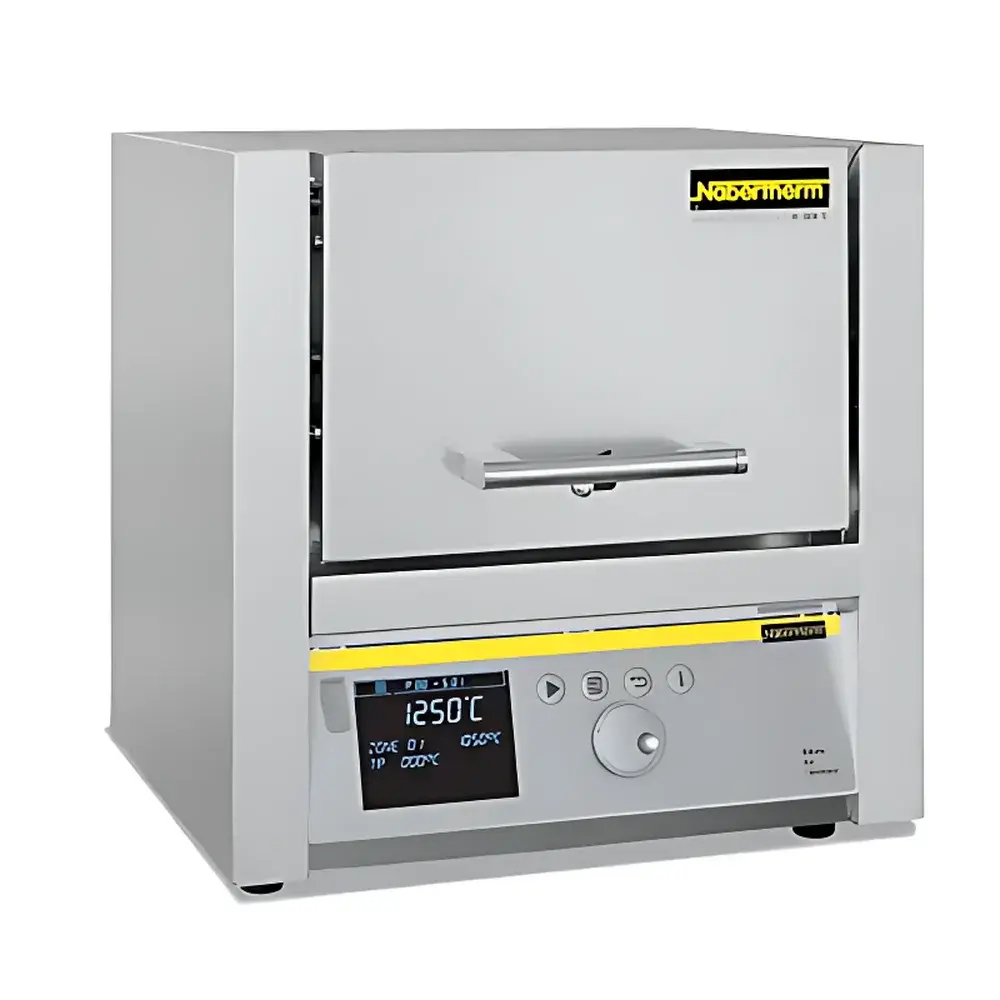
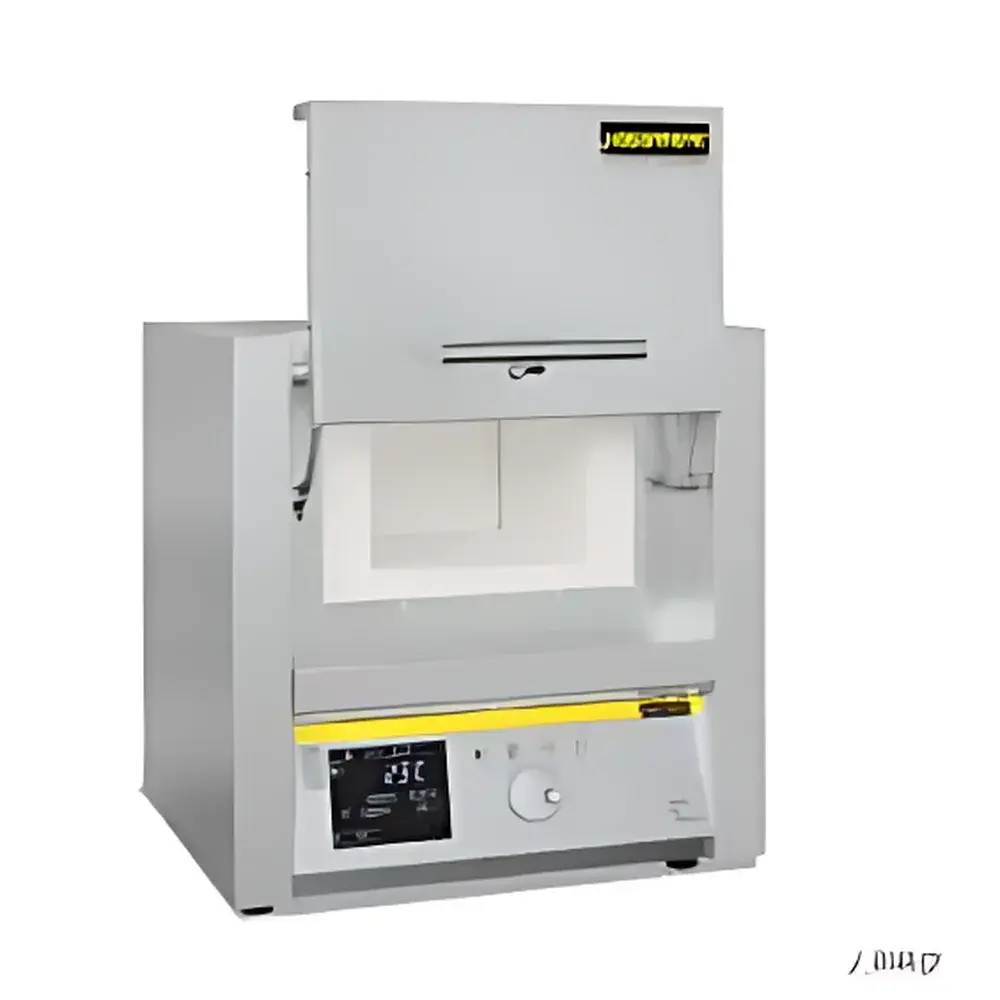
Nabertherm LT9 11 B410 Benchtop Muffle Furnace
| Brand | Nabertherm |
|---|---|
| Country of Origin | Germany |
| Model | LT9 11 B410 |
| Instrument Type | Box-Type Muffle Furnace |
| Maximum Temperature | 1100 °C |
| Temperature Control Accuracy | ±3 °C |
| Rated Power | 3 kW |
| Heating Time to Max Temp | 75 min |
| Heating Method | Electric (Dual-Sided Ceramic Heating Plates with Embedded Resistance Wire) |
| Internal Dimensions (W×D×H) | 230 × 240 × 170 mm |
| Chamber Volume | 3 L |
| External Dimensions (W×D×H) | 415 × 455 × 515 mm + 240 mm (for optional top-hinged door) |
| Weight | 35 kg |
| Phase | Single-Phase |
Overview
The Nabertherm LT9 11 B410 is a precision-engineered benchtop muffle furnace designed for routine thermal processing in research laboratories, quality control environments, and academic institutions. Operating on the principle of radiant heat transfer within an electrically heated, fully insulated chamber, it isolates samples from direct contact with heating elements—ensuring uniform temperature distribution, minimal contamination risk, and reproducible thermal profiles. Its dual-sided ceramic heating plates incorporate embedded resistance wire, providing rapid, symmetrical heating while resisting chemical attack from volatiles or splashes. The furnace complies with EN 60519-2 for electrical safety in industrial heating equipment and integrates thermal protection Class 2 per IEC 60519, featuring independent overtemperature limiters that physically disconnect power if preset thresholds are exceeded—critical for unattended operation and GLP-compliant workflows.
Key Features
- Robust double-walled stainless steel housing with brushed finish, engineered to maintain low external surface temperatures (<60 °C at ambient conditions) during extended operation at 1100 °C.
- Ceramic fiber insulation system—non-combustible, low thermal conductivity—optimized for energy efficiency and long-term dimensional stability under cyclic thermal stress.
- Top-hinged door option (L-type) available ex-factory, minimizing operator exposure to radiant heat during loading/unloading; includes adjustable air inlet for controlled atmosphere ingress.
- Rear-mounted exhaust port compatible with optional catalytic converters, active exhaust chimneys, or gas-fired afterburners—enabling safe handling of organic off-gases or reactive atmospheres.
- B410 programmable controller with 4-segment ramp-soak capability, USB data logging via NTLog firmware, and configurable process alarms—including real-time deviation monitoring and automatic shutdown on fault detection.
- Integrated solid-state relay (SSR) switching ensures silent, wear-free power modulation with high cycle endurance—essential for applications requiring frequent thermal cycling.
Sample Compatibility & Compliance
The LT9 11 B410 accommodates crucibles, boats, and trays up to 230 mm wide × 240 mm deep × 170 mm high, supporting standard silica, alumina, and platinum ware. Its inert muffle chamber enables ashing of pharmaceutical excipients (per USP ), food matrices (AOAC 942.05), and environmental samples (EPA Method 3010A). Optional gas purging kits allow nitrogen or argon blanketing for oxidation-sensitive materials (e.g., battery cathode precursors), while catalytic exhaust units meet VOC abatement requirements under ISO 14001-aligned lab EHS protocols. All configurations adhere to CE marking directives (2014/35/EU Low Voltage Directive and 2014/30/EU EMC Directive) and support audit-ready documentation for ISO/IEC 17025-accredited testing labs.
Software & Data Management
Process parameters are managed via the B410 controller’s intuitive rotary encoder interface, with full programmability including ramp rates (°C/min), soak durations, and multi-step sequences. NTLog software (Windows-compatible) enables real-time visualization, CSV export, and timestamped event logging—including power status, thermocouple drift alerts, and overtemperature interventions. When paired with VCD software suite (optional), users gain remote monitoring, electronic signature support, and 21 CFR Part 11–compliant audit trails—meeting FDA-regulated QC environments’ requirements for traceability and data integrity. All logged data retain metadata such as operator ID, calibration certificate reference, and environmental ambient readings (when interfaced with external sensors).
Applications
- Thermal gravimetric analysis (TGA) pre-treatment and residue quantification in food safety and nutraceutical testing.
- Calcination of catalyst supports (e.g., γ-Al2O3, SiO2) and ceramic green bodies prior to sintering.
- Metallurgical sample preparation: decarburization of steel coupons, homogenization annealing of alloy powders.
- Pharmaceutical residual solvent removal and tablet coating stability studies per ICH Q1A(R2).
- Academic materials science: phase transformation studies in oxide systems, glass transition annealing, and thermal shock resistance evaluation.
- Environmental compliance: heavy metal recovery from fly ash via controlled oxidative roasting.
FAQ
What is the maximum continuous operating temperature of the LT9 11 B410?
The furnace is rated for continuous operation at 1100 °C, with short-term tolerance up to 1150 °C for ≤30 minutes per cycle—subject to validation against manufacturer-specified thermal cycling limits.
Can the B410 controller be integrated into a central laboratory LIMS or SCADA system?
Yes—via RS485 Modbus RTU protocol (optional interface module required); native USB logging supports automated ingestion into LabWare LIMS or Thermo Fisher SampleManager via scheduled batch exports.
Is the ceramic fiber insulation compliant with EU REACH and RoHS regulations?
Yes—the high-purity alumino-silicate fiber formulation contains no regulated SVHCs and carries full material declaration documentation upon request.
What safety certifications apply to the exhaust catalytic converter option?
The catalytic unit (part no. 631000812) conforms to DIN EN 1539 for industrial thermal oxidizers and includes CE-marked explosion-proof wiring for Class II, Group IIA hazardous area use when installed per Nabertherm mounting guidelines.
How often does the thermocouple require recalibration per ISO/IEC 17025?
Nabertherm recommends annual verification against a certified reference thermometer (e.g., Fluke 1523) traceable to NIST; internal validation intervals may be extended to 18 months if supported by documented historical stability data per Clause 6.5.2 of ISO/IEC 17025:2017.



