
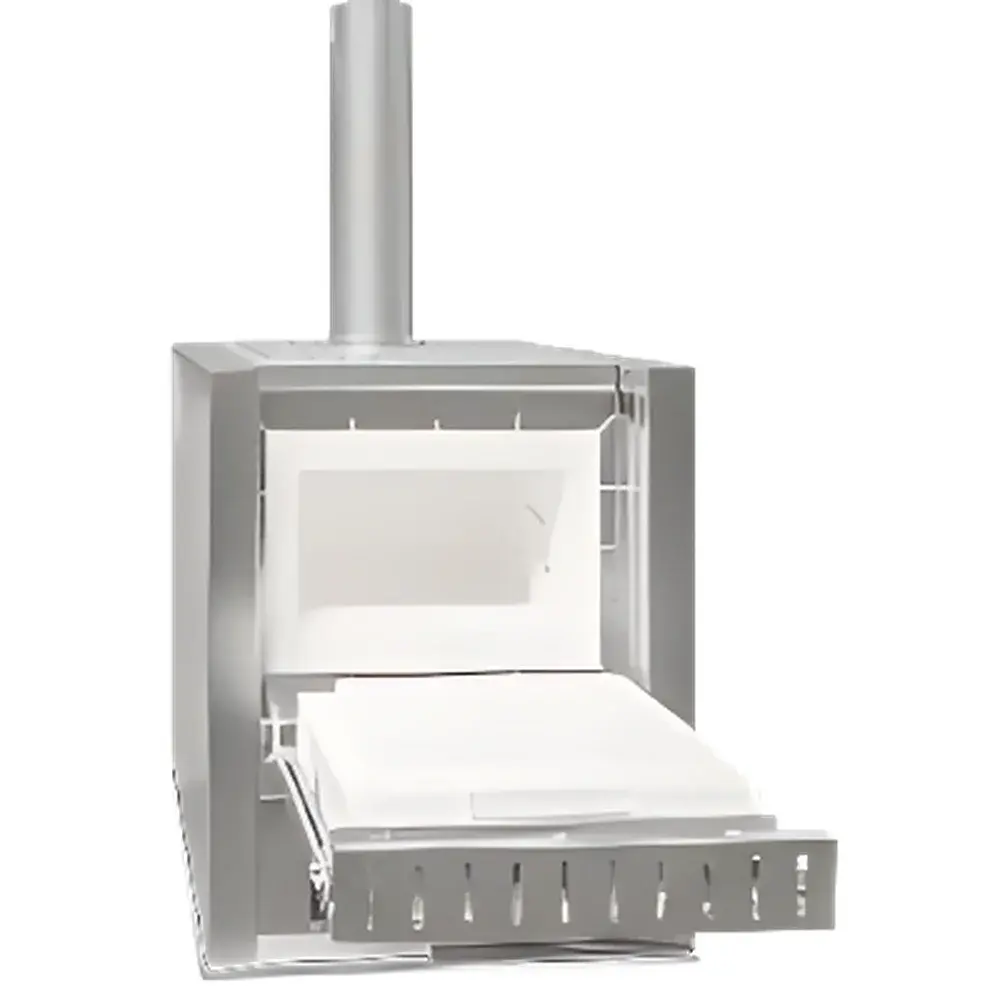
Nabertherm LV3/11 Ashing Furnace
| Brand | EYELA |
|---|---|
| Origin | Germany |
| Model | LV3/11 |
| Max. Operating Temperature | 1100 °C |
| Internal Dimensions (W×D×H) | 160 × 140 × 100 mm |
| Chamber Volume | 3 L |
| External Dimensions (W×D×H) | 385 × 360 × 735 mm |
| Power Supply | 1-phase, 1.2 kW |
| Net Weight | 20 kg |
| Air Exchange Rate | ≥6 air changes/min |
| Heating Method | Dual-sided ceramic heating plates with embedded resistance wire |
| Insulation | High-purity vacuum-formed fiber modules |
| Safety | EN 60519-2 compliant overtemperature protection (Class 2), adjustable cutoff temperature |
| Control System | Controltherm MV software-enabled process monitoring and data logging |
Overview
The Nabertherm LV3/11 Ashing Furnace is a precision-engineered laboratory muffle furnace designed for controlled thermal decomposition of organic matrices in analytical and quality control workflows. Operating on the principle of oxidative ashing—where samples are subjected to precisely regulated high-temperature combustion in ambient or forced-air atmospheres—the LV3/11 delivers reproducible residue quantification for applications such as total ash content determination (e.g., ASTM D2593, ISO 2107, USP <281>), catalyst residue analysis, and preparation of inorganic standards for ICP-OES/MS. Its maximum operating temperature of 1100 °C is achieved via dual-sided ceramic heating plates with fully embedded resistance elements, ensuring uniform thermal distribution across the 3 L chamber while protecting heating components from corrosive volatiles and condensates typical in biological, pharmaceutical, or polymer ashing protocols.
Key Features
- Dual-sided ceramic heating system with recessed resistance wires—minimizes contamination risk and extends service life under aggressive ashing conditions
- High-efficiency forced-air ventilation delivering ≥6 complete chamber air exchanges per minute, enabling rapid atmosphere refresh and consistent oxidation kinetics
- Vacuum-formed alumina-silica fiber insulation (density ~128 kg/m³) providing low thermal mass, rapid ramp rates, and outer casing surface temperatures <50 °C at full operation
- Robust double-walled stainless steel housing with brushed finish—mechanically stable, corrosion-resistant, and compliant with laboratory ergonomic safety standards
- Optional door configurations: front-opening (LV variant) for easy sample loading/unloading, or top-hinged (LT variant) to reduce operator exposure to radiant heat during access
- Integrated Class 2 overtemperature protection per EN 60519-2, featuring independently adjustable cutoff temperature and fail-safe thermal cutout independent of main controller
- Low-noise solid-state relay (SSR) switching and optimized airflow acoustics—suitable for shared lab environments requiring minimal operational disturbance
Sample Compatibility & Compliance
The LV3/11 accommodates crucibles up to Ø90 mm × 60 mm height (standard porcelain, Pt, or high-purity Al₂O₃), supporting routine ashing of foodstuffs, feedstuffs, clinical tissues, lubricants, plastics, and filter media. Its forced-air design ensures stoichiometric oxygen availability for complete organic burn-off without carbon carryover—critical for gravimetric accuracy per AOAC 942.05 and ISO 5984. The furnace meets CE marking requirements under the EU Machinery Directive 2006/42/EC and Electromagnetic Compatibility Directive 2014/30/EU. For regulated environments, its Controltherm MV interface supports audit-trail-capable data recording aligned with FDA 21 CFR Part 11 principles when deployed with validated PC configuration and user access controls.
Software & Data Management
Process execution and thermal profiling are managed via the Controltherm MV software suite (Windows-based, USB or RS485 interface). Users define multi-step programs—including ramp rates (0.1–30 °C/min), dwell times (1 min–99 h 59 min), and end-of-cycle actions (cool-down hold, audible alert, or auto-shutdown). All setpoints, actual temperatures, timestamps, and alarm events are logged in .csv format with millisecond resolution. Data integrity safeguards include electronic signatures, session lockout after inactivity, and tamper-evident file hashing—enabling compliance with GLP and GMP documentation requirements. Optional integration with LIMS via OPC UA is supported through third-party middleware.
Applications
- Gravimetric ash content analysis in food, agricultural, and environmental testing laboratories
- Preparation of inorganic residues for elemental analysis (ICP, AAS, XRF)
- Thermal cleaning of quartz and ceramic labware in semiconductor and nanomaterial research
- Decomposition of polymeric filters and membranes prior to metal leaching studies
- Calibration standard preparation for thermogravimetric analyzers (TGA)
- Residue testing in pharmaceutical excipient and active ingredient release studies (ICH Q5C)
FAQ
What is the recommended maintenance interval for the ceramic heating plates?
Ceramic heating plates require no scheduled replacement under normal use; visual inspection every 200 operating hours is advised for signs of cracking or discoloration. Replacement is only necessary if electrical continuity fails or surface erosion compromises thermal uniformity.
Can the LV3/11 be used under inert gas purge?
No—the furnace is engineered exclusively for ambient air or forced-air oxidative environments. It lacks gas inlet/outlet ports, pressure rating, or explosion-proof certification required for inert or reducing atmospheres.
Is calibration traceable to national standards?
Yes—Nabertherm provides optional factory calibration certificates (DIN EN ISO/IEC 17025 accredited) including as-found/as-left data at three points (300 °C, 700 °C, 1000 °C) using reference thermocouples calibrated against PTB-traceable standards.
Does the Controltherm MV software support automated report generation?
Yes—templates can be configured to export PDF reports containing furnace ID, operator name, sample ID, program log, deviation alerts, and digital signature fields—fully customizable to internal QA templates.
What safety certifications does the LV3/11 hold beyond EN 60519-2?
It carries full CE marking with declarations of conformity to Low Voltage Directive 2014/35/EU, RoHS 2011/65/EU, and REACH Regulation (EC) No. 1907/2006, verified by TÜV Rheinland.



