
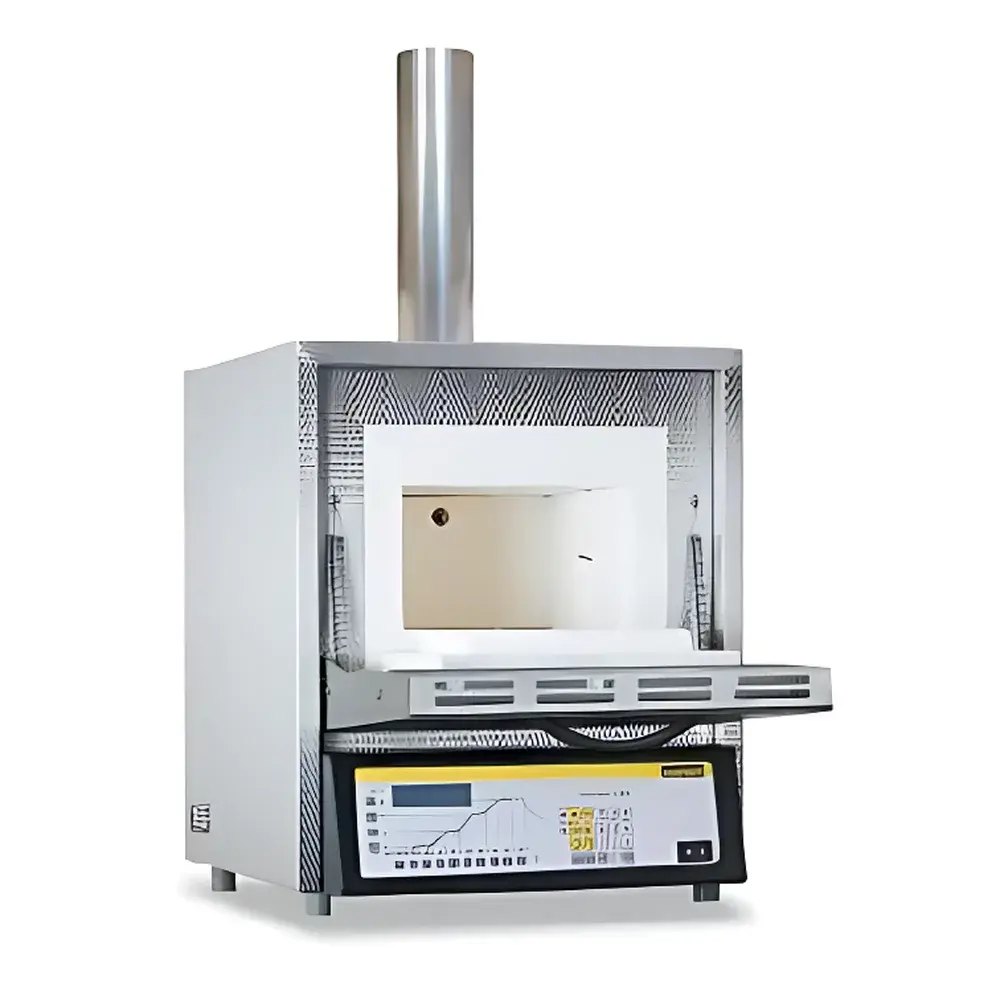
Nabertherm LVT5/11/B180 Ashing Furnace with Lift-Type Door
| Brand | Nabertherm |
|---|---|
| Origin | Germany |
| Model | LVT5/11/B180 |
| Maximum Temperature | 1100 °C |
| Internal Dimensions (W×D×H) | 200 × 170 × 130 mm |
| Chamber Volume | 5 L |
| External Dimensions (W×D×H) | 440 × 470 × 850 mm |
| Rated Power | 2.4 kW |
| Electrical Supply | Single-phase |
| Weight | 35 kg |
| Time to Max Temperature | ~120 min |
| Air Exchange Rate | >6 air changes per minute |
| Controller Type | B180 Programmable Microprocessor Controller (1 program, 2 segments, graphical color display, programmable start time, runtime counter, self-optimization, skip function, digital keypad, touch input, kWh meter, clock, MV output interface, optional programmable socket) |
Overview
The Nabertherm LVT5/11/B180 is a precision-engineered laboratory ashing furnace designed for controlled thermal decomposition of organic matrices in analytical and quality control workflows. Operating on resistive heating principles via dual-sided ceramic heating plates embedded with protected resistance wire, the furnace achieves stable, uniform temperature distribution across its 5-liter chamber—critical for reproducible ash yield and residue integrity. Its forced-air ventilation system delivers over six complete air exchanges per minute, combined with preheated intake air to minimize thermal gradients and suppress localized condensation or re-deposition of volatiles. The lift-type door configuration eliminates direct contact between operators and hot surfaces during loading/unloading, enhancing safety and reducing thermal shock to samples and furnace insulation. Constructed to DIN/EN standards for laboratory thermal equipment, the LVT5/11/B180 complies with EN 60519-2 (safety requirements for industrial electroheating equipment), including integrated Class 2 thermal cut-off protection to prevent both furnace and sample overheating under fault conditions.
Key Features
- Dual-sided ceramic heating plates with recessed heating elements—resistant to chemical attack from ashing byproducts and impervious to splashes or volatile condensates
- High-density vacuum-formed fiber insulation modules—providing low thermal mass, rapid heat-up, and minimal external surface temperature rise
- Double-walled stainless steel housing (brushed finish)—mechanically robust, corrosion-resistant, and engineered for long-term dimensional stability at elevated temperatures
- Lift-type door mechanism—enables unobstructed vertical access to the chamber while maintaining consistent sealing pressure and minimizing heat loss during operation
- Quiet solid-state power relays—eliminating mechanical wear, contact arcing, and audible switching noise common in electromechanical controllers
- Integrated overtemperature protection limiter—certified to EN 60519-2 Class 2, independently interrupting power when preset safety thresholds are exceeded
Sample Compatibility & Compliance
The LVT5/11/B180 supports standardized ashing procedures for diverse sample types including biological tissues, foodstuffs, pharmaceutical excipients, polymers, and environmental filter media. Its precise temperature control (±3 °C typical repeatability at 550 °C) and uniformity (<±8 °C across working zone per DIN 17007) ensure compliance with ASTM E1868 (Standard Test Method for Determination of Ash Content), ISO 2171 (Cereals and cereal products — Determination of ash), and USP <281> (Residue on Ignition). The furnace’s design accommodates standard porcelain, quartz, or alumina crucibles (up to 100 mm height); optional accessories include crucible tongs, ash trays, and calibrated thermocouple ports for in-chamber validation. All electrical and thermal safety systems meet CE marking requirements and support GLP/GMP documentation workflows through traceable controller logs and audit-ready parameter settings.
Software & Data Management
The B180 microprocessor controller serves as the operational core—developed in-house by Nabertherm to match application-specific thermal profiles. It features a 3.5-inch graphical color LCD with intuitive icon-based navigation, real-time status feedback (e.g., “Heating”, “Soak”, “Cooling”, “Error”), and full parameter visibility without menu nesting. Users can define up to two programmable segments per cycle (ramp rate, soak time, hold temperature), with 1°C/1 min resolution, start-time scheduling (for off-peak energy utilization), and a cumulative runtime counter. The controller supports manual MV (manipulated variable) output adjustment, optional kWh metering, and an RS485 interface for integration into centralized lab monitoring systems (e.g., LabVantage, DeltaV). While the base unit does not include FDA 21 CFR Part 11-compliant electronic signatures, its event log (power-on, program start/end, alarm triggers) provides timestamped, non-erasable records suitable for internal QA audits.
Applications
This furnace is routinely deployed in accredited testing laboratories for gravimetric determination of inorganic residue following combustion—essential in nutritional labeling (AOAC 942.05), catalyst characterization, waste incineration residue analysis, and purity assessment of active pharmaceutical ingredients (APIs). Its rapid air exchange and preheated inlet airflow make it particularly effective for high-moisture or high-volatile-content samples where conventional muffle furnaces risk spattering or incomplete oxidation. Research applications include thermal stability screening of novel ceramics, pre-treatment of electrodes for electrochemical analysis, and conditioning of reference materials prior to elemental analysis (ICP-OES/MS). The lift-door design further facilitates use in cleanroom-adjacent environments where horizontal door swing could compromise laminar flow integrity.
FAQ
What is the maximum recommended continuous operating temperature?
The LVT5/11/B180 is rated for continuous operation up to 1100 °C, with optimal long-term stability and insulation performance maintained below 1050 °C.
Can the B180 controller store multiple ashing programs?
No—the B180 variant supports one stored program consisting of two segments; for multi-program flexibility, upgrade to the B190 or T300 series controllers.
Is the furnace compatible with inert gas purging?
Not natively—the LVT5/11/B180 lacks dedicated gas inlet/outlet ports; however, custom flanged adapters may be installed subject to engineering review and safety validation.
Does the unit include calibration documentation?
Factory calibration certificates (temperature uniformity and controller accuracy) are available upon request and may be supplied with optional UKAS-accredited traceability.
What maintenance is required for the vacuum fiber insulation?
No routine maintenance is needed; however, visual inspection for physical damage or moisture ingress is recommended before each high-temperature cycle, especially after extended idle periods.



