
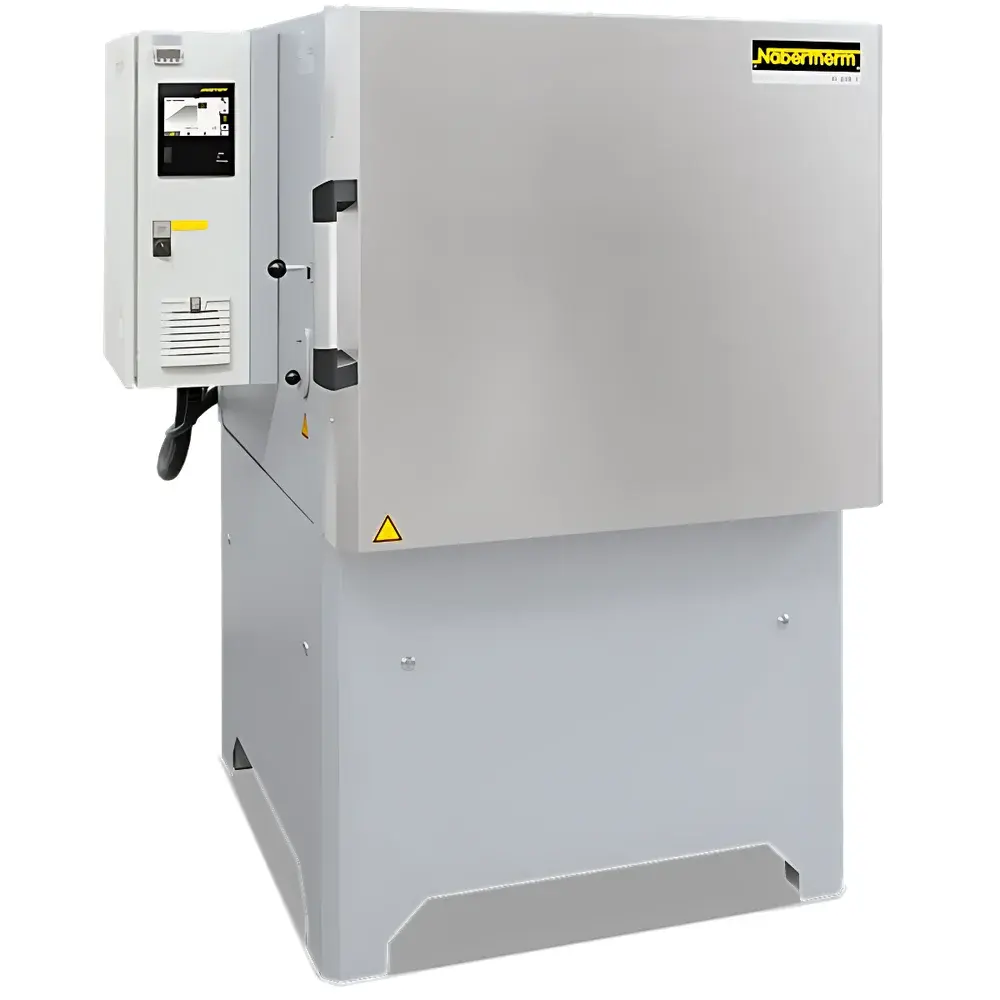
Nabertherm NA 60/85 High-Temperature Forced-Air Circulation Furnace (Drying Oven)
| Brand | Nabertherm |
|---|---|
| Origin | Germany |
| Model | NA 60/85 |
| Temperature Range | 450–850 °C |
| Temperature Uniformity | ±1 °C (at setpoint), compliant with DIN 17052-1 (±3 °C across working chamber) |
| Chamber Dimensions (W×D×H) | 350 × 500 × 350 mm |
| External Dimensions (W×D×H) | 790 × 1330 × 1440 mm |
| Chamber Material | Stainless Steel (AISI 310S or equivalent) |
| Heating Method | Resistance Wire Heating |
| Air Circulation | Horizontal forced-air via adjustable stainless steel baffle and high-flow fan |
| Controller | B500 Touchscreen Interface (5 programs × 4 segments each) |
| Door Type | Left-hinged rotating door (manual operation) |
| Compliance | Designed to meet AMS 2750F and CQI-9 thermal processing requirements |
Overview
The Nabertherm NA 60/85 is a precision-engineered, forced-air circulation furnace designed for high-temperature thermal processing in research laboratories, quality control facilities, and industrial R&D environments. Operating within a calibrated temperature range of 450 °C to 850 °C, this furnace employs horizontal air convection driven by a high-efficiency fan and optimized stainless steel airflow baffles to achieve exceptional thermal uniformity—validated to ±1 °C at setpoint and conforming to DIN 17052-1 specifications (±3 °C across the full working chamber). Its robust construction, featuring an AISI 310S stainless steel chamber and mineral-insulated resistance heating elements, ensures long-term stability under repeated thermal cycling. Unlike static ovens, the NA 60/85 delivers reproducible heat transfer kinetics essential for metallurgical treatments such as annealing, solution heat treatment, artificial aging, brazing, and PTFE sintering—processes where spatial temperature consistency directly impacts microstructural evolution and mechanical property outcomes.
Key Features
- Horizontal forced-air circulation system with adjustable stainless steel baffles for optimal thermal homogeneity across the entire 350 × 500 × 350 mm working chamber
- B500 touchscreen controller supporting up to five independent programs, each with four programmable ramp/soak segments and real-time PID tuning
- DIN 17052-1 certified temperature uniformity (±3 °C) and traceable TUS capability using calibrated sensor arrays—fully compatible with AMS 2750F and CQI-9 audit requirements
- Integrated cooling control via motorized damper and variable-speed fan, enabling precise post-process quench rate modulation
- Modular accessory architecture: configurable gas supply boxes (for inert, reducing, or reactive atmospheres), load-handling rollers (for 850 °C operation), material thermocouple inputs for process recording, and optional signal tower integration
- Left-hinged rotating door with ceramic fiber sealing and optional pneumatic lift mechanism for ergonomic access and repeatable closure force
Sample Compatibility & Compliance
The NA 60/85 accommodates diverse sample geometries and materials—including copper alloys, titanium grades, stainless steels, ceramics, and polymer composites—within its deep-draw stainless chamber. Its gas-tight design (when equipped with optional supply box) permits operation under nitrogen, argon, hydrogen/nitrogen blends, or controlled oxidizing atmospheres—critical for oxide-sensitive annealing or carburizing pre-steps. All electrical and thermal safety systems comply with EN 61000-6-4 (EMC), EN 61000-6-2 (immunity), and IEC 61000-3-12 (harmonic current limits). The furnace meets CE marking requirements and is supplied with factory calibration documentation aligned with ISO/IEC 17025 traceability protocols. For regulated industries, the B500 controller supports optional 21 CFR Part 11-compliant electronic signatures and audit trail logging when integrated with Nabertherm’s LabControl software suite.
Software & Data Management
Data acquisition and process validation are supported through Nabertherm’s LabControl software (Windows-based), which enables remote monitoring, real-time graphing of up to eight thermocouple channels, automated TUS report generation, and export of CSV/Excel-compatible datasets. The B500 controller stores all program logs internally with timestamps and operator IDs. Optional Ethernet or RS485 interfaces allow integration into centralized MES or LIMS platforms. Process records—including ramp rates, dwell times, maximum deviation from setpoint, and ambient pressure correlation—can be archived with SHA-256 hash verification to satisfy GLP/GMP documentation integrity standards.
Applications
- Copper soft annealing and titanium stress-relief annealing under inert gas protection
- Solution treatment of aluminum alloys prior to age hardening
- PTFE sintering cycles requiring precise 340–380 °C dwell profiles
- Preheating of tooling and dies prior to hot forming operations
- Thermal calibration of reference materials and thermocouple wire validation
- Research-scale brazing of dissimilar metals using controlled atmosphere modules
FAQ
What temperature uniformity specifications apply to the NA 60/85 at 850 °C?
At 850 °C, the furnace achieves ±3 °C uniformity across the working zone per DIN 17052-1, verified via 9-point TUS with Class 1 thermocouples.
Can the NA 60/85 operate under vacuum or reduced pressure?
No—this model is designed exclusively for atmospheric or positive-pressure gas environments; vacuum-capable variants (e.g., Nabertherm LHT series) are available separately.
Is third-party TUS validation support included with purchase?
Yes—Nabertherm provides on-site TUS commissioning services and supplies certified calibration certificates compliant with AMS 2750F Rev E.
What maintenance intervals are recommended for the fan and heating elements?
Fan bearings require lubrication every 2,000 operating hours; heating elements are rated for >10,000 hours at 850 °C and should be inspected annually for oxidation or sagging.
Does the B500 controller support custom alarm logic or external interlocks?
Yes—the controller offers configurable digital I/O ports for hardware interlocks (e.g., gas flow monitors, door switches) and user-defined alarm thresholds with relay outputs.



