
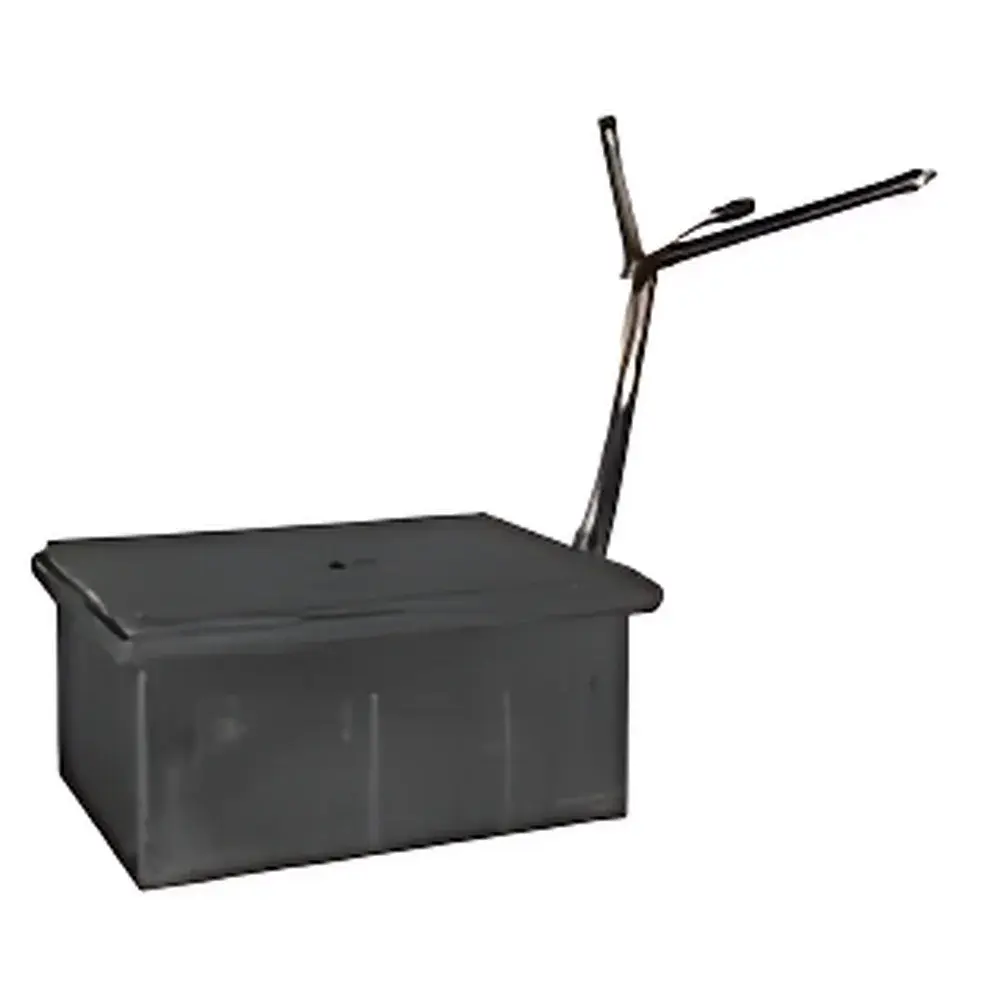
Nabertherm Quenching and Annealing Box for Muffle Furnaces
| Brand | Nabertherm |
|---|---|
| Origin | Germany |
| Equipment Type | Import |
| Temperature Range | Up to 1100 °C |
| Atmosphere Options | With or without protective gas inlet |
| Application | Vacuum or inert-atmosphere annealing and quenching of small parts and loose components |
| Compliance | Designed for integration with Nabertherm muffle furnaces (e.g., L, R, or HT series) |
Overview
The Nabertherm Quenching and Annealing Box is a precision-engineered auxiliary chamber designed for controlled thermal processing of small components, wire segments, foil samples, and loose metallic or ceramic parts under reduced pressure or protective atmospheres. It operates on the principle of rapid thermal equilibration within a sealed, refractory-lined cavity, enabling reproducible heat treatment cycles—including austenitizing, solution annealing, stress relieving, and quenching—within standard Nabertherm muffle furnaces. Unlike open crucibles, this box features tight-fitting lids and optional gas-tight flanges to maintain vacuum integrity down to 10⁻² mbar or support continuous purging with argon, nitrogen, or forming gas (e.g., 95% N₂ / 5% H₂). Its operational envelope spans ambient temperature to 1100 °C, aligning with the maximum working temperature of Nabertherm’s L 9/11, R 180, and HT 160 furnace models. The design prioritizes thermal uniformity (±5 °C at 1000 °C over 50 mm³ volume), mechanical stability during thermal cycling, and compatibility with furnace safety interlocks and programmable controllers.
Key Features
- Refractory construction using high-purity alumina-silica ceramic fiber insulation and corrosion-resistant Inconel 600 alloy frame for long-term structural integrity at 1100 °C
- Modular lid configuration: standard clamp-sealed lid for air or inert-gas use; optional welded flange with ISO-KF 25 or CF-35 port for vacuum coupling
- Integrated thermocouple well (Type S or K, Ø4 mm) positioned adjacent to sample zone for independent process temperature monitoring
- Low thermal mass design minimizes energy consumption and accelerates ramp rates (typical heating rate: 10–15 °C/min from 20 °C to 1000 °C when used in compatible furnace)
- Compatible with Nabertherm’s THERMOCOMMAND® control systems, supporting multi-step programs with dwell times, cooling rate control, and atmosphere switching logic
Sample Compatibility & Compliance
The box accommodates samples up to 100 × 100 × 80 mm (L × W × H) with a usable internal volume of approximately 0.8 L. It supports batch processing of stainless steel fasteners, titanium alloys, Ni-based superalloy shims, silicon wafers, and sintered ferrites—materials requiring oxidation-sensitive or carbon-controlled heat treatment. All materials comply with DIN EN 10027 and ASTM A269/A270 standards for high-temperature hardware. The design meets requirements for GLP-compliant thermal validation per ISO/IEC 17025:2017 Annex B, and supports traceable calibration using accredited PtRh10-Pt reference thermocouples. When integrated with furnaces equipped with Nabertherm’s FDA 21 CFR Part 11-compliant software modules, full electronic audit trails—including operator ID, setpoint logs, atmosphere pressure records, and cooling curve timestamps—are retained.
Software & Data Management
No standalone software is embedded in the box itself; instead, it functions as a fully addressable peripheral within Nabertherm’s THERMOCOMMAND® ecosystem. Process parameters—including target temperature, hold duration, gas flow rate (via external mass flow controller), and vacuum pump status—are configured via the furnace’s touchscreen HMI or exported/imported through .csv or XML templates. Real-time data logging (sample temperature, furnace chamber temperature, pressure, and gas composition if interfaced with residual gas analyzer) is stored locally on the furnace controller’s SD card and synchronized to networked servers via Ethernet/IP or OPC UA. Export formats include CSV, PDF reports (with digital signatures), and raw binary files for post-processing in MATLAB or Python-based thermal modeling tools.
Applications
- Austenitic stainless steel fasteners: stress relief and carbide precipitation control prior to passivation
- Titanium Grade 5 (Ti-6Al-4V) orthopedic implants: alpha-beta annealing under argon to optimize grain structure and tensile ductility
- Thin-film resistor substrates: low-oxygen annealing to stabilize sheet resistance without interfacial oxidation
- Recycled rare-earth magnet powders: degassing and homogenization prior to hot pressing
- Research-scale shape-memory alloy wires (NiTi): controlled cooling-rate studies to map R-phase transformation kinetics
FAQ
Can this box be used in a non-Nabertherm furnace?
Yes, provided the furnace chamber dimensions, door opening, and temperature uniformity profile meet minimum compatibility criteria (e.g., ≥120 mm clearance around box, ±10 °C uniformity at 1100 °C); however, full functionality—including automated atmosphere sequencing and safety interlock integration—is only guaranteed with Nabertherm furnace controllers.
Is vacuum quenching possible directly inside the box?
No—the box is not a vacuum vessel. It is intended for use inside a furnace chamber that is itself evacuated or backfilled. Rapid quenching requires external transfer to oil, polymer, or forced-gas quench units.
What maintenance is required for long-term vacuum compatibility?
Annual inspection of lid gasket compression force and replacement of Viton® or metal-CF gaskets per manufacturer’s torque specifications; cleaning of flange sealing surfaces with isopropanol and lint-free wipes before each vacuum cycle.



