
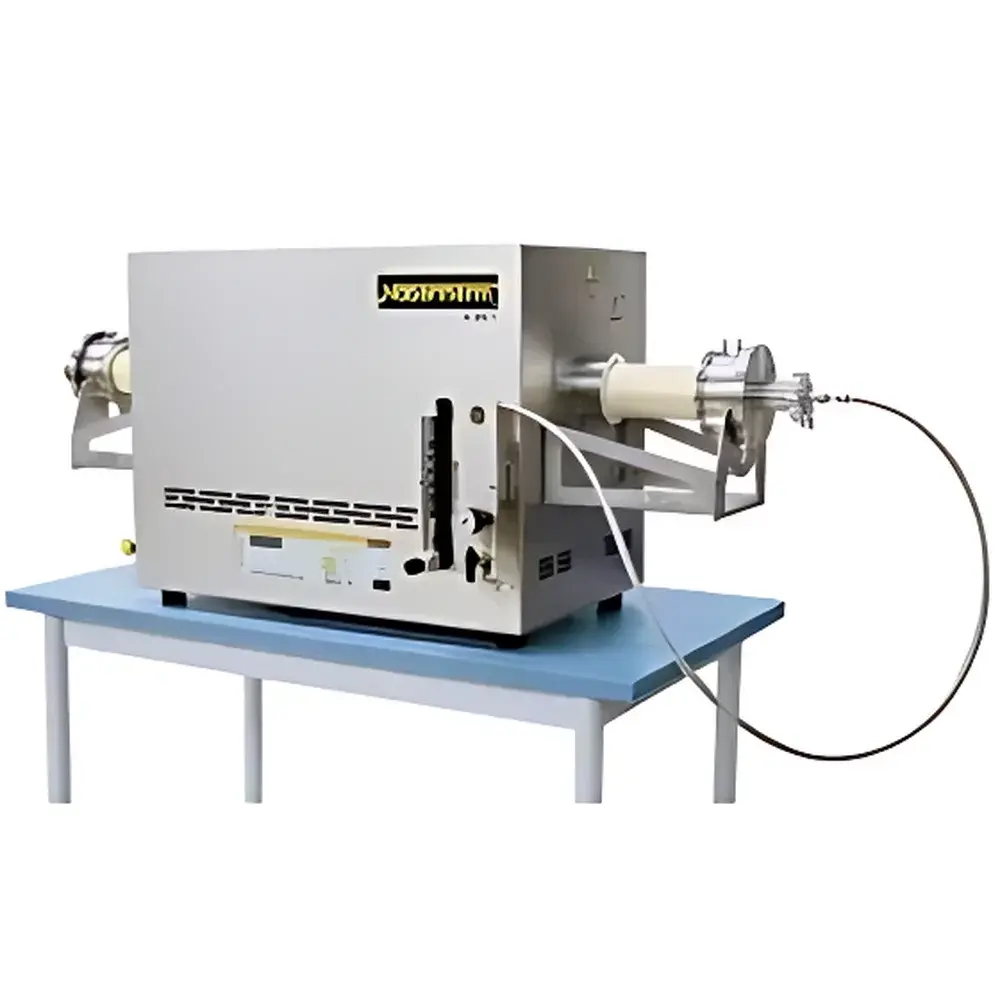
Nabertherm RHTC 80-230/15 & RHTC 80-710/15 High-Temperature Tube Furnace with SiC Heating Elements
| Origin | Germany |
|---|---|
| Manufacturer Type | Authorized Distributor |
| Origin Category | Imported |
| Model | RHTC 80-230/15 / RHTC 80-710/15 |
| Temperature Range | Up to 1500 °C |
| Temperature Uniformity | ±10 K over specified hot zone length |
| Control Accuracy | ±1 °C |
| Heating Method | Silicon Carbide (SiC) Rod Heaters |
| Maximum Power | 11.7 kW |
| Chamber Inner Diameter | 80 mm |
| External Dimensions (W×D×H) | up to 1070×430×580 mm |
| Weight | up to 90 kg |
| Electrical Supply | 3-phase, 400 V AC |
| Thermal Insulation | High-performance ceramic fiber module system |
| Safety Compliance | EN 60519-2 Class 2 Overtemperature Protection |
Overview
The Nabertherm RHTC series represents a class of precision-engineered high-temperature tube furnaces designed for demanding laboratory and pilot-scale thermal processing applications. Built in Germany and conforming to stringent DIN and EN manufacturing standards, these furnaces operate on the principle of resistive heating via silicon carbide (SiC) heating elements—mounted parallel to the quartz or ceramic process tube—ensuring exceptional axial and radial temperature homogeneity. The RHTC 80-230/15 and RHTC 80-710/15 models are engineered for continuous operation at temperatures up to 1500 °C, with optimized thermal architecture that minimizes heat loss and accelerates both heating and cooling cycles. Their compact stainless-steel housing—featuring brushed finish and active shell cooling—maintains external surface temperatures below 60 °C even at maximum operating temperature, enhancing operator safety and lab environment stability. Each unit integrates a robust internal switching cabinet with solid-state semiconductor relays, eliminating mechanical contact wear and enabling silent, maintenance-free control actuation.
Key Features
- High-purity silicon carbide (SiC) heating rods delivering stable, oxidation-resistant performance up to 1500 °C in air, inert, or reducing atmospheres
- Advanced multi-layer ceramic fiber insulation system (density ≥ 128 kg/m³) providing superior thermal efficiency and rapid thermal response
- Precision-machined stainless-steel housing with active air-cooling ducts to limit external casing temperature during prolonged operation
- Integrated S-type thermocouple (Pt10Rh–Pt) for primary temperature measurement, compliant with IEC 60584-1 Class 1 tolerances
- Configurable hot zone lengths (230 mm, 450 mm, and 710 mm) with documented uniformity zones (±10 K) certified per DIN 17007
- Optional water-cooled flange assemblies for vacuum-tight or gas-purged operation, compatible with ISO-KF and CF vacuum standards
- EN 60519-2-compliant dual-stage safety architecture: independent overtemperature limiter (Class 2) and cascaded regulation using secondary thermocouple feedback from the rear tube wall
- Modular design supporting quick-swap ceramic or quartz working tubes meeting DIN C 799 quality specifications
Sample Compatibility & Compliance
The RHTC series accommodates standard 80 mm inner diameter working tubes fabricated from high-purity alumina (Al₂O₃), quartz (SiO₂), or recrystallized silicon carbide (R-SiC), depending on atmosphere and thermal cycling requirements. Tubes comply with DIN C 799 for dimensional consistency and thermal shock resistance. The furnace meets essential EU directives including Machinery Directive 2006/42/EC, Low Voltage Directive 2014/35/EU, and Electromagnetic Compatibility Directive 2014/30/EU. For regulated environments, optional data logging and audit-trail-capable controllers support compliance with GLP, GMP, and FDA 21 CFR Part 11 when paired with validated software packages. All electrical components carry CE marking and undergo factory calibration traceable to PTB (Physikalisch-Technische Bundesanstalt) standards.
Software & Data Management
While the base configuration includes a programmable digital controller with ramp-soak profiles and real-time temperature display, optional upgrades include the Nabertherm THERMOCOM® software suite. This Windows-based platform enables remote monitoring, automated profile execution, event-triggered data capture, and export of timestamped CSV or XML files. Full audit trail functionality—including user login logs, parameter change history, and electronic signatures—is available for installations requiring ALCOA+ data integrity principles. Communication protocols include RS485 (Modbus RTU), Ethernet/IP, and optional USB interface for direct PC connection. Firmware updates are delivered via secure HTTPS portal and verified with SHA-256 checksums.
Applications
These furnaces serve critical roles across materials science, catalysis research, metallurgy, and semiconductor process development. Typical use cases include sintering of advanced ceramics (e.g., ZrO₂, Si₃N₄), annealing of thin-film substrates, controlled oxidation/reduction of metal oxides, synthesis of battery cathode precursors (e.g., NMC, LFP), and thermal gravimetric analysis (TGA) coupling. Their precise temperature zoning supports isothermal hold studies for kinetic modeling (e.g., Arrhenius activation energy determination), while compatibility with inert gas purging or low-pressure operation enables reproducible carbonization of polymer-derived ceramics. Universities, national labs, and industrial R&D centers rely on RHTC units for method development aligned with ASTM E1113, ISO 8501-1, and IEC 60068-2-1 environmental test protocols.
FAQ
What atmosphere types are supported by the RHTC series?
The furnace is rated for operation in ambient air, nitrogen, argon, hydrogen/nitrogen mixtures (≤5% H₂), and vacuum down to 10⁻² mbar when equipped with appropriate flanges and seals.
Is the hot zone uniformity validated and documented?
Yes—each model undergoes factory hot-zone mapping per DIN 17007; uniformity reports (±10 K over stated length) are supplied with delivery documentation.
Can the furnace be integrated into an automated process line?
Absolutely—digital I/O terminals and Modbus RTU communication allow seamless integration with PLC-based control systems and MES platforms.
What maintenance intervals are recommended for SiC heating elements?
Under typical usage (≤1400 °C, air atmosphere), SiC rods retain >95% resistance stability for ≥5000 operational hours; visual inspection every 6 months is advised.
Are replacement working tubes available as standard parts?
Yes—Nabertherm maintains inventory of DIN-compliant alumina and quartz tubes (80 mm ID), with lead times under 2 weeks for most configurations.



