
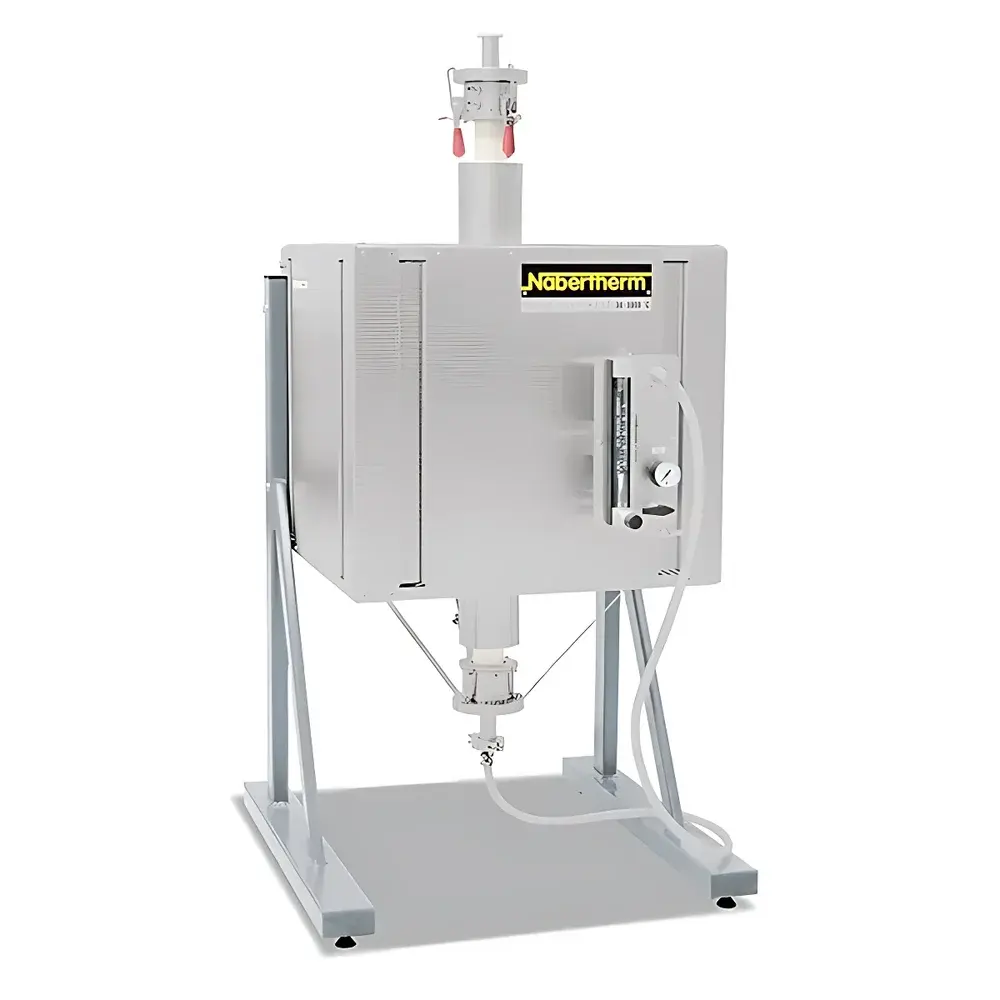
Nabertherm RHTH High-Temperature Horizontal Tube Furnace
| Brand | Nabertherm |
|---|---|
| Origin | Germany |
| Model | RHTH |
| Temperature Range | Up to 1600 °C, 1700 °C or 1800 °C |
| Configuration | Horizontal |
| Heating Zone Length | 150–600 mm |
| Uniformity (ΔT ≤ 10 K) | Over Specified Zone |
| Tube Diameter | 50–120 mm |
| Power Supply | 3-phase, 400 V |
| Total Power | 5.4–14.4 kW |
| Net Weight | 70–110 kg |
| Insulation | Vacuum-formed Ceramic Fiber Boards (Low Thermal Mass) |
| Heating Element | Suspended MoSi₂ |
| Thermocouple Type | Type B (PtRh30/PtRh6) |
| Compliance | EN 60519-2 (Temperature Protection Class II) |
| Control Cabinet | Separate Vertical Enclosure with SCR Power Controller & Low-Voltage Transformer |
| Optional Features | Gas/Vacuum Sealing Flanges, Multi-Zone Temperature Control (3–4 Zones), Work-Tube Internal Thermocouple Monitoring, Backflow Prevention Check Valve, Vertical Mounting Kit (RHTV variant) |
Overview
The Nabertherm RHTH series represents a high-precision horizontal tube furnace engineered for demanding high-temperature laboratory and pilot-scale thermal processing applications. Operating at maximum temperatures of 1600 °C, 1700 °C, or 1800 °C—depending on model configuration—the RHTH utilizes suspended molybdenum disilicide (MoSi₂) heating elements embedded within a low-thermal-mass insulation architecture composed of vacuum-formed ceramic fiber boards. This design minimizes heat storage, reduces energy consumption by up to 30% compared to traditional refractory-lined furnaces, and enables rapid thermal ramping (up to 20 K/min typical) with exceptional thermal stability (< ±1 K at setpoint over 24 h). The furnace chamber is defined by a high-purity alumina-silica ceramic working tube (material C 799), rated for continuous operation under inert, reducing, or vacuum atmospheres. Its horizontal orientation supports gravity-stable sample placement, uniform gas flow distribution, and compatibility with in-line gas delivery systems and effluent monitoring interfaces.
Key Features
- Suspended MoSi₂ heating elements—mechanically decoupled from the furnace shell to eliminate thermal stress-induced failure and simplify field replacement without disassembly.
- Vacuum-formed ceramic fiber insulation (density ~128 kg/m³)—provides thermal conductivity < 0.12 W/(m·K) at 1000 °C, ensuring low standby losses and high thermal efficiency.
- Three- or four-zone independent temperature control—enables precise axial thermal profiling across the heating zone (e.g., gradient annealing, zone melting, or controlled cooling ramps).
- Integrated Type B thermocouples—mounted at furnace wall, work-tube interior, and post-tube cavity—support dual-point temperature validation and process traceability per GLP/GMP requirements.
- EN 60519-2 compliant dual-level temperature protection—primary controller + independently adjustable secondary cut-off (Class II) limits maximum exposure temperature for both equipment and samples.
- Modular gas handling interface—equipped with ISO-KF or CF flanges, manual/automated mass flow controllers, and check valves to prevent ambient air ingress during vacuum or low-pressure operations.
- Separate vertical control cabinet—houses SCR-based power regulation, low-voltage transformer, PID controller, and optional data logging hardware; electrically isolated from furnace body to reduce EMI and improve service accessibility.
Sample Compatibility & Compliance
The RHTH accommodates cylindrical samples up to 120 mm in diameter and 600 mm in length, compatible with standard quartz, alumina, silicon carbide, or molybdenum working tubes (C 799 grade supplied as standard). It meets essential safety and performance standards including EN 60519-2 (electrical safety for industrial electroheating equipment), IEC 61000-6-3 (EMC emission limits), and conforms to structural requirements of ISO/IEC 17025 for accredited calibration laboratories. When equipped with optional audit-trail-capable controllers and electronic signature modules, the system supports FDA 21 CFR Part 11 compliance for regulated pharmaceutical and materials development workflows. All models are CE-marked and manufactured in accordance with German Machinery Directive 2006/42/EC.
Software & Data Management
Nabertherm’s THERMOCOM® software suite (optional) provides full remote operation via Ethernet or RS485, supporting programmable multi-step profiles with real-time graphing, alarm logging, and CSV export. Data integrity is maintained through time-stamped event records—including power interruptions, temperature deviations >2 K, and manual override actions—with configurable retention policies. For integration into LIMS or MES environments, OPC UA and Modbus TCP protocols are supported. All controllers feature non-volatile memory with battery-backed RAM, preserving setpoints and historical data during power loss. Audit trails include user ID, timestamp, parameter change, and pre/post-value—fully aligned with ALCOA+ principles for data reliability.
Applications
- High-temperature sintering of advanced ceramics (e.g., Si₃N₄, ZrO₂, AlN) and metal matrix composites.
- Controlled-atmosphere annealing of semiconductor wafers and thin-film substrates.
- Thermal gravimetric analysis (TGA) coupling with mass spectrometry or FTIR gas analyzers.
- Synthesis of nanomaterials via CVD, carbothermal reduction, or solid-state reaction under Ar/H₂/N₂ mixtures.
- Calibration of high-temperature reference standards traceable to PTB (Physikalisch-Technische Bundesanstalt).
- Research-grade crystal growth using vertical Bridgman or horizontal gradient freeze techniques (with RHTV variant).
FAQ
What atmosphere options are supported?
The RHTH supports inert (Ar, N₂), reducing (H₂/N₂, CO), vacuum (down to 10⁻³ mbar with optional pump), and reactive (NH₃, CH₄) atmospheres—subject to appropriate sealing, material compatibility, and safety interlocks.
Can the furnace be integrated into an automated production line?
Yes—via digital I/O, Modbus TCP, or OPC UA, the RHTH supports handshake protocols with PLCs and SCADA systems for batch-triggered start/stop, fault reporting, and real-time setpoint synchronization.
Is the working tube included in the base configuration?
Yes—each unit ships with one C 799-grade ceramic tube and two fiber end plugs suitable for air or inert-gas operation. Alternative tubes (quartz, SiC, Mo) are available as configurable options.
How is temperature uniformity validated?
Uniformity is specified as ΔT ≤ ±10 K over the declared hot zone length at maximum operating temperature, verified per ASTM E220 and certified in the factory test report accompanying each unit.
What maintenance intervals are recommended?
MoSi₂ elements require no scheduled replacement under normal use; annual inspection of fiber insulation integrity, thermocouple calibration (traceable to national standards), and electrical contact torque verification are advised per Nabertherm Maintenance Manual V3.2.
Related Products



