
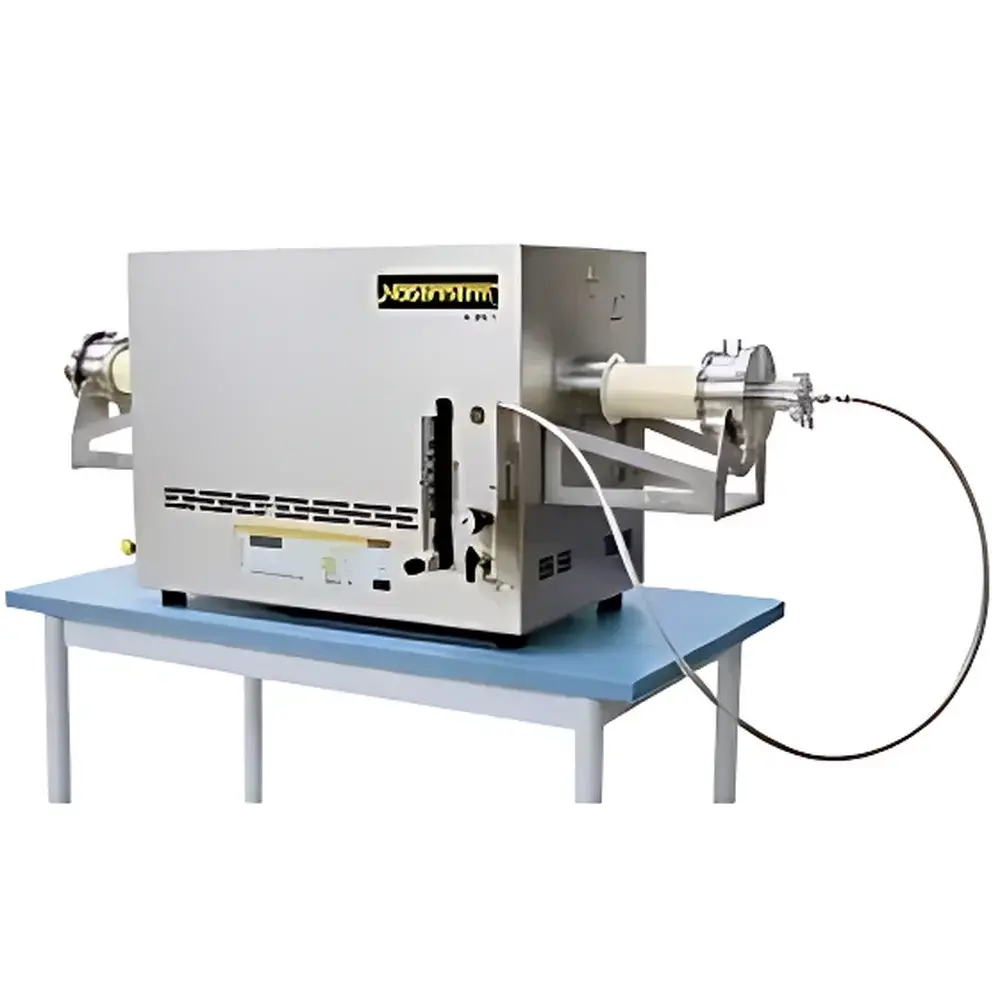
Nabertherm RS Series Hinged-Tube Furnace
| Origin | Germany |
|---|---|
| Manufacturer Type | Authorized Distributor |
| Origin Category | Imported |
| Model Range | RS 80/300/11 – RS 170/1000/13 |
| Heating Method | Resistance Wire |
| Max Temperature | 1100 °C or 1300 °C |
| Temperature Control Accuracy | ±1 °C |
| Max Power | 12.6 kW |
| Internal Tube Diameter | 80 mm to 170 mm |
| Standard Tube Material | C 530 (Alumina-Rich Ceramic, Suitable for Air Atmosphere) |
Overview
The Nabertherm RS Series Hinged-Tube Furnace is a precision-engineered laboratory tube furnace designed for high-reliability thermal processing under controlled atmospheres. Built in Germany to DIN EN ISO 9001 standards, the RS series employs resistive heating via high-stability Kanthal® or similar alloy resistance wires embedded in ceramic insulation, delivering uniform thermal energy across extended heating zones. Its defining mechanical feature — a vertically hinged front door — enables rapid, tool-free access to the quartz or ceramic work tube without disturbing furnace alignment or insulation integrity. This design significantly reduces thermal shock during sample loading/unloading and supports repeatable positioning of thermocouples, gas inlets, and vacuum feedthroughs. The furnace operates in horizontal configuration as standard; vertical orientation is achievable using an optional support frame with integrated power and control routing. Temperature regulation is executed via a programmable logic controller (PLC) with three independently controllable heating zones — front, center, and rear — enabling precise axial temperature profiling and compensation for end-zone heat loss. This architecture extends the usable isothermal zone (±10 K deviation) by up to 40% compared to single-zone equivalents, critical for processes requiring strict thermal homogeneity over extended lengths.
Key Features
- Hinged front door mechanism with air-cooled stainless steel housing (brushed finish), ensuring long-term structural stability and operator safety during frequent access cycles
- Three-zone PID-controlled heating system with independent thermocouple inputs (Type K for ≤1100 °C; Type S for ≤1300 °C), enabling dynamic axial temperature gradient programming
- Modular electrical cabinet — physically separated from the furnace body — houses the PLC controller, solid-state relays, and safety interlocks, minimizing electromagnetic interference and simplifying maintenance
- Standard C 530 alumina-rich ceramic work tube supplied; additional tube materials (e.g., fused silica, high-purity alumina, silicon carbide) available per application requirements and atmosphere compatibility
- Integrated non-return valve at exhaust port to prevent ambient air ingress during vacuum or inert-gas purging sequences
- Optional vertical mounting kit includes reinforced support structure, dedicated cable management, and cabinet-integrated controller interface for seamless reorientation
- Ceramic insulating tiles protect heating elements and provide stable sample support surfaces within the hot zone
Sample Compatibility & Compliance
The RS furnace accommodates cylindrical samples and reactors up to 170 mm in outer diameter and 1000 mm in length. Its modular gas/vacuum interface supports integration with Nabertherm’s standardized supply systems — including mass flow controllers, pressure regulators, gas mixing manifolds, and two-stage vacuum pumps — enabling operation under inert (N₂, Ar), reducing (H₂/N₂), oxidizing (O₂-enriched air), or vacuum conditions (down to 10⁻² mbar with optional pump). All models comply with IEC 61000-6-2 (EMC immunity) and IEC 61000-6-4 (EMC emission) standards. Safety architecture meets EN 60519-1 (electrical safety for industrial electroheating equipment) and incorporates dual redundant overtemperature protection (independent limit controller + hardware cut-off). For GLP/GMP environments, optional audit-trail-enabled PLC firmware supports 21 CFR Part 11-compliant electronic records when paired with validated software interfaces.
Software & Data Management
The embedded PLC controller features a 5.7″ TFT touchscreen HMI with multilingual UI (English, German, French, Chinese), supporting up to 16 programmable ramp-soak profiles with 32 segments each. Real-time data logging (temperature, power, zone status) is stored internally (≥10,000 records) and exportable via USB or Ethernet (Modbus TCP/IP). Optional Nabertherm ThermControl™ PC software enables remote monitoring, recipe management, and CSV-based report generation. All logged parameters include timestamp, operator ID (via login), and system event flags (e.g., door open, alarm trigger, power interruption), fulfilling traceability requirements for ISO/IEC 17025-accredited laboratories.
Applications
- Thermal annealing of thin-film substrates and semiconductor wafers under controlled partial pressures
- Calcination and sintering of catalyst precursors, battery cathode materials (e.g., NMC, LFP), and ceramic powders
- Controlled-atmosphere synthesis of metal oxides, nitrides, and carbides via carbothermal or ammonolysis routes
- Thermogravimetric analysis (TGA) coupling with external mass spectrometers or FTIR gas analyzers
- Heat treatment qualification per ASTM E220, ISO 8573-1 (gas purity), and AMS 2750E (pyrometry system accuracy)
- Research-scale CVD precursor decomposition and film deposition studies
FAQ
Can the RS furnace be operated vertically without modification?
No — vertical operation requires the optional vertical support stand, which includes structural reinforcement, re-routed power cabling, and a relocated control cabinet. The standard unit is configured for horizontal use only.
What is the maximum allowable vacuum level without additional pumping equipment?
The furnace body itself is rated for static vacuum down to 10⁻¹ mbar. Achieving lower pressures (e.g., 10⁻²–10⁻³ mbar) requires connection to an external two-stage rotary vane or turbomolecular pump system.
Is the C 530 work tube suitable for hydrogen atmospheres at 1100 °C?
C 530 is optimized for air and inert gas use. For continuous H₂ operation above 800 °C, fused silica or high-purity alumina tubes are recommended to prevent reduction-induced embrittlement.
Does the three-zone control allow independent setpoint programming for each zone?
Yes — each zone has fully independent PID tuning parameters and setpoint schedules, enabling complex thermal gradients (e.g., thermal barrier formation, directional solidification) or extended uniformity optimization.
Are calibration certificates provided with shipment?
A factory calibration certificate (traceable to PTB/DKD standards) is included for the main chamber thermocouple. Optional on-site verification and DKD-accredited calibration services are available upon request.



