
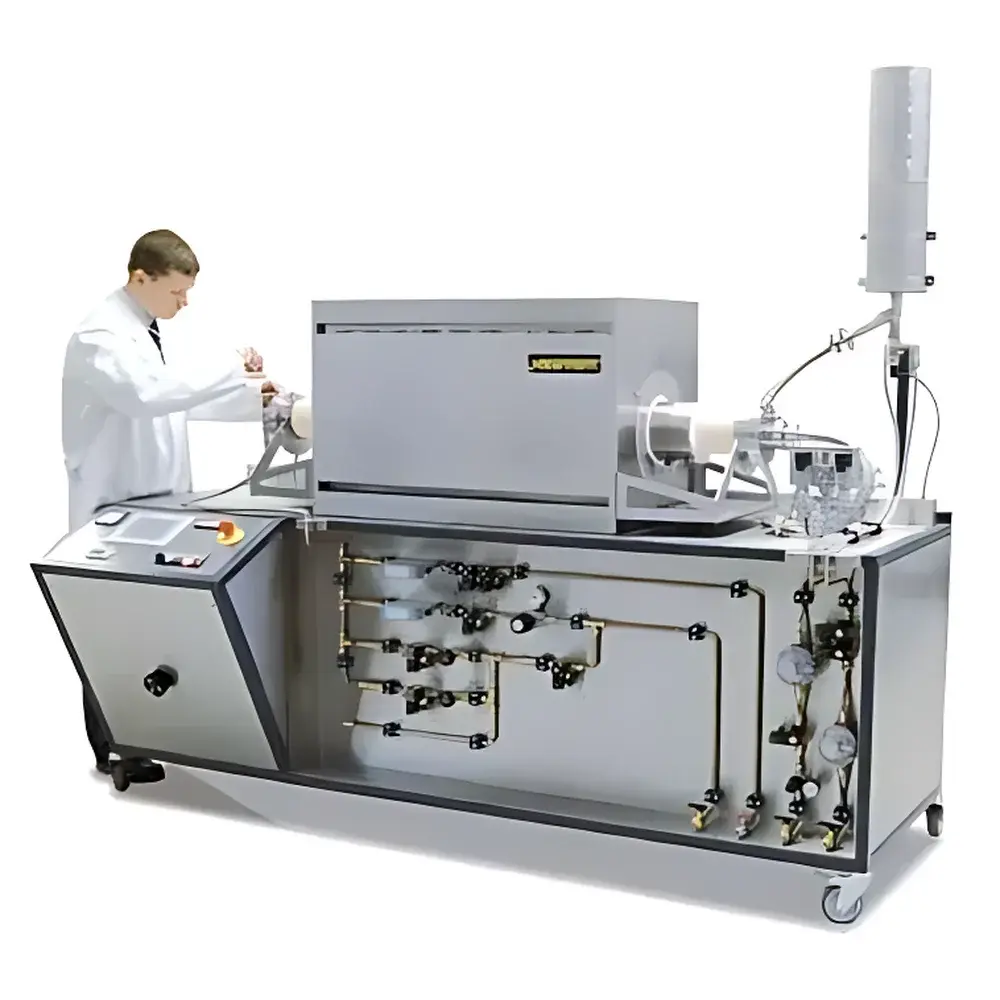
Nabertherm R/RT/RS/RHTC/RHTH/RHTV Series Tube Furnace Gas Supply & Vacuum Operation Systems
| Brand | Nabertherm |
|---|---|
| Origin | Germany |
| Product Type | Gas & Vacuum Interface System for Horizontal Tube Furnaces |
| Model Designation | Gas Supply & Vacuum Kit (Configurable for Inert, Reactive, or Vacuum Atmospheres) |
| Compliance | CE-marked, Designed for Integration with Nabertherm’s P330/P340 Programmable Controllers and GLP/GMP-Compatible Process Documentation |
Overview
The Nabertherm R/RT/RS/RHTC/RHTH/RHTV Series Gas Supply & Vacuum Operation Systems are engineered interface solutions enabling precise atmospheric control within horizontal tube furnaces. These modular systems support three operational regimes: inert gas purging (Ar, N₂, synthetic air), vacuum processing (down to 10⁻⁵ mbar), and controlled hydrogen atmosphere operation (manual or fully automated). Each configuration is built upon Nabertherm’s proprietary high-temperature ceramic fiber insulation architecture and integrates seamlessly with the furnace’s existing control framework—primarily the P330 and P340 programmable controllers. The systems operate on fundamental principles of gas dynamics, pressure differential management, and thermal boundary integrity: inert gas flow maintains positive overpressure to exclude ambient oxygen; vacuum operation relies on staged pumping and cold-trap-compatible evacuation protocols; and hydrogen handling incorporates redundant safety layers—including pressure-switched purge logic, flame supervision, and PLC-monitored emergency nitrogen flushing. All configurations comply with EN 61000-6-2 (EMC immunity) and EN 61000-6-4 (EMC emission) standards, and support audit-ready process documentation when paired with optional data logging modules.
Key Features
- Modular design supporting four distinct operational kits: Kit 1 (inert gas only), Kit 2 (inert + vacuum), Kit 3 (manual H₂ operation), and Kit 4 (fully automated H₂ with integrated safety PLC)
- Gas-tight working tubes fabricated from C610 (≤1300 °C) or C799 (≥1300 °C) high-purity alumina-silica ceramics, replacing standard C530 tubes for vacuum and reactive applications
- Water-cooled stainless-steel flanges (NW9 coolant interface) with integrated quartz observation windows for real-time sample monitoring under inert or vacuum conditions
- Mass-flow-regulated inert gas supply (50–500 L/h) with dual-stage isolation valves, needle-type flow regulators, and optional electromagnetic valve integration for controller-triggered gas sequencing
- Vacuum subsystems scalable from single-stage rotary vane pumps (20 mbar ultimate pressure) to PT70 dry pump stations with turbomolecular backing (10⁻⁵ mbar ultimate pressure)
- H₂-specific safety architecture including overpressure relief (30 mbar max), catalytic exhaust combustion, flame detection circuitry, and rupture-pressure monitoring via calibrated pressure switches
- PLC-controlled automation in Kit 4: pre-purge with N₂, H₂ introduction, operational phase monitoring, fault-triggered immediate N₂ flush, and post-cycle inerting—all executed without operator intervention
Sample Compatibility & Compliance
These systems accommodate a wide range of sample geometries and chemistries, including powder beds, crucibles, catalyst pellets, thin-film substrates, and wire specimens mounted inside the working tube. The C610/C799 tube materials ensure chemical inertness toward halides, oxides, and reducing atmospheres up to rated temperatures. For vacuum applications, maximum operating temperature is constrained by mechanical strength reduction at low pressure—consult Nabertherm’s “Vacuum Temperature Limits” technical bulletin for material-specific derating curves. All kits conform to ISO 17025 requirements for calibration traceability when used with certified flow meters and pressure transducers. Hydrogen configurations meet DIN EN 15650 (hydrogen system safety) and support FDA 21 CFR Part 11 compliance when integrated with validated electronic batch records via optional Ethernet/IP or Modbus TCP interfaces.
Software & Data Management
The gas and vacuum subsystems interface directly with Nabertherm’s P330/P340 controllers, which provide programmable logic for gas sequencing, pressure ramping, and interlock validation. Optional firmware upgrades enable event-logged timestamped records of gas valve actuation, pressure setpoint deviations, vacuum pump runtime, and safety-triggered events (e.g., purge initiation, flame loss detection). When connected to Nabertherm’s LabControl software suite (Windows-based), users can generate ASTM E29-22–compliant test reports, export CSV/Excel datasets for statistical process control (SPC), and configure alarm thresholds aligned with ICH Q7 Annex 11 guidelines. Audit trails include user ID, timestamp, parameter change, and reason-for-change fields—fully compliant with GLP and GMP documentation standards.
Applications
- Thermal synthesis of metal oxides, nitrides, and carbides under controlled N₂/Ar atmospheres
- Low-oxygen annealing of semiconductor wafers and magnetic thin films
- Hydrogen reduction of metal precursors (e.g., NiO → Ni, CuO → Cu) in catalysis R&D
- High-vacuum sintering of refractory ceramics and advanced composites
- Thermo-gravimetric analysis (TGA) coupling with mass spectrometry (MS) via vacuum-compatible feedthroughs
- Accelerated aging studies of battery electrode materials under inert or reducing environments
FAQ
Can Kit 2 be upgraded to Kit 4 after initial installation?
Yes—mechanical mounting points, flange dimensions, and controller I/O architecture are forward-compatible. Retrofit requires addition of the safety PLC module, N₂ emergency reservoir, flame sensor assembly, and firmware update.
Is cooling water supply mandatory for all vacuum flanges?
Yes—water cooling is required for all stainless-steel vacuum flanges to maintain seal integrity and prevent thermal deformation at temperatures above 800 °C.
What vacuum pump is recommended for carbon nanotube synthesis requiring ≤10⁻⁴ mbar?
The PT70 dry pump station with turbomolecular backing is specified for this application; its base pressure of 10⁻⁵ mbar ensures sufficient vacuum stability during extended pyrolysis cycles.
Does Kit 3 support unattended overnight operation?
No—Kit 3 mandates continuous operator presence per DIN EN 15650 Clause 7.3.2; only Kit 4 meets requirements for unmanned operation under hydrogen atmosphere.
Are gas flow meters calibrated per ISO/IEC 17025?
Factory-calibrated flow meters are supplied with NIST-traceable certificates; on-site recalibration services are available through Nabertherm’s certified service centers.
Related Products



