
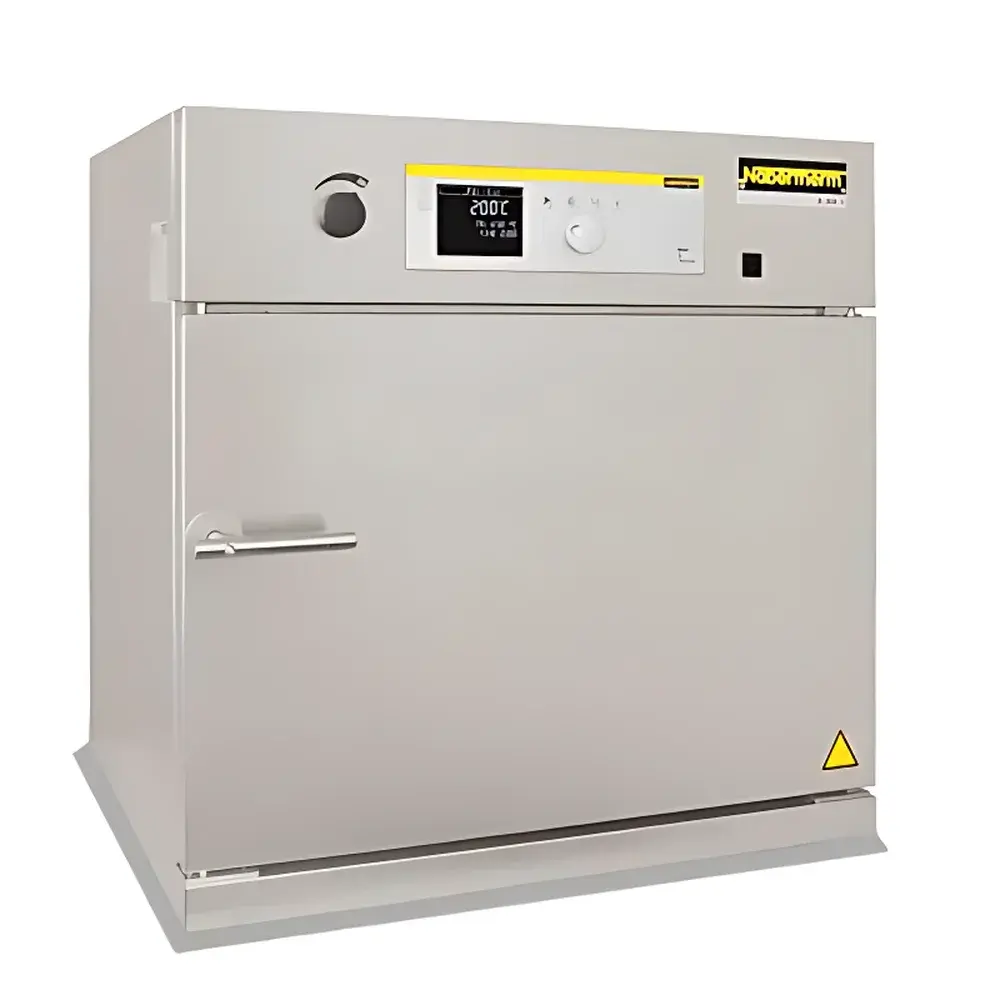
Nabertherm TR120 Forced-Convection Drying Oven
| Brand | Nabertherm |
|---|---|
| Origin | Germany |
| Model | TR120 |
| Temperature Range | +5 to 300 °C |
| Temperature Uniformity | ±1 °C (at 100 °C, load-free) |
| Interior Dimensions (W×D×H) | 650 × 390 × 500 mm |
| Interior Volume | 120 L |
| Exterior Dimensions (W×D×H) | 900 × 610 × 860 mm |
| Chamber Material | AISI 304 stainless steel (1.4301) |
| Heating Method | Horizontal forced-air convection |
| Airflow Control | Continuously adjustable fan speed |
| Power Supply | 1-phase, 3 kW |
| Net Weight | 120 kg |
| Max. Load Capacity | 150 kg (30 kg per shelf) |
| Standard Shelving | 2 removable grid shelves (up to 7 optional) |
| Safety Compliance | EN 60519-2 (Class 2 overtemperature protection), EN 1539 (solvent-safe design), AMS 2750E-ready, FDA-compliant process recording with VCD software |
Overview
The Nabertherm TR120 is a precision-engineered, horizontally configured forced-convection drying oven designed for laboratory and pilot-scale thermal processing applications requiring high reproducibility, long-term stability, and stringent compliance with international safety and quality standards. Operating on the principle of horizontal laminar airflow—driven by a continuously variable-speed fan mounted at the rear wall—the TR120 ensures exceptional temperature uniformity across its 120 L stainless-steel chamber (AISI 304 / 1.4301). This architecture minimizes thermal stratification and eliminates cold spots, enabling reliable performance in drying, sterilization, thermal conditioning, stress-relief annealing, and pre-heating of samples or components. With a maximum operating temperature of 300 °C and a certified uniformity of ±1 °C (measured at 100 °C under no-load conditions per DIN 12880), the TR120 exceeds standard requirements for Class 2 laboratory ovens and supports critical workflows governed by ISO/IEC 17025, GLP, and GMP environments.
Key Features
- Horizontally oriented forced-air circulation system with rear-mounted, electronically controlled fan—ensures uniform heat distribution and rapid temperature recovery after door opening.
- AISI 304 stainless-steel interior chamber and reinforced base plate compliant with EN 1539 for safe operation with solvent-laden loads.
- PID-based microprocessor controller with self-diagnostic capability, integrated overtemperature protection (EN 60519-2, Class 2), and adjustable cut-off temperature limit.
- Large left-hinged swing door with ergonomic handle and wide-opening geometry for unobstructed access; features quick-connect mechanism and integrated viewing window with removable protective grid.
- Two standard removable grid shelves (capacity: 30 kg each); up to seven shelves configurable via standardized side-slot mounting system.
- Side-intake ventilation with integrated condensate collection trough to prevent moisture ingress and protect internal insulation integrity.
- Low-noise operation (<55 dB(A)) enabled by solid-state relay switching and vibration-damped fan assembly.
Sample Compatibility & Compliance
The TR120 accommodates a broad range of sample formats—including Petri dishes, crucibles, glassware, metal parts, polymer substrates, and coated wafers—without risk of cross-contamination or oxidation, thanks to its inert stainless-steel chamber and absence of catalytic surfaces. Its design conforms to multiple regulatory frameworks: EN 1539 for thermal processing equipment handling flammable vapors; EN 60519-2 for electrical safety in industrial heating apparatus; and AMS 2750E readiness when paired with calibrated thermocouples and external data loggers. Optional VCD software integration enables full audit-trail capability compliant with FDA 21 CFR Part 11 for electronic records and signatures, supporting validation protocols in pharmaceutical, aerospace, and medical device manufacturing.
Software & Data Management
The built-in NTLog function allows time-stamped process data (temperature setpoint, actual chamber temperature, fan speed, alarm status) to be recorded directly onto a USB flash drive—no external PC required. For advanced traceability, the optional VCD (Validation & Control Data) software package provides real-time monitoring, multi-channel charting, automated report generation (PDF/CSV), and secure user-level access control. All logged data include metadata such as operator ID, batch number, and calibration certificate references—fully aligned with ALCOA+ principles (Attributable, Legible, Contemporaneous, Original, Accurate, Complete, Consistent, Enduring, Available).
Applications
- Moisture content determination per ASTM D2297 and ISO 758.
- Thermal stabilization of reference standards and calibration artifacts.
- Drying of filter papers, chromatography media, and catalyst supports prior to analysis.
- Pre-baking of printed circuit boards (PCBs) and semiconductor packaging substrates.
- Post-curing of epoxy and silicone encapsulants in electronics assembly.
- Residual solvent removal from coated films and thin-film deposition substrates.
- Accelerated aging studies under controlled thermal profiles (e.g., IEC 60068-2-2).
FAQ
What is the maximum permissible load weight for the TR120, and how is it distributed?
The total maximum load is 150 kg, with a per-shelf limit of 30 kg. Load distribution must remain symmetrical to preserve airflow dynamics and temperature uniformity.
Does the TR120 support IQ/OQ/PQ qualification out of the box?
Yes—the unit ships with factory calibration documentation and is compatible with third-party qualification kits. Full validation support (including sensor mapping, alarm testing, and deviation reporting) is enabled via VCD software and optional PT100 probe inputs.
Can the TR120 be integrated into a central laboratory automation network?
While the base model lacks Ethernet or RS-485 ports, optional communication modules (Modbus RTU or Ethernet/IP) are available for SCADA and MES integration, subject to Nabertherm’s OEM interface specifications.
Is the interior chamber passivated or electropolished for ultra-clean applications?
Standard chambers feature mechanically polished AISI 304; electropolished finish (per ASTM A967) and additional passivation (ASTM A967 Type VI) are available as custom configurations upon request.
How frequently does the overtemperature protection require recalibration?
Per EN 60519-2, the independent Class 2 safety limiter is factory-set and sealed; verification is recommended annually during routine maintenance or after any physical impact to the controller housing.



