
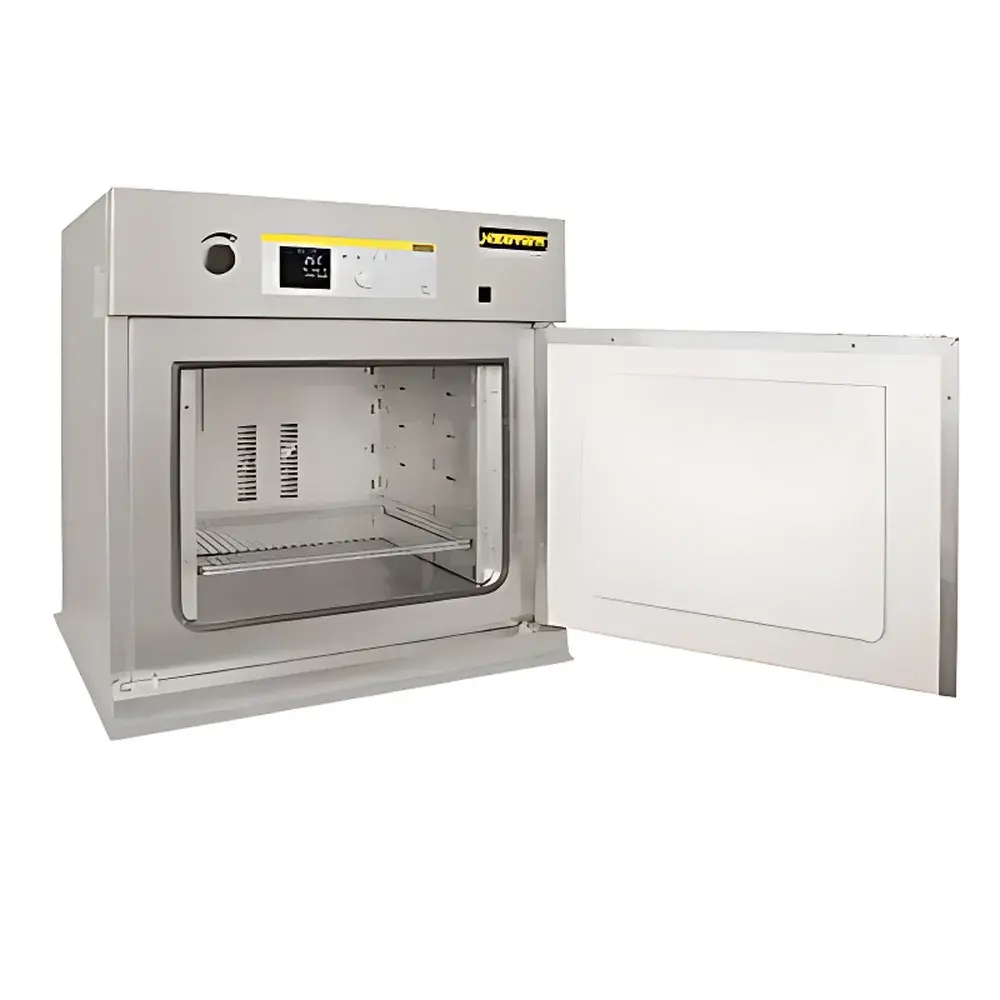
Nabertherm TR240 Forced-Convection Drying Oven
| Brand | Nabertherm |
|---|---|
| Origin | Germany |
| Model | TR240 |
| Instrument Type | General-Purpose Forced-Air Drying Oven |
| Temperature Range | +5 °C to 300 °C |
| Temperature Uniformity | ±1 °C (at 100 °C, steady state) |
| Internal Dimensions (W×D×H) | 750 × 550 × 600 mm |
| Internal Volume | 240 L |
| External Dimensions (W×D×H) | 1000 × 780 × 970 mm |
| Chamber Material | AISI 304 Stainless Steel (DIN 1.4301) |
| Heating Method | Horizontal Forced-Air Circulation |
| Airflow Control | Continuously Variable-Speed Fan |
| Power Supply | 1-phase, 3 kW |
| Net Weight | 165 kg |
| Standard Shelving | 2 removable perforated stainless-steel grid plates |
| Max. Load Capacity | 150 kg total (30 kg per shelf) |
| Safety Compliance | EN 60519-2 (Overtemperature Protection Class 2), EN 1539 (Solvent-Safe Design) |
Overview
The Nabertherm TR240 is a precision-engineered, horizontally configured forced-convection drying oven designed for reproducible thermal processing in research laboratories, quality control environments, and industrial R&D settings. Its operational principle relies on a horizontally oriented, variable-speed fan-driven air circulation system that ensures uniform heat distribution across the entire 240 L chamber—critical for applications demanding tight thermal consistency, such as moisture removal, pre-heat conditioning, sterilization validation, and thermal stabilization of samples prior to analytical testing. The oven achieves a maximum operating temperature of 300 °C with a certified temperature uniformity of ±1 °C at 100 °C under steady-state conditions—a performance benchmark aligned with ISO 14644-1 cleanroom environmental monitoring prerequisites and ASTM E2251-22 guidelines for laboratory oven qualification. Constructed entirely from AISI 304 stainless steel (DIN 1.4301), the chamber resists corrosion, withstands repeated cleaning with mild alkaline or ethanol-based agents, and complies with GLP-compliant facility hygiene standards.
Key Features
- Horizontally mounted, infinitely adjustable forced-air circulation system delivering consistent laminar airflow across all shelf levels
- High-stability PID microprocessor controller with integrated self-diagnostic functions and solid-state relay output for silent, jitter-free heating cycles
- Left-hinged, large-opening swing door with ergonomic wide handle and quick-connect mechanism for rapid access and process interruption minimization
- Two standard removable perforated stainless-steel grid plates; up to eight plates optionally installable using standardized side-slot guides
- Dual safety architecture: independent overtemperature limiter (EN 60519-2 Class 2) plus thermally insulated rear exhaust duct with adjustable vent aperture
- Integrated observation window with optically clear, heat-resistant borosilicate glass and secondary movable grid plate for real-time visual monitoring without thermal loss
- Reinforced base plate engineered to EN 1539 specifications for safe operation with solvent-laden loads, including vapour containment and flame arrestor compatibility
- Stainless-steel condensate collection tray beneath the chamber floor to prevent residue accumulation and simplify maintenance
Sample Compatibility & Compliance
The TR240 accommodates a broad spectrum of sample formats—including Petri dishes, crucibles, glassware stacks, polymer pellets, metal coupons, and coated substrates—without compromising thermal homogeneity. Its chamber geometry and airflow path are validated per DIN 12880 Annex B for drying oven classification and support routine IQ/OQ/PQ protocols required by pharmaceutical and medical device manufacturers. The unit meets essential requirements of EU Machinery Directive 2006/42/EC and carries CE marking. Optional VCD software integration enables full compliance with FDA 21 CFR Part 11 for electronic records and signatures, supporting audit-ready data logging, user access control, and change history tracking. For aerospace thermal processing, optional configuration to AMS 2750E pyrometric system requirements is available upon request.
Software & Data Management
The built-in NTLog function enables direct USB flash drive recording of time-stamped temperature profiles, setpoint changes, alarm events, and fan speed adjustments—capturing raw process data in CSV format for traceability. When paired with the optional VCD (Validation & Control Data) software suite, the TR240 supports automated calibration verification, multi-point uniformity mapping, deviation alerting, and PDF report generation compliant with ISO/IEC 17025 accredited laboratory documentation standards. All logged data include immutable timestamps, operator ID, and instrument serial number—enabling full forensic reconstruction during regulatory audits or internal CAPA investigations.
Applications
- Residual solvent removal from pharmaceutical intermediates and excipients (per ICH Q5C)
- Moisture content determination in food, polymers, and ceramics (aligned with AOAC 950.46 and ISO 6587)
- Thermal aging studies of elastomers and composites (ASTM D573, D865)
- Pre-conditioning of test specimens prior to tensile, adhesion, or coating performance evaluation
- Low-temperature sterilization validation of reusable lab tools and packaging components
- Stabilization of reference standards and calibration artifacts in metrology labs
- Controlled drying of chromatography columns and sensor elements sensitive to thermal shock
FAQ
What is the maximum permissible load weight per shelf?
Each perforated grid plate is rated for a maximum static load of 30 kg; the total chamber capacity is 150 kg distributed across up to eight shelves.
Does the TR240 support programmable ramp-soak profiles?
Yes—the PID controller supports up to 16 segment programs with customizable ramp rates, dwell times, and cycle repeats via front-panel interface or VCD software.
Is the chamber volume verified per ISO 12777?
Chamber volume is calculated geometrically from nominal internal dimensions (750 × 550 × 600 mm) and confirmed during factory acceptance testing; volumetric calibration certificates are available upon request.
Can the TR240 be integrated into a central building management system (BMS)?
Optional analog 4–20 mA output and Modbus RTU RS485 interface modules enable seamless integration with third-party SCADA or BMS platforms for remote status monitoring and alarm forwarding.
What maintenance intervals are recommended for the airflow system?
Fan motor bearings require inspection every 12 months or 2,000 operating hours; filter replacement (if installed upstream of intake) is advised quarterly under continuous-use conditions.



