
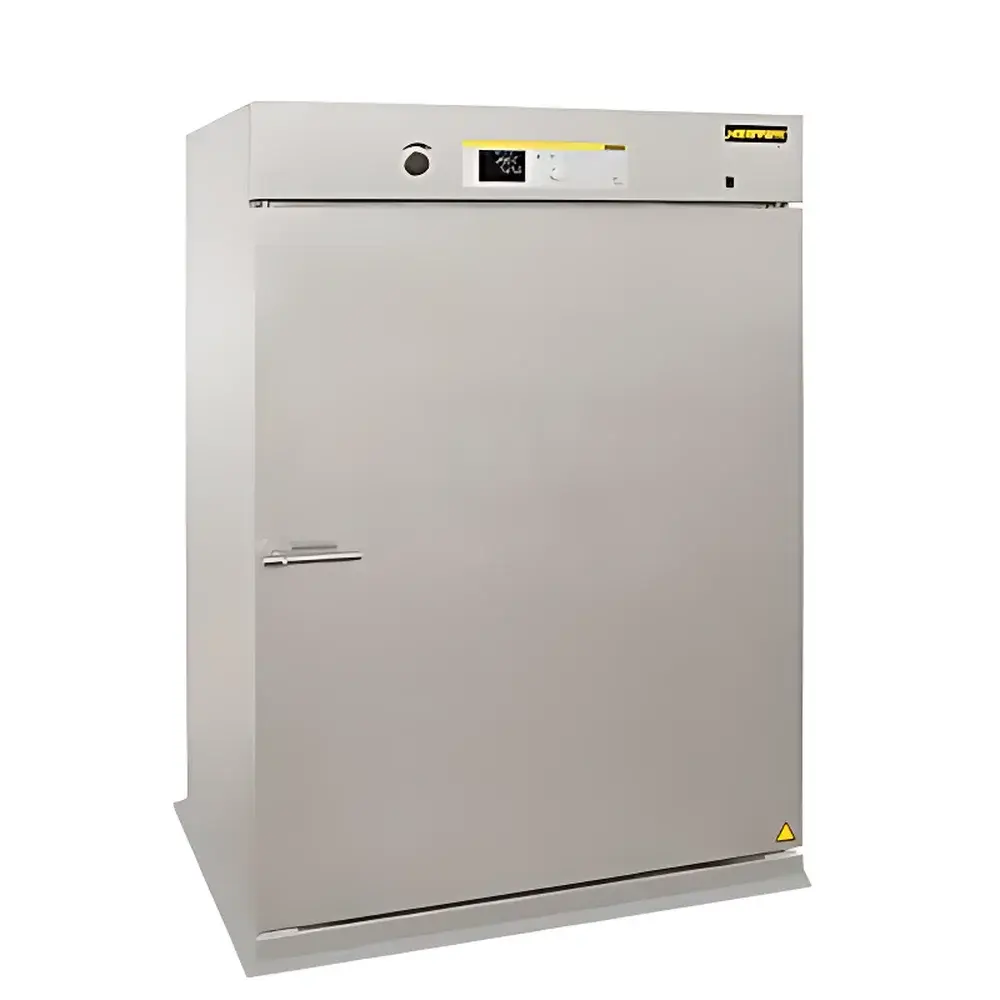
Nabertherm TR450 Forced-Convection Laboratory Drying Oven
| Brand | Nabertherm |
|---|---|
| Origin | Germany |
| Model | TR450 |
| Temperature Range | +5 to 300 °C |
| Temperature Uniformity | ±1 °C (at 100 °C, per DIN 12880) |
| Interior Dimensions (W×D×H) | 750 × 550 × 1100 mm |
| Interior Volume | 450 L |
| Exterior Dimensions (W×D×H) | 1000 × 780 × 1470 mm |
| Chamber Material | AISI 304 stainless steel (1.4301) |
| Heating Method | Horizontal forced-air circulation via adjustable-speed centrifugal fan |
| Power Supply | 3-phase, 6 kW |
| Net Weight | 235 kg |
| Standard Shelving | 3 removable perforated grid plates (max. 15 optional) |
| Max. Load Capacity | 180 kg total (30 kg per shelf) |
| Safety Compliance | EN 60519-2 (Class 2 overtemperature protection), EN 1539 (solvent-safe design), AMS 2750E readiness, FDA 21 CFR Part 11–compatible VCD software option |
Overview
The Nabertherm TR450 is a high-performance, horizontally ventilated forced-convection laboratory drying oven engineered for precision thermal processing in research, quality control, and industrial R&D environments. Its core operating principle relies on a horizontally oriented, variable-speed centrifugal blower system that ensures uniform airflow distribution across the entire chamber volume—critical for achieving reproducible drying, conditioning, sterilization, and thermal stabilization outcomes. Unlike natural convection ovens, the TR450’s active air circulation architecture minimizes vertical and horizontal thermal gradients, delivering certified temperature uniformity of ±1 °C at 100 °C (per DIN 12880), with validated performance up to ±3 °C across the full operational range (+5 to 300 °C). The chamber’s robust construction—featuring 1.4301 (AISI 304) stainless steel walls, floor, and door liner—provides long-term corrosion resistance, ease of decontamination, and compatibility with aqueous, organic, and mildly aggressive media. Designed to meet stringent safety requirements for solvent-laden loads, the TR450 complies with EN 1539 and integrates dual independent overtemperature protection circuits per EN 60519-2 Class 2.
Key Features
- Horizontally aligned forced-air circulation system with infinitely adjustable fan speed for optimized heat transfer and minimal sample disturbance
- High-strength AISI 304 stainless steel chamber (1.4301) with seamless welded corners and smooth interior surfaces for GMP-compliant cleaning
- Large left-hinged swing door with ergonomic wide handle and quick-connect sealing mechanism for rapid access and reduced thermal loss
- Three standard removable perforated grid shelves (15 optional), each rated for 30 kg load; total capacity 180 kg
- Integrated side-mounted air intake ducts and rear-positioned exhaust port with manual damper for controlled atmosphere management
- PID-based microprocessor controller (NTLog series) with self-diagnostic functions, USB data logging (via FAT32-formatted flash drive), and real-time process visualization
- Reinforced base plate and structural bracing to support heavy-duty applications and long-term stability under thermal cycling
- Optional VCD software package enabling full traceability, electronic signatures, audit trails, and 21 CFR Part 11–compliant recordkeeping
Sample Compatibility & Compliance
The TR450 accommodates diverse sample formats—including glassware, metal parts, polymer components, pharmaceutical excipients, ceramic precursors, and moisture-sensitive powders—within its 450 L chamber. Its solvent-safe configuration (EN 1539) permits safe operation with volatile organic compounds when equipped with appropriate exhaust routing and explosion-proof accessories. The oven meets essential European safety directives (CE-marked), including Low Voltage Directive 2014/35/EU and EMC Directive 2014/30/EU. Optional calibration packages align with AMS 2750E pyrometric requirements for aerospace thermal processing validation. For regulated laboratories, the NTLog controller supports GLP/GMP workflows through timestamped event logs, password-protected parameter locking, and configurable alarm thresholds.
Software & Data Management
The standard NTLog controller provides embedded process monitoring, setpoint ramp/soak programming, and real-time deviation alerts. Process data—including chamber temperature, setpoint, fan speed, and alarm status—is recorded at user-defined intervals (1–600 seconds) directly to a USB memory device in CSV format. When paired with the optional VCD (Validation & Control Data) software suite, the TR450 becomes a fully compliant thermal process instrument: users gain centralized remote control, automated report generation (PDF/Excel), electronic signature capture, role-based access control, and immutable audit trails satisfying FDA 21 CFR Part 11 and EU Annex 11 requirements. All firmware updates are delivered via secure Nabertherm-signed binaries and validated through checksum verification.
Applications
- Moisture content determination (ASTM D229, ISO 293, USP <643>)
- Thermal aging studies of polymers and composites (ISO 2578, ASTM D3045)
- Pre- and post-weighing desiccation of analytical samples
- Heat treatment of calibration standards and reference materials
- Stabilization of hygroscopic reagents prior to formulation
- Residual solvent removal from coated substrates or printed electronics
- Low-temperature sterilization of non-critical lab tools (160 °C for 2 hours per ISO 17665)
- Conditioning of sensors, filters, and porous media prior to performance testing
FAQ
What is the maximum validated temperature uniformity across the working volume?
At 100 °C, the TR450 achieves ±1 °C uniformity per DIN 12880; at 300 °C, uniformity remains within ±3 °C under standard loading conditions.
Can the TR450 be integrated into a central laboratory automation system?
Yes—via optional RS485 Modbus RTU or Ethernet TCP/IP interface (VCD software required), enabling SCADA integration and centralized fleet monitoring.
Is the chamber suitable for use with flammable solvents?
Only when configured with EN 1539–compliant explosion relief panels, intrinsically safe wiring, and dedicated exhaust ducting—consult Nabertherm Application Engineering before deployment.
How is overtemperature protection implemented?
Dual independent safety circuits: a primary PID-controlled limit thermostat and a hardwired Class 2 mechanical overtemperature limiter (EN 60519-2), both disconnecting power if setpoint exceeds user-defined threshold.
What documentation is provided for IQ/OQ/PQ validation?
Nabertherm supplies Factory Acceptance Test (FAT) reports, as-built schematics, calibration certificates (traceable to DAkkS/NIST), and customizable validation protocols compatible with ASTM E2500 and GAMP5 frameworks.



