
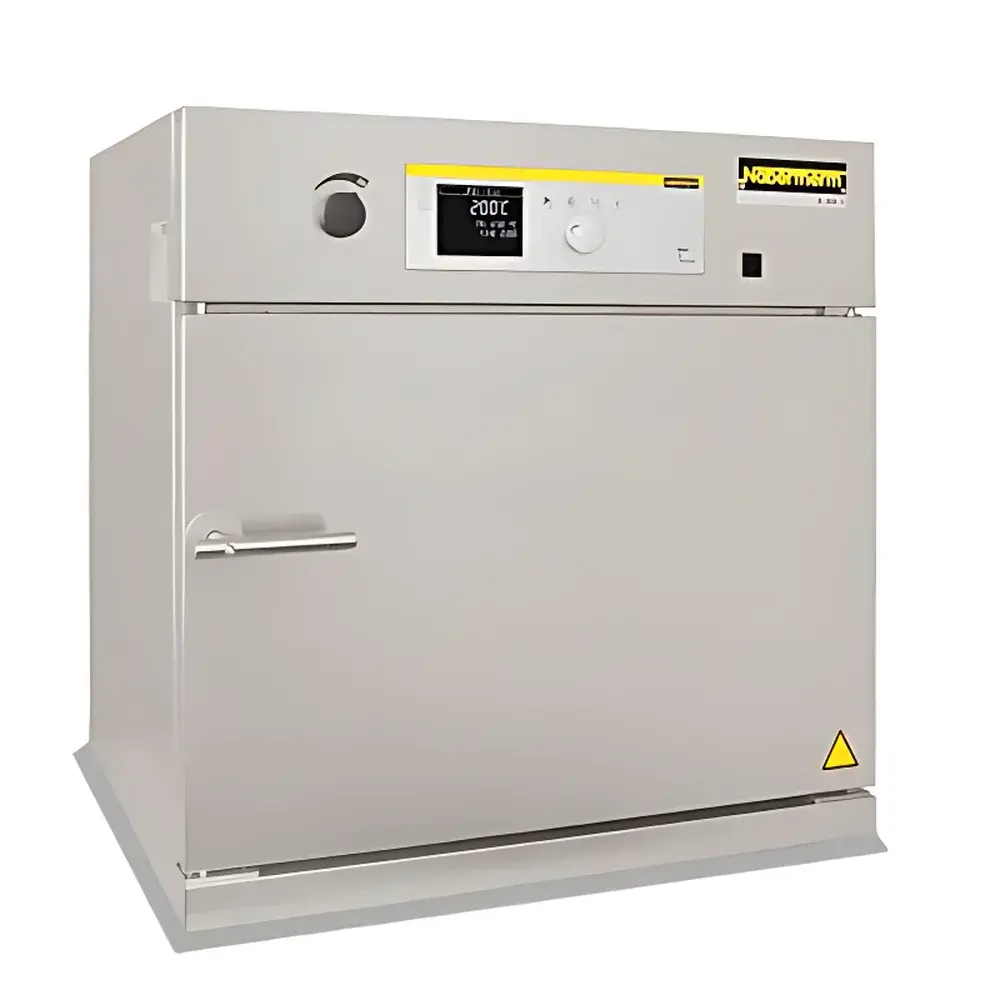
Nabertherm TR60 Forced-Convection Laboratory Drying Oven
| Brand | Nabertherm |
|---|---|
| Origin | Germany |
| Model | TR60 |
| Instrument Type | General-Purpose Forced-Air Drying Oven |
| Temperature Range | +5 °C to 300 °C |
| Temperature Uniformity | ±1 °C (at setpoint, steady state) |
| External Dimensions (W×D×H) | 700 × 610 × 710 mm |
| Internal Chamber Dimensions (W×D×H) | 450 × 390 × 350 mm |
| Chamber Volume | 60 L |
| Chamber Material | AISI 304 Stainless Steel (DIN 1.4301) |
| Heating Method | Horizontal Forced-Air Circulation via Adjustable-Speed Fan |
| Power Supply | 1-phase, 3 kW |
| Net Weight | 90 kg |
| Max. Load Capacity | 120 kg (30 kg per shelf) |
| Standard Shelving | 1 removable perforated grid shelf (up to 4 optional) |
| Safety Compliance | EN 60519-2 (Class 2 overtemperature protection), EN 1539 (solvent-safe construction), CE-marked |
Overview
The Nabertherm TR60 is a precision-engineered, benchtop forced-convection laboratory drying oven designed for reproducible thermal processing in research, quality control, and production environments. Operating on the principle of horizontal air circulation—driven by a continuously adjustable-speed fan—the TR60 ensures exceptional temperature uniformity across its 60 L stainless steel chamber (AISI 304 / DIN 1.4301). With a working temperature range from +5 °C above ambient to 300 °C, the oven supports a broad spectrum of thermally driven protocols including moisture removal, pre-sterilization heat treatment, thermal stabilization of samples, and post-processing conditioning of materials. Its robust mechanical architecture—including reinforced base plate, left-hinged wide-opening door with ergonomic handle, and integrated solvent-safe design per EN 1539—reflects Nabertherm’s long-standing commitment to safety, durability, and compliance in industrial and regulated laboratory settings.
Key Features
- Horizontal forced-air circulation system with infinitely variable fan speed control, enabling precise optimization of airflow dynamics for diverse sample loads and thermal mass profiles.
- AISI 304 stainless steel interior chamber (DIN 1.4301) resistant to corrosion, oxidation, and cleaning agents; seamless welds and rounded corners facilitate GMP-compliant cleaning and residue-free operation.
- PID microprocessor controller with self-diagnostic functionality, real-time process monitoring, and programmable ramp/soak cycles; includes integrated Class 2 overtemperature protection per EN 60519-2 with independent cut-off limit.
- Large-format viewing window with anti-fog coating and optional internal LED illumination for non-intrusive process observation without thermal disturbance.
- Modular shelving system: one standard perforated grid shelf (load-rated to 30 kg); up to three additional shelves available (max. 4 total), each with guided insertion and secure lateral retention.
- Side-mounted air intake and rear-mounted adjustable exhaust port enable controlled atmosphere management—critical for solvent-laden or moisture-sensitive applications.
- Integrated stainless steel drip tray beneath the chamber floor collects condensate or incidental spills, preventing contamination of insulation and heating elements.
Sample Compatibility & Compliance
The TR60 accommodates a wide variety of sample formats—including Petri dishes, crucibles, glassware, polymer specimens, metal components, and coated substrates—within its 450 × 390 × 350 mm usable chamber volume. Its EN 1539-certified construction ensures safe operation with organic solvents, making it suitable for drying solvent-based coatings, pharmaceutical granules, or chromatography media. The oven meets CE requirements for electromagnetic compatibility (EMC) and low-voltage directive (LVD), and its controller architecture supports audit-ready operation under GLP and GMP frameworks. Optional VCD software enables full traceability—including timestamped temperature logs, user authentication, and electronic signatures—aligning with FDA 21 CFR Part 11 requirements when deployed with validated configurations.
Software & Data Management
The standard NTLog function allows direct data logging to USB flash drives, capturing time-stamped temperature readings, setpoints, fan speed, and alarm events at user-defined intervals. For advanced process validation, the optional VCD (Validation & Control Data) software package provides comprehensive lifecycle management: protocol definition, real-time visualization, automated report generation (PDF/CSV), and secure database archiving. All logged data include metadata such as operator ID, instrument serial number, calibration status, and environmental context—ensuring full compliance with ISO/IEC 17025, ASTM E2500, and ICH Q9 guidelines.
Applications
- Drying of filter papers, textiles, soil samples, and ceramic precursors under controlled airflow and thermal stability.
- Thermal conditioning of calibration standards, reference materials, and metrology artifacts prior to measurement.
- Pre-heat treatment of components prior to coating, bonding, or soldering processes in electronics and aerospace manufacturing.
- Residual solvent removal from pharmaceutical intermediates and excipients in development labs adhering to ICH Q5C stability protocols.
- Heat aging studies per ASTM D573, ISO 188, or DIN 53508 for elastomers, plastics, and composites.
- Low-temperature sterilization hold steps for reusable labware where autoclaving is unsuitable.
FAQ
What is the maximum permissible load per shelf?
Each perforated grid shelf is rated for up to 30 kg; the total chamber load must not exceed 120 kg.
Is the TR60 suitable for use with flammable solvents?
Yes—its EN 1539-compliant construction includes explosion-relief design elements, solvent-resistant gaskets, and mandatory ventilation interlocks when configured with optional exhaust integration.
Can temperature uniformity be verified and documented?
Yes—uniformity mapping is supported using calibrated thermocouples and third-party validation services; Nabertherm provides IQ/OQ documentation templates compatible with AMS 2750E and EU GMP Annex 15.
Does the oven support remote monitoring or network connectivity?
Via optional Ethernet interface and VCD software, the TR60 can be integrated into centralized Lab Information Management Systems (LIMS) or SCADA platforms for real-time status reporting and alarm forwarding.
What maintenance intervals are recommended for optimal performance?
Fan motor lubrication and door seal inspection are advised every 12 months; chamber calibration verification should occur semiannually or per internal SOP—especially following transport or mechanical impact.



