
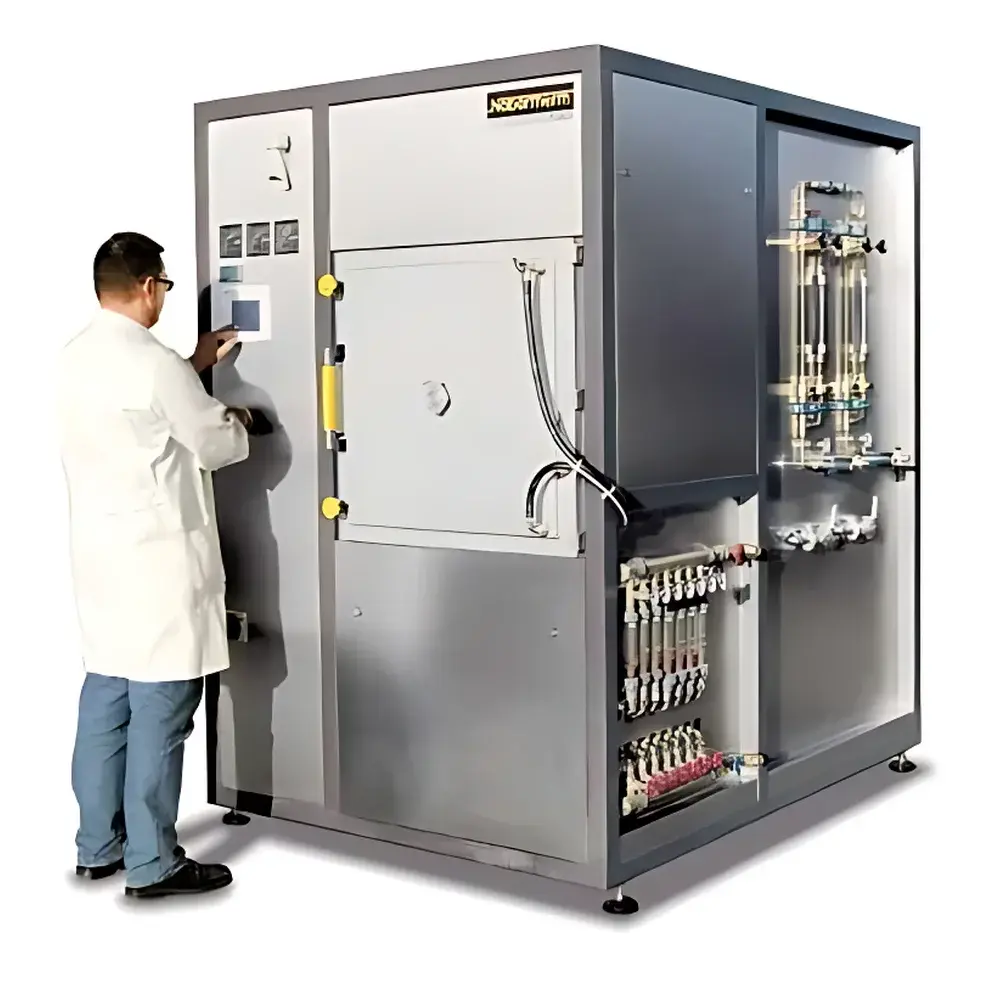
Nabertherm VHT 8/22-GR High-Temperature Vacuum Furnace with Graphite Heating Elements
| Brand | Nabertherm |
|---|---|
| Origin | Germany |
| Model | VHT 8/22-GR |
| Max Operating Temperature | 2200 °C |
| Chamber Volume | 8 L |
| Internal Dimensions (W×D×H) | 170 × 240 × 200 mm |
| External Dimensions (W×D×H) | 1250 × 1100 × 2000 mm |
| Power Connection | 3-phase, 27.0 kW |
| Weight | 1200 kg |
| Heating Element | Graphite / Graphite Felt Insulation |
| Vacuum Capability | Down to 10⁻⁵ mbar (with optional pump) |
| Atmosphere Compatibility | Inert gas (N₂, Ar), H₂, vacuum, low-pressure reactive gas |
| Cooling System | Integrated open-loop water cooling with flow monitoring and temperature display |
| Control System | PLC-based H700 controller with 5.7" touchscreen, 10 programmable 20-segment thermal profiles |
| Safety Compliance | EN 60519-2 Class 2 overtemperature protection |
Overview
The Nabertherm VHT 8/22-GR is a compact, high-precision high-temperature vacuum furnace engineered for advanced thermal processing under controlled atmospheres and deep vacuum conditions. Designed and manufactured in Germany, this furnace employs graphite heating elements and graphite felt insulation to achieve stable, uniform temperatures up to 2200 °C — a capability critical for sintering ultra-refractory ceramics, annealing single-crystal substrates, densifying C/C composites, and performing high-purity metallurgical treatments. Its fully water-cooled stainless steel process chamber features O-ring sealed flanges rated for vacuum integrity down to 10⁻⁵ mbar (when equipped with a two-stage rotary vane pump), enabling reproducible operation in inert, reducing (e.g., H₂), or low-pressure reactive environments. The furnace conforms to IEC/EN 60519-2 safety standards for industrial electroheating equipment, incorporating dual independent overtemperature protection circuits and real-time thermal monitoring via optical pyrometry — essential for applications where thermocouple drift above 1800 °C compromises accuracy.
Key Features
- Graphite heating system with graphite felt insulation, optimized for thermal stability and minimal outgassing at elevated temperatures
- Hermetically sealed stainless steel process chamber with integrated water cooling jacket and high-temperature Viton®/metal hybrid O-rings
- PLC-based H700 control unit with 5.7-inch capacitive touchscreen interface; supports up to 10 user-defined 20-segment heating/cooling programs
- Automated cooling water management: flow rate monitoring, inlet/outlet temperature display, and fail-safe shutdown on thermal or flow anomaly
- Manual gas handling system with dual mass-flow adjustable inlets (N₂/Ar), bypass valve for rapid chamber purging, and pressure-relief vent with 20 mbar relief setpoint
- Integrated primary vacuum system: single-stage rotary vane pump with ball valve isolation, capable of base pressure ≤5 × 10⁻³ mbar; upgrade path to two-stage pump for ≤10⁻⁵ mbar operation
- Mechanically robust steel frame with removable top lid and roller-mounted base (VHT 8 variant), facilitating maintenance and sample loading
Sample Compatibility & Compliance
The VHT 8/22-GR accommodates diverse sample geometries within its 170 × 240 × 200 mm usable chamber volume, supporting crucibles (graphite, Mo, TZM, or high-purity Al₂O₃), susceptor trays, and custom fixtures. It is routinely deployed in R&D laboratories conducting ASTM C1161-compliant flexural strength testing of ceramics after high-temperature annealing, ISO 2738 density measurements of sintered refractories, and USP residual solvent analysis of pharmaceutical excipients subjected to vacuum drying. For hydrogen-compatible operation, the furnace meets DIN EN 15650 requirements for equipment used in explosive atmospheres (Group II, Category 2G), with all electrical components certified for H₂ service. All control logs — including temperature, pressure, gas flow, and alarm events — are timestamped and exportable, supporting GLP/GMP audit readiness and 21 CFR Part 11–compliant data integrity when paired with Nabertherm’s optional data logging software.
Software & Data Management
The embedded H700 controller records full thermal cycle data at user-selectable intervals (1–60 s) and stores it internally for immediate review or USB export in CSV format. Optional Nabertherm ThermControl™ software enables remote monitoring via Ethernet, real-time graphing of multi-channel inputs (chamber temperature, cold-junction compensation, coolant temperature, vacuum pressure), and automated report generation compliant with ISO/IEC 17025 documentation requirements. Audit trails capture operator ID, parameter changes, program starts/stops, and safety interlock activations — all time-stamped and non-erasable. Data encryption and role-based access control (administrator/operator) ensure regulatory alignment for quality-critical environments.
Applications
- Sintering of SiC, ZrB₂, HfC, and other UHTCs (ultra-high-temperature ceramics)
- Graphitization of carbon preforms and C/C composite densification
- High-vacuum annealing of semiconductor wafers (SiC, GaN) and optical crystals (sapphire, YAG)
- Thermal reduction of metal oxides (e.g., TiO₂ → Ti) under controlled H₂ partial pressure
- Outgassing studies and vacuum compatibility testing of space-grade materials per ECSS-Q-ST-70-02C
- Heat treatment of aerospace superalloys (Inconel®, Waspaloy®) requiring precise thermal homogeneity ±3 °C at 2000 °C
FAQ
What temperature measurement method is used above 1800 °C?
Optical pyrometry (two-color or ratio pyrometer) is standard for temperatures exceeding 1800 °C; B-type thermocouples are provided for lower-range verification and cold-zone monitoring.
Can the furnace be upgraded for ultra-high vacuum (UHV) operation?
Yes — by replacing the standard single-stage pump with a two-stage rotary vane pump and adding a metal-sealed gate valve and turbomolecular pump interface (optional accessory kit), base pressure can reach ≤10⁻⁶ mbar.
Is hydrogen operation certified and what safety provisions exist?
Hydrogen use is supported with factory-installed H₂-rated solenoid valves, leak-tested gas lines, explosion-proof junction boxes, and continuous H₂ concentration monitoring via integrated catalytic bead sensor (optional).
What maintenance intervals are recommended for graphite components?
Graphite heating elements and insulation require visual inspection every 200 operating hours above 1800 °C; typical service life exceeds 500 cycles at 2200 °C under inert/vacuum conditions with proper cooldown protocols.
Does the system support automated gas switching during a thermal cycle?
Not natively — gas selection is manual via front-panel valves. However, the optional GasLogic™ module adds programmable MFC-controlled gas sequencing synchronized with temperature ramps.



