
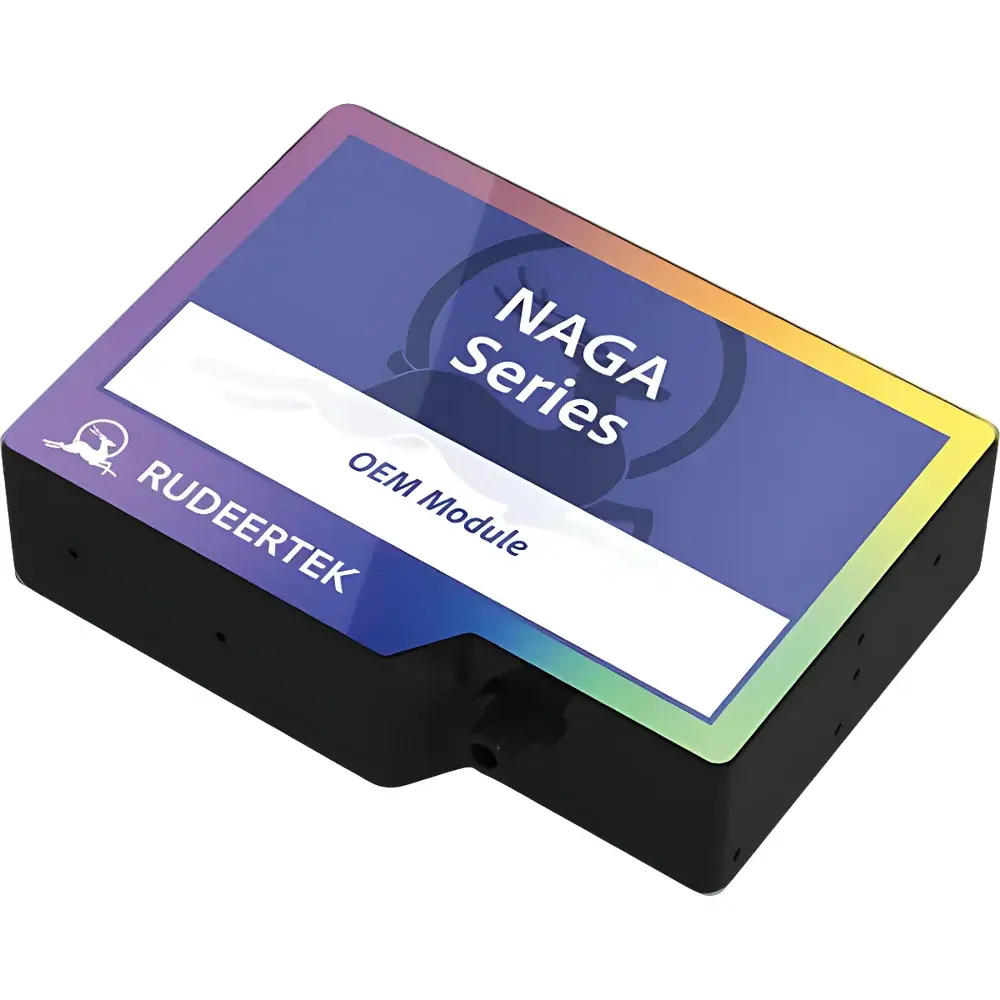
NAGA Crossed Czerny-Turner OEM Optical Platform
| Brand | Luqi Technology |
|---|---|
| Origin | Anhui, China |
| Manufacturer Type | OEM Manufacturer |
| Model | NAGA |
| Price | Upon Request |
| Spectral Range | 200–1100 nm |
| Optical Architecture | Crossed Czerny-Turner |
| F-number | f/4 |
| Slit Width Options | 10 / 25 / 50 / 75 / 100 µm |
| Grating Options | 300 / 600 / 900 / 1200 / 1800 lines/mm |
| Stray Light | <1% |
| Weight | 200 g |
| Interface | USB 2.0 Type-B, Digital I/O |
| Fiber Optic Connector | Standard SMA 905, Customizable |
Overview
The NAGA Crossed Czerny-Turner OEM Optical Platform is a compact, high-stability spectroscopic engine engineered for integration into portable and embedded optical instrumentation. Based on the crossed Czerny-Turner optical layout—where the entrance and exit arms are oriented orthogonally—the platform minimizes optical path length while maintaining high spectral fidelity and mechanical rigidity. This architecture inherently suppresses stray light through optimized beam folding and physical separation of input/output optics, achieving <1% stray light performance across the full 200–1100 nm spectral range. Designed explicitly for OEM deployment, the NAGA platform delivers consistent optical alignment stability under thermal cycling and mechanical vibration, making it suitable for field-deployable instruments such as handheld Raman spectrometers, portable colorimeters, and in-situ water quality analyzers. Its f/4 optical speed balances throughput and resolution, supporting high signal-to-noise ratio acquisition even with low-light detectors or short integration times.
Key Features
- Compact monolithic optical bench (200 g) with integrated mounting kinematics for repeatable sensor alignment
- Crossed Czerny-Turner configuration enabling minimal footprint (<120 mm × 80 mm × 45 mm typical envelope) without compromising spectral dispersion linearity
- Modular slit assembly with external-access replaceable slits (10, 25, 50, 75, or 100 µm width options) to balance resolution and throughput per application requirement
- Interchangeable diffraction gratings (300–1800 lines/mm) mounted via precision kinematic interface for rapid reconfiguration of dispersion and spectral sampling
- Standard SMA 905 fiber coupling; optional FC/PC, ST, or custom ferrule interfaces available upon request
- Dual-interface connectivity: USB 2.0 Type-B for spectral data streaming and firmware control, plus TTL-compatible digital I/O for hardware synchronization (e.g., laser triggering, shutter control)
Sample Compatibility & Compliance
The NAGA platform supports direct coupling to industry-standard silicon-based linear CCD and CMOS array detectors, including those from Hamamatsu, ON Semiconductor, and e2v. It is compatible with Luqi’s LUNA-series photodetector modules—pre-aligned and thermally stabilized for optimal quantum efficiency across UV-VIS-NIR. While the platform itself is not a finished instrument, its optical design adheres to foundational principles referenced in ISO 17025-compliant calibration workflows for spectrometers. When integrated into final systems, the NAGA enables traceable spectral measurements compliant with ASTM E308 (colorimetry), ASTM D5386 (liquid color), and EPA Method 100.1 (UV-Vis absorbance for water analysis). Its mechanical stability and low thermal drift support GLP-aligned operation in regulated QC environments when paired with appropriate detector and software validation.
Software & Data Management
The NAGA platform operates via vendor-agnostic USB HID or CDC ACM protocols, allowing seamless integration with third-party spectral acquisition frameworks—including LabVIEW, Python (PyUSB, NumPy), MATLAB, and Qt-based C++ applications. Luqi Technology provides open-source SDKs with documented register maps, timing diagrams, and example firmware for common microcontroller platforms (e.g., STM32, ESP32). All digital I/O signals follow deterministic timing specifications, enabling synchronized multi-event capture (e.g., simultaneous laser pulse, grating position readback, and detector exposure). Audit-trail-ready logging is achievable when deployed with host software implementing FDA 21 CFR Part 11-compliant electronic signatures and change control—though platform-level firmware does not embed cryptographic signing or user-role management (these reside in the host system layer).
Applications
- Handheld and battery-powered Raman spectrometers requiring high stray-light rejection in 785 nm excitation bands
- In-line water quality monitors measuring nitrate, dissolved organic carbon (DOC), and turbidity via UV-Vis absorption at 220–350 nm and 600–900 nm
- Portable color measurement devices for textile, paint, and food industries conforming to CIE 15:2018 spectral rendering standards
- OEM miniature spectrophotometers embedded in medical point-of-care diagnostics (e.g., hemoglobin oxygen saturation, bilirubin quantification)
- Educational lab modules for teaching optical design, diffraction theory, and spectral calibration techniques
FAQ
Can the NAGA platform be used with cooled detectors for low-light applications?
Yes—its mechanical interface and optical path accommodate standard 14-pin or 20-pin linear array packages with thermoelectric coolers. Thermal expansion coefficients of the aluminum alloy baseplate are matched to common detector substrates to minimize focus shift over −10 °C to +50 °C.
Is grating alignment adjustable by the end user?
No—grating positioning is factory-optimized and locked during assembly. However, interchangeable grating modules are pre-aligned and certified for angular deviation <5 arcsec, ensuring plug-and-play replacement without recalibration.
Does Luqi provide optical simulation files (e.g., Zemax .ZAR)?
Yes—Zemax Sequential and Non-Sequential files, including tolerance analyses and stray light ray traces, are provided under NDA to qualified OEM partners engaged in co-development.
What is the typical spectral calibration uncertainty when using NAGA with a LUNA detector?
When calibrated against NIST-traceable mercury-argon emission lines, wavelength accuracy is ±0.25 nm RMS across 200–1100 nm, assuming proper slit selection and detector pixel mapping.
Can custom firmware features (e.g., onboard dark subtraction, region-of-interest readout) be implemented?
Yes—Luqi offers turnkey firmware development services based on customer-defined functional requirements, including real-time processing extensions compliant with IEC 62304 for medical device software lifecycle management.




