
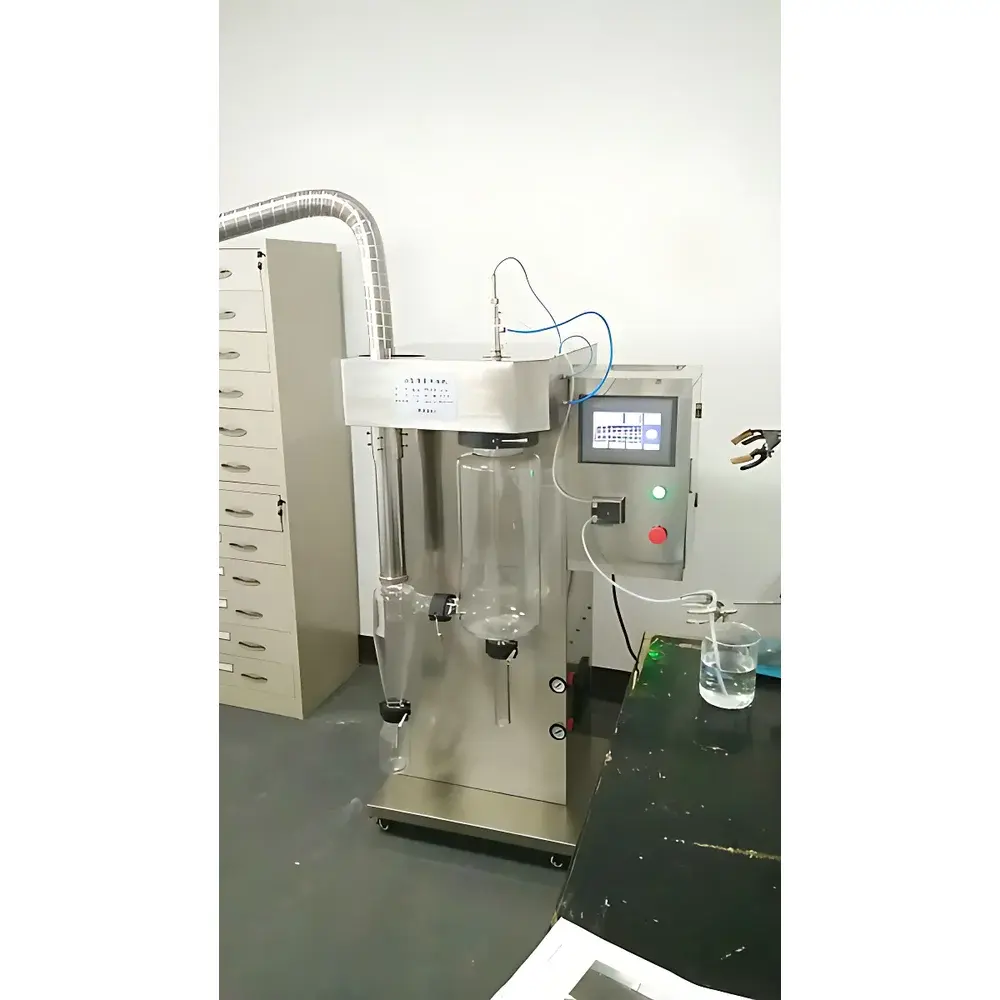
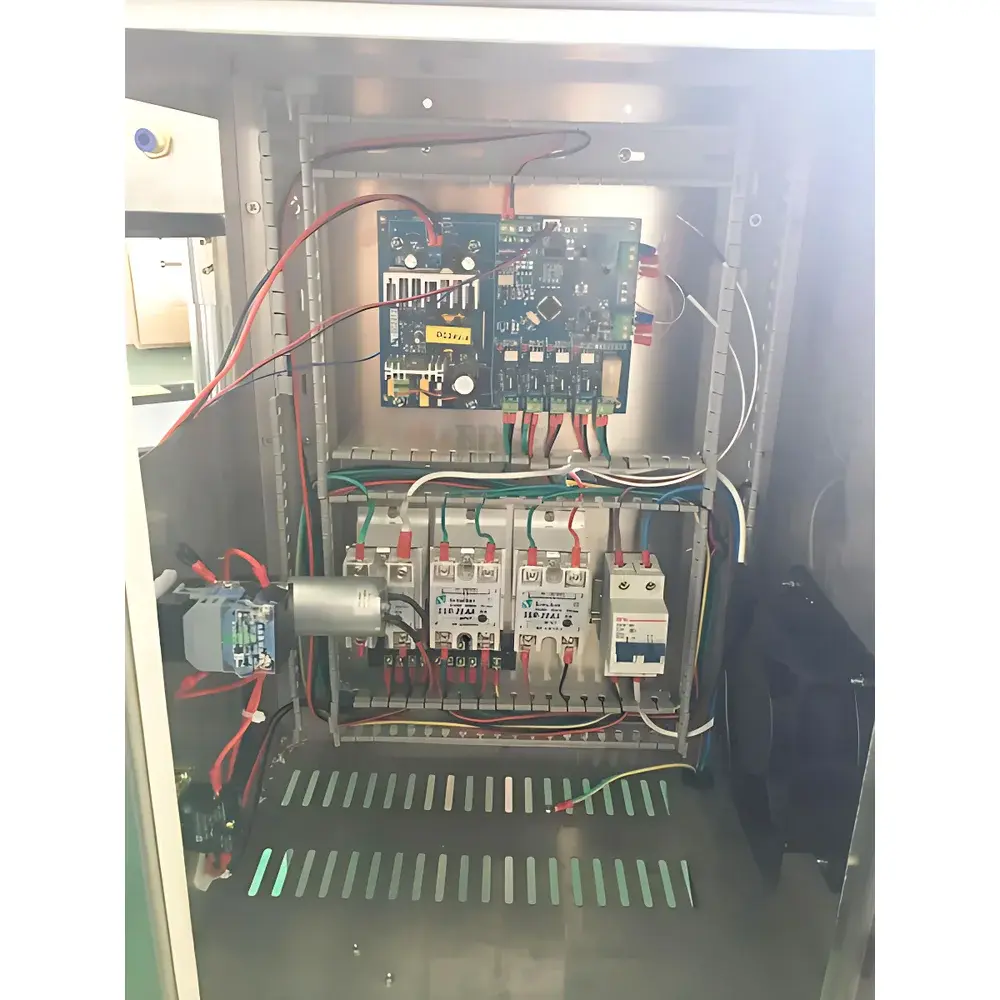
NAI-GZJ Benchtop Spray Dryer
| Brand | NAI Instruments |
|---|---|
| Origin | Shanghai, China |
| Manufacturer Type | Authorized Distributor |
| Country of Origin | China |
| Model | NAI-GZJ |
| Pricing | Available Upon Request |
| Material Contact Parts | Borosilicate Glass & 304 Stainless Steel |
| Drying System | Open-Circuit |
| Atomization | Dual-Fluid Nozzle (Standard: 0.75 mm Orifice) |
| Airflow Configuration | Co-Current |
| Hot Air Residence Time | 1.0–1.5 s |
| Evaporation Capacity | 1500–2000 mL/h |
| Inlet Air Temperature Range | Ambient to 300 °C (PID-Controlled, ±0.5 °C Accuracy) |
| Outlet Air Temperature Display Range | Up to 140 °C |
| Heating Power | 3 kW |
| Compressed Air Supply | Integrated Oil-Free Air Compressor (0.6 kW, 0.7 MPa) |
| Blower | 0.4 kW, 7 m³/min |
| Total Power Consumption | 4 kW / 220 V AC |
| Dimensions (L×W×H) | 770 × 590 × 1380 mm |
| Net Weight | 100 kg (Glass Tower), 125 kg (Stainless Steel Tower) |
| Minimum Feed Volume | 50 mL |
| Maximum Feed Rate | 2000 mL/h |
| Control System | PCB-Based Controller + 7-inch Color Touchscreen Interface |
| Optional Accessories | Syringe Pump Module, Cold Trap, Inert Gas Purge Kit |
Overview
The NAI-GZJ Benchtop Spray Dryer is a compact, open-circuit, co-current spray drying system engineered for precise, reproducible micro-scale powder production in research and development environments. It operates on the principle of rapid solvent evaporation via atomization—where liquid feed is dispersed into fine droplets using a dual-fluid nozzle, then exposed to a controlled stream of heated air. Due to the short residence time (1.0–1.5 seconds) and transient thermal exposure, thermolabile compounds—including enzymes, probiotics, monoclonal antibodies, vaccine adjuvants, and natural extracts—retain structural integrity and bioactivity post-drying. Designed for laboratories requiring flexibility between visual process monitoring and robust operational durability, the system supports interchangeable borosilicate glass and 304 stainless steel drying towers—enabling real-time observation during method development and long-term use under abrasive or corrosive conditions.
Key Features
- Integrated oil-free air compressor (0.6 kW, 0.7 MPa) ensures consistent atomization pressure with noise levels <60 dB(A), compliant with ISO 15714 and national laboratory acoustic standards.
- Dual-mode control architecture: fully automated sequence-driven operation (pre-set temperature ramp, pump start/stop logic, dynamic animation display) plus real-time manual override for parameter tuning during active drying cycles.
- PID-based inlet air temperature regulation across 0–300 °C with ±0.5 °C stability and embedded temperature curve logging—critical for DOE (Design of Experiments) and thermal stress profiling.
- Self-cleaning nozzle mechanism (adjustable-frequency needle probe) mitigates clogging during processing of viscous or particulate-laden feeds such as protein suspensions, polysaccharide solutions, or nanosuspensions.
- Feed delivery via precision peristaltic pump (50 mL–2000 mL/h range) with linear flow calibration; compatible with syringe-based low-volume dosing modules for high-value biologics.
- All wetted parts constructed from USP Class VI-certified borosilicate glass (tower, cyclone, collection vessel) and electropolished 304 stainless steel (heater housing, air ducts)—ensuring chemical compatibility and ease of cleaning validation.
- Safety-integrated shutdown protocol: pressing “Stop” halts heating elements and feed pump immediately while allowing blower to continue cooling—preventing thermal damage from abrupt airflow cessation.
Sample Compatibility & Compliance
The NAI-GZJ accommodates aqueous solutions, colloidal dispersions, emulsions, and low-viscosity suspensions (up to ~500 cP). It is routinely deployed in applications aligned with ASTM E2913 (spray drying of pharmaceutical powders), ISO 8573-1 (compressed air purity class 3 for instrument air), and ICH Q5C (stability testing of biotechnological products). While not intrinsically compliant with FDA 21 CFR Part 11 out-of-the-box, its touchscreen controller supports audit trail export (CSV), user-level access control, and timestamped event logs—facilitating GLP/GMP-aligned documentation when integrated into validated lab workflows. The open-system design permits optional nitrogen purging for oxygen-sensitive materials, supporting USP <1118> requirements for inert atmosphere processing.
Software & Data Management
The 7-inch color touchscreen interface provides intuitive navigation through multi-layer menus for setpoint configuration, real-time trend visualization (inlet/outlet temperature, feed rate), and historical session recall. All operational parameters—including temperature profiles, pump speed, air pressure, and runtime—are logged automatically at 1-second intervals and exportable via USB to CSV format. No proprietary software installation is required; raw data files are natively readable in Excel, MATLAB, or Python pandas environments. For labs implementing LIMS integration, Modbus RTU communication protocol is available upon request (RS-485 port), enabling remote monitoring and centralized data aggregation.
Applications
- Pharmaceutical R&D: Preparation of amorphous solid dispersions, inhalable dry powders, and nanoparticle-loaded microparticles for dissolution enhancement studies.
- Food Science: Encapsulation of probiotics, omega-3 oils, and anthocyanins; optimization of wall material ratios (e.g., maltodextrin vs. whey protein isolate).
- Agrochemical Development: Formulation of water-dispersible granules (WDGs) and biopesticide carriers with controlled release kinetics.
- Materials Research: Synthesis of ceramic precursors, metal oxide nanoparticles, and battery cathode precursors with narrow PSD (particle size distribution).
- Academic Teaching Labs: Hands-on instruction in mass transfer fundamentals, thermal processing economics, and scale-down modeling for industrial spray dryer design.
FAQ
What is the minimum sample volume required for a valid drying run?
A minimum of 50 mL is recommended to ensure stable atomization and representative powder yield; however, method development trials may begin with as little as 20 mL using syringe-assisted feed.
Can the NAI-GZJ process organic solvents?
No—the standard configuration is rated for aqueous systems only. Processing flammable solvents requires explosion-proof modifications, inert gas recirculation, and additional safety interlocks—not included in base model NAI-GZJ.
Is the glass drying tower autoclavable?
Borosilicate glass components are heat-resistant up to 500 °C but are not designed for repeated autoclaving; thermal shock risk necessitates gradual heating/cooling. Cleaning validation should follow SOPs using validated detergents and rinse protocols.
How is particle size distribution controlled?
PSD is primarily governed by feed concentration, nozzle orifice size (standard 0.75 mm; optional 0.5/1.0 mm), inlet temperature, and atomization air pressure—each adjustable independently during operation.
Does the system support GMP-compliant operation?
Yes—with documented IQ/OQ protocols, electronic signature capability (via external tablet integration), and full traceability of all critical process parameters, it meets foundational GMP expectations for non-sterile R&D manufacturing environments.



