
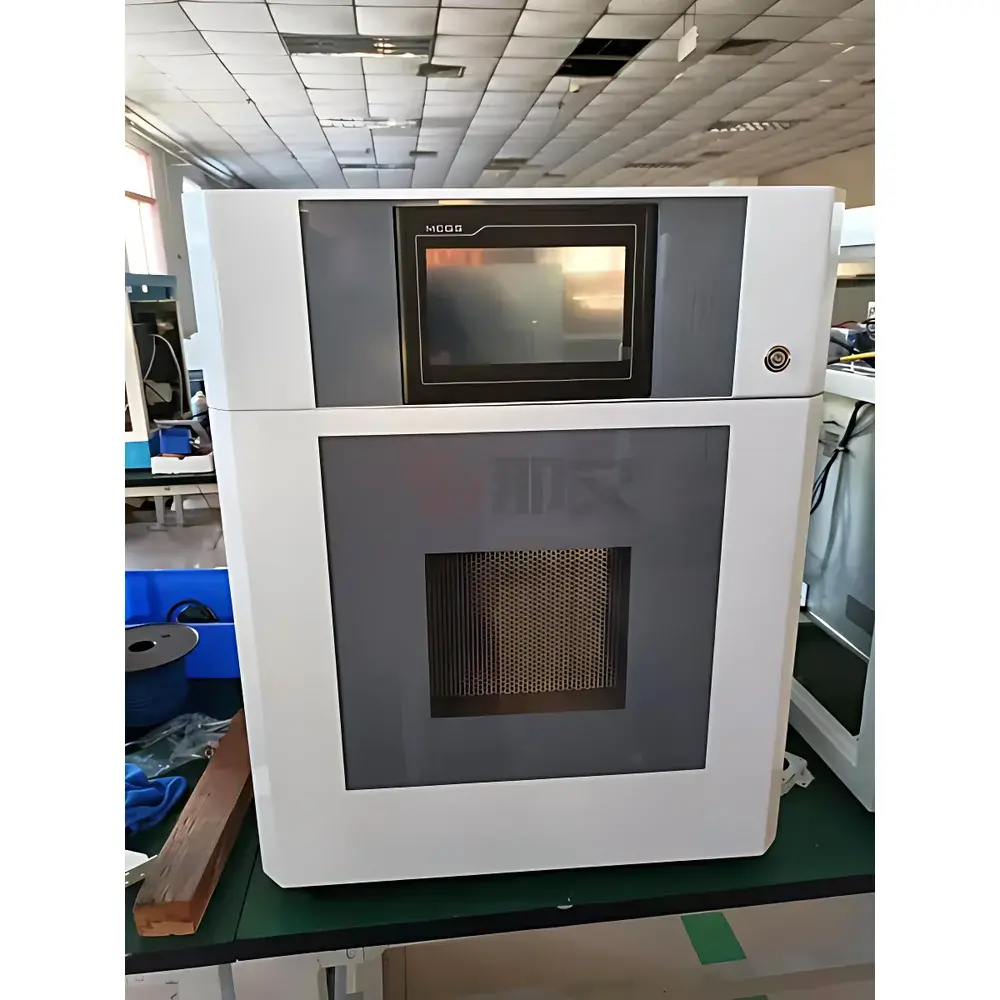
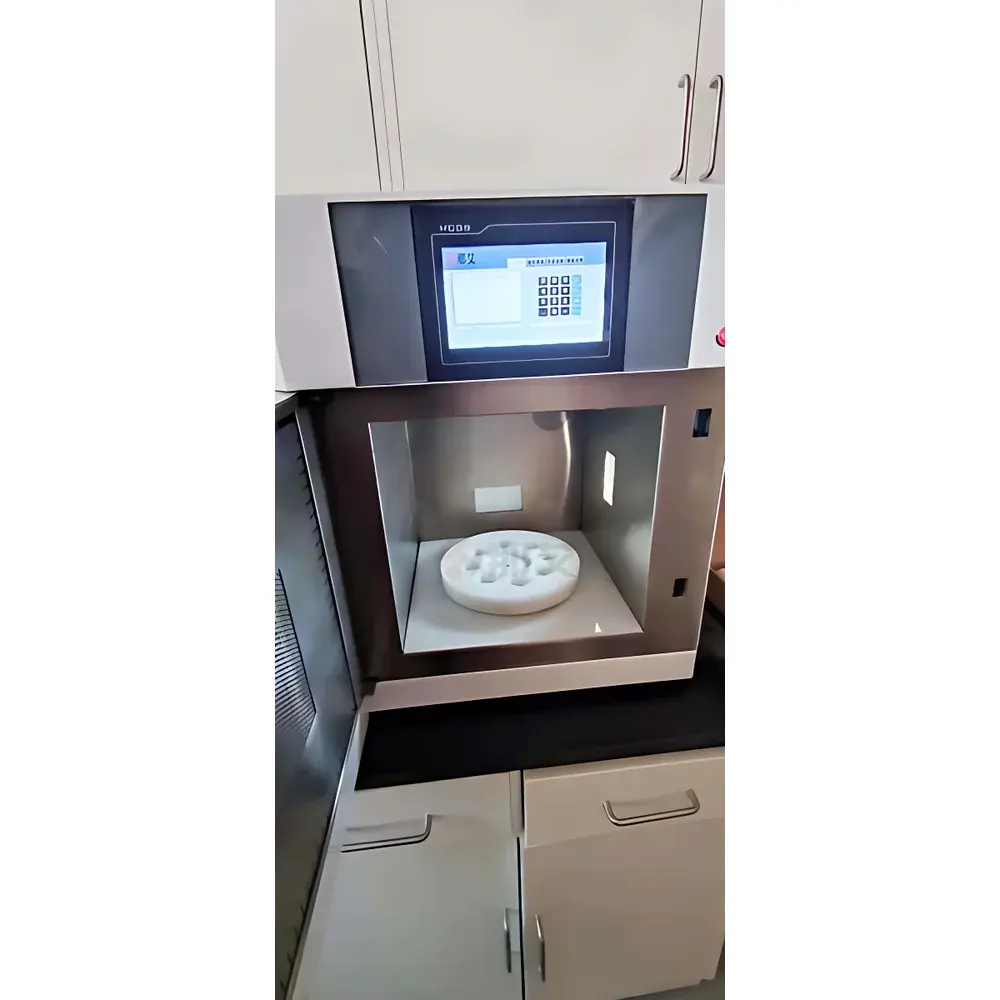
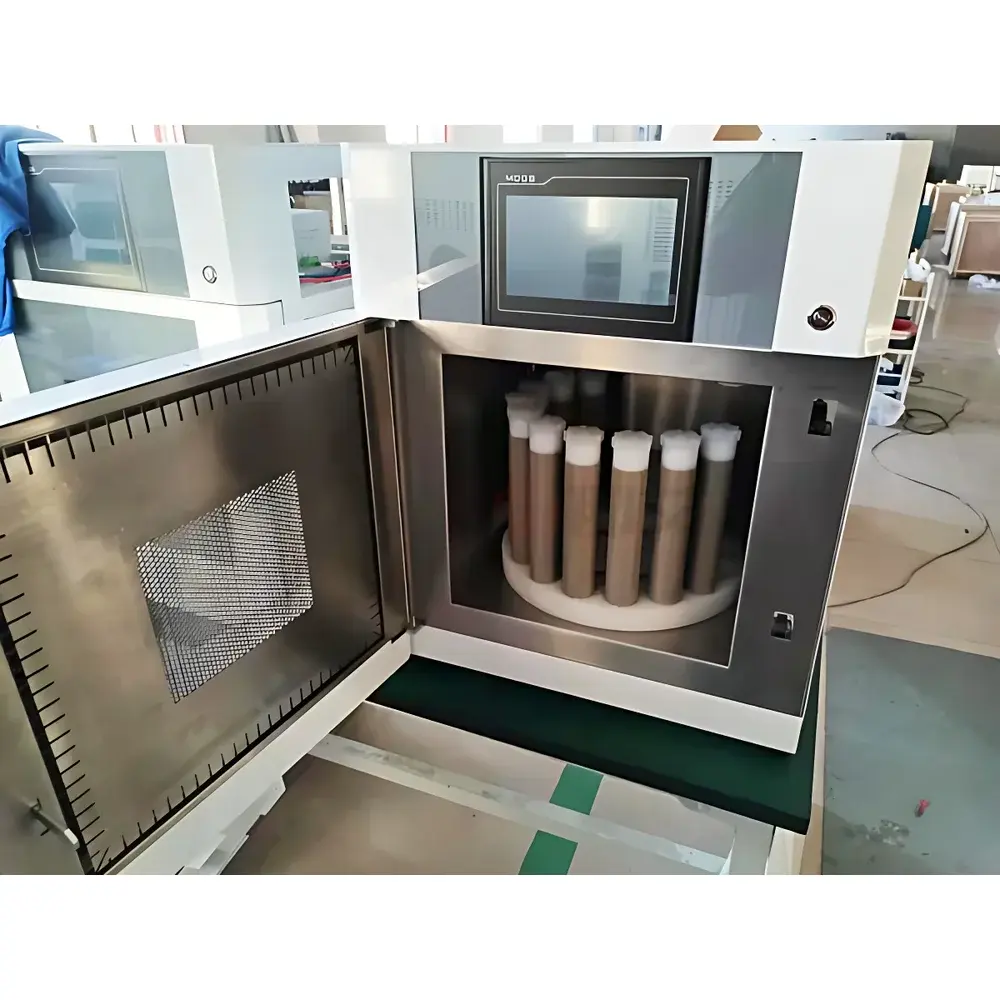
NAI NAI-WBC Microwave Hydrothermal Synthesis System
| Brand | NAI |
|---|---|
| Origin | Shanghai, China |
| Model | NAI-WBC6 / NAI-WBC12 |
| Sample Capacity | 6 or 12 vessels |
| Vessel Material | PTFE inner + PEEK outer |
| Inner Volume | 100 mL per vessel |
| Temperature Range | 0–300 °C |
| Temp. Control Accuracy | ±0.5 °C |
| Pressure Range | 0–10 MPa |
| Microwave Output | 0–1600 W, continuous auto-frequency modulation |
| Safety features | self-locking anti-explosion door, rupture disc + pressure relief valve, real-time fault diagnostics, automatic microwave cutoff on overpressure/overtemperature |
| Cooling | forced-air circulation ≥5 m³/min, integrated cavity air-cooling |
| Display | 8″ industrial touch HMI (Siemens PLC-based) |
Overview
The NAI NAI-WBC Microwave Hydrothermal Synthesis System is an engineered platform for controlled, high-pressure hydrothermal reactions accelerated by microwave energy. Unlike conventional oven-based hydrothermal synthesis—where thermal inertia, slow heat transfer, and unmonitored internal conditions lead to irreproducible crystallization kinetics—the NAI-WBC integrates real-time, non-contact temperature and pressure feedback directly at the reaction vessel level. It operates on the principle of dielectric heating: microwave energy couples efficiently with polar solvents (e.g., water, ethylene glycol), enabling rapid, volumetric heating under sealed conditions. This eliminates thermal gradients and “black-box” uncertainty, delivering precise control over nucleation, crystal growth rate, phase evolution, and final particle morphology. Designed for laboratories requiring reproducible nanomaterial synthesis—including metal oxides, perovskites, MOFs, and layered double hydroxides—the system supports reaction completion in 60–120 minutes versus 48–72 hours in conventional autoclaves.
Key Features
- Continuous auto-frequency modulated microwave generation (0–1600 W), powered by dual industrial-grade magnetrons and a robust 10-year-rated power supply—distinct from domestic microwave sources in stability, spectral purity, and field homogeneity.
- 360° synchronous rotational motion ensures uniform microwave exposure across all vessels, minimizing inter-sample variability and supporting statistical reliability in parallel synthesis.
- 316L stainless steel cavity with six-layer PTFE lining resists acid/alkali corrosion and maintains structural integrity under repeated thermal cycling and pressure stress.
- Self-locking, buffer-structured explosion-proof door complies with EN 61000-6-4 and IEC 61000-6-2 electromagnetic compatibility standards; incorporates dual mechanical safety: pressure-activated rupture disc and spring-loaded pressure relief valve.
- Real-time, non-contact infrared temperature sensing (long-wave IR) and piezoresistive pressure transducers provide millisecond-level response with no signal lag—critical for detecting exothermic runaway or solvent superheating events.
- Siemens S7-1200 PLC core with 8″ industrial HMI enables deterministic control logic, audit-trail-capable operation logging, and configurable alarm thresholds per parameter (temperature, pressure, power, rotation status).
- Forced-air cooling system delivers ≥5 m³/min airflow with acid-resistant centrifugal blower, enabling sustained operation during multi-hour syntheses while maintaining external surface temperature <45 °C.
Sample Compatibility & Compliance
The NAI-WBC accommodates standard 100 mL PTFE-lined PEEK vessels—chemically inert up to 250 °C and compatible with aggressive reagents (e.g., HF, concentrated HNO₃, NaOH). Vessel geometry and rotational dynamics are optimized to prevent vortex-induced uneven heating or localized hot spots. The system meets essential safety requirements outlined in ISO 17025:2017 (clause 6.4.2 on equipment suitability), ASTM E2877-19 (standard guide for microwave-assisted chemical synthesis), and EU Directive 2014/30/EU (EMC Directive). Its PLC-based control architecture supports GLP-compliant data integrity: all setpoints, measured values, alarms, and operator actions are time-stamped and stored locally with write-protection—enabling traceability during regulatory audits (e.g., FDA 21 CFR Part 11 readiness via optional networked data export).
Software & Data Management
The embedded Siemens PLC interface records full experimental profiles—including temperature vs. time, pressure vs. time, and microwave power modulation—with 1-second resolution. Data export is supported via USB 2.0 to CSV or Excel-compatible formats. No proprietary software installation is required: raw logs are human-readable and interoperable with LIMS platforms (e.g., LabWare, Thermo Fisher SampleManager) via standard ODBC drivers. All operational events—including door open/close cycles, fault triggers, and manual overrides—are logged with ISO 8601 timestamps and user IDs. Optional Ethernet connectivity enables remote monitoring through Modbus TCP, facilitating integration into centralized lab automation frameworks.
Applications
- Synthesis of nanostructured transition metal oxides (e.g., TiO₂ anatase/rutile, Fe₃O₄ spinel) with tunable crystallite size (5–50 nm) and narrow size distribution (PDI <0.15).
- Rapid preparation of perovskite precursors (e.g., MAPbI₃, CsPbBr₃) under inert atmosphere, minimizing halide segregation and improving photoluminescence quantum yield.
- Hydrothermal carbonization of biomass derivatives for functionalized carbon dots or heteroatom-doped graphene quantum dots.
- Crystallization of zeolitic imidazolate frameworks (ZIF-8, ZIF-67) with >95% phase purity and BET surface areas exceeding 1200 m²/g.
- Accelerated digestion of biological tissues and environmental solids (soils, sediments) prior to ICP-MS analysis—reducing total assay time by 70% compared to block digesters.
FAQ
What safety certifications does the NAI-WBC hold?
The system conforms to IEC 61010-1 (Safety Requirements for Electrical Equipment for Measurement, Control, and Laboratory Use) and carries CE marking for EMC and Low Voltage Directive compliance. Full test reports are available upon request.
Can the system operate under inert gas purging?
Yes—each vessel port includes a dedicated gas inlet/outlet fitting compatible with standard Schrader or Swagelok connections; optional mass flow controller integration is supported.
Is method transfer from conventional hydrothermal reactors possible?
Empirical correlation protocols are provided in the user manual; typical scaling factors range from 1:20 to 1:40 (oven time : microwave time) depending on solvent dielectric loss tangent and vessel loading.
What maintenance is required for long-term reliability?
Annual calibration of IR sensor and pressure transducer is recommended; magnetron output power verification every 2 years. No consumables beyond standard PTFE gaskets (supplied in spare kit).
Does the system support custom reaction programming?
Yes—up to 10 multi-step programs can be saved, each with independent ramp rates, hold times, power profiles, and safety limits; conditional branching (e.g., “hold until pressure reaches 6 MPa”) is programmable via ladder logic editor.



