
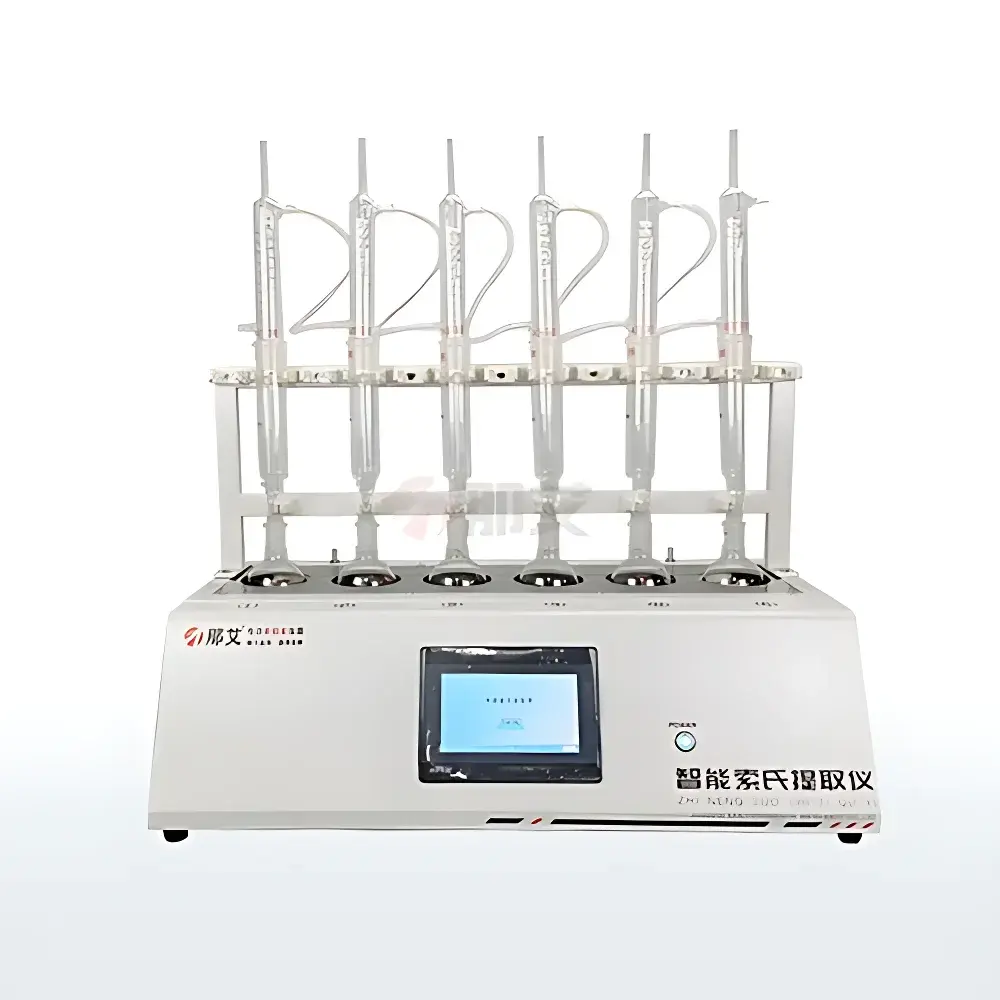
NAI-ST-6S Six-Position Water-Bath Soxhlet Extractor with 250 mL Extraction Thimbles
| Brand | NAI Instruments |
|---|---|
| Origin | Shanghai, China |
| Model | NAI-ST-6S |
| Extraction Chamber Volume | 250 mL per position |
| Receiver Flask Volume | 250 mL |
| Temperature Range | +5 °C to 99 °C |
| Temperature Control Accuracy | ±5 °C |
| Number of Extraction Channels | 6 |
| Power Supply | 220 V ±10 V, 50 Hz |
| Heating Power | 2000 W |
| Dimensions (L×W×H) | 800 mm × 400 mm × 220 mm (excluding support frame) |
| Net Weight | 26 kg |
Overview
The NAI-ST-6S is a six-channel, programmable water-bath Soxhlet extractor engineered for standardized fat and semi-volatile organic compound (SVOC) extraction in compliance with international analytical protocols. It operates on the classical Soxhlet principle—continuous solvent reflux through solid matrix—where a heated water bath provides uniform, controllable thermal energy to drive solvent evaporation, condensation, and cyclic percolation through a sample contained in a glass thimble. Unlike direct-heating systems, the water-bath design ensures gentle, homogeneous temperature distribution across all six extraction units, minimizing thermal degradation of thermolabile analytes and enhancing reproducibility between replicates. The system supports method validation under ISO 11337 (Animal feeding stuffs — Determination of crude fat), AOAC Official Method 920.39 (Fat in Animal Feeds), and EPA Method 3541 (Soxhlet Extraction), while its modular architecture facilitates integration into GLP-compliant laboratory workflows.
Key Features
- PLC-based control system with a 5-inch color LCD interface for real-time monitoring of bath temperature, extraction duration, and operational status; user-defined timer with audible end-of-cycle alert.
- Automated water-level management: integrated level sensors trigger automatic refilling during operation and full drainage post-extraction to inhibit microbial growth in stagnant water.
- Six independent water-bath zones, each precisely regulated from ambient +5 °C to 99 °C, enabling parallel multi-method extractions or inter-laboratory method harmonization.
- Compatible with standard borosilicate glass thimbles (Φ30 × H120 mm) and dual-ground-glass joints (24/29, 45/40, and 14.5/22), accommodating both granular and powdered samples without cross-contamination.
- Triple-layer safety architecture: overtemperature cutoff, pressure-relief venting, and earth-leakage circuit interruption ensure uninterrupted 24/7 operation in high-throughput environments.
- Built-in recirculating chiller interface and drainable condenser tubing prevent biofilm formation during extended idle periods and reduce municipal water consumption by >70% versus tap-cooled systems.
- Embedded QR-coded technical documentation—scannable via smartphone—for instant access to electronic user manuals, firmware update logs, and direct escalation to NAI’s certified service network.
Sample Compatibility & Compliance
The NAI-ST-6S accommodates diverse solid matrices including animal feed pellets, cereal grains, edible oils, soil cores, sediment slurries, and activated carbon filters. Its 250 mL extraction chamber volume aligns with ASTM D2974 (Moisture, Ash, and Organic Matter in Peat and Other Organic Soils) and GB/T 6433–2006 (Crude Fat in Feeds). The instrument meets mechanical safety requirements per IEC 61010-1 and electromagnetic compatibility per CISPR 11 Group 1, Class B. All wetted components are constructed from borosilicate glass and PTFE-sealed joints, ensuring chemical resistance to chlorinated solvents (e.g., dichloromethane, petroleum ether), alcohols, and ethyl acetate. For regulated environments, audit trails—including operator ID, start/stop timestamps, setpoint history, and error codes—are retained locally for ≥18 months, supporting FDA 21 CFR Part 11 readiness when paired with validated LIMS integration.
Software & Data Management
While the NAI-ST-6S operates as a standalone benchtop unit, its PLC firmware supports RS-232 and optional Ethernet connectivity for remote parameter synchronization and event logging. Extraction cycles are timestamped and stored in non-volatile memory with cyclic overwrite protection. Exportable CSV logs include bath temperature profiles (recorded every 30 seconds), total elapsed time, and fault flags—enabling correlation with downstream GC-MS or gravimetric analysis results. Firmware updates are delivered via USB flash drive with SHA-256 checksum verification. No cloud dependency or proprietary software installation is required, preserving data sovereignty and simplifying IT validation under ISO/IEC 17025 Clause 5.9.
Applications
This extractor serves routine and regulatory applications across food safety (fat content in dairy products per GB 5009.6–2016), agricultural testing (crude fat in soybean meal per AOAC 920.39), environmental analysis (PAHs in soil per HJ 834–2017), and industrial quality control (insoluble impurities in edible oils per T/NAIA 040–2021). Its consistent thermal delivery supports method transfer between research labs and contract testing facilities, particularly where inter-laboratory precision (RSD < 3.5% at n=6) is mandated by accreditation bodies such as CNAS or UKAS. The 20 g maximum sample load per thimble enables representative subsampling of heterogeneous materials without pre-grinding artifacts.
FAQ
What solvent types are compatible with the NAI-ST-6S?
Commonly used solvents include petroleum ether (boiling range 30–60 °C), diethyl ether, chloroform, and dichloromethane—provided their boiling points fall within the water-bath’s operational envelope (up to 99 °C). Solvent selection must comply with local EHS guidelines and method-specific requirements.
Is the system suitable for volatile organic compound (VOC) extraction?
No—it is optimized for semi-volatile and non-volatile analytes (e.g., fats, waxes, PAHs, PCBs). VOCs require low-boiling solvents and cold-trap configurations not supported by this platform.
Can extraction parameters be locked to prevent unauthorized changes?
Yes. Administrator-level password protection restricts modification of temperature setpoints, timer values, and system calibration constants—ensuring method integrity during routine QC operations.
Does the unit meet GLP documentation requirements?
It generates traceable, tamper-evident cycle records and supports external audit via printed or exported logs. Full GLP compliance requires site-specific SOPs and periodic performance verification per ISO/IEC 17025 Annex A.
What maintenance intervals are recommended?
Daily visual inspection of water level and condenser flow; quarterly descaling of heating elements using 5% citric acid solution; annual verification of temperature sensor accuracy against NIST-traceable reference thermometers.



