
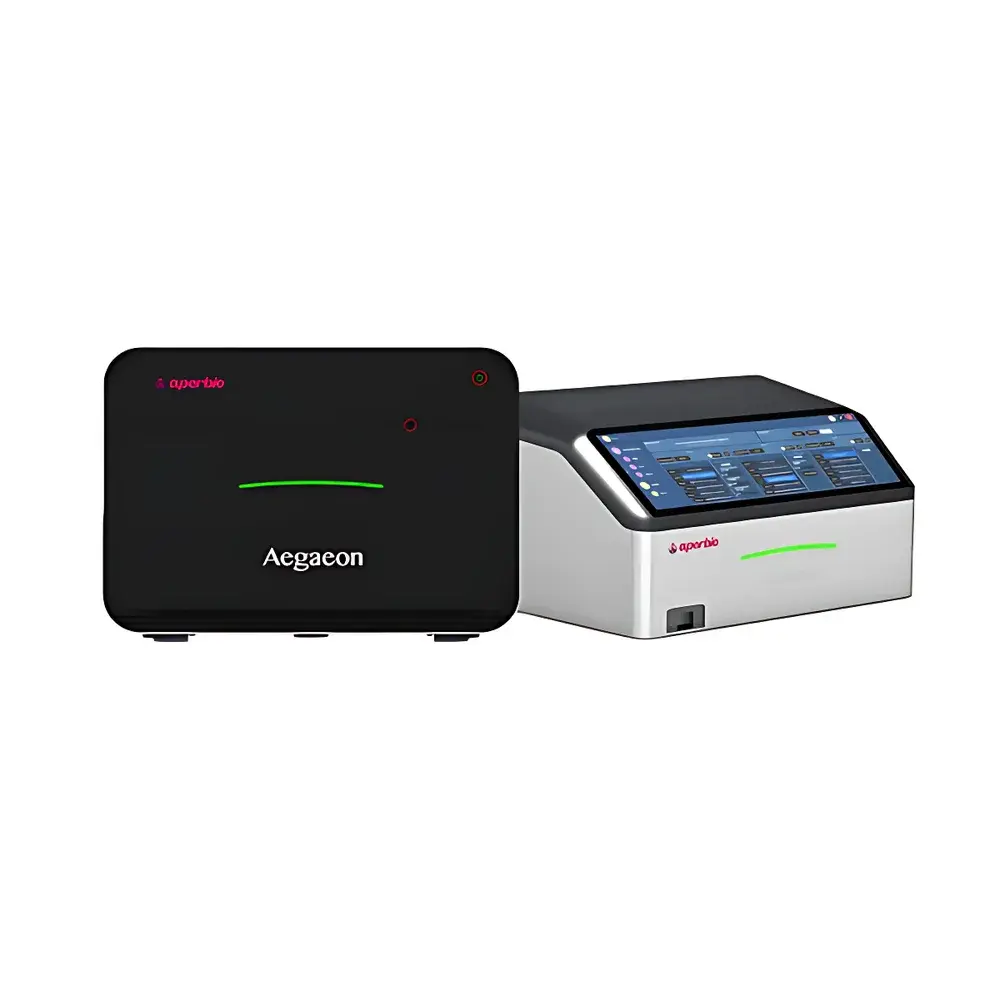
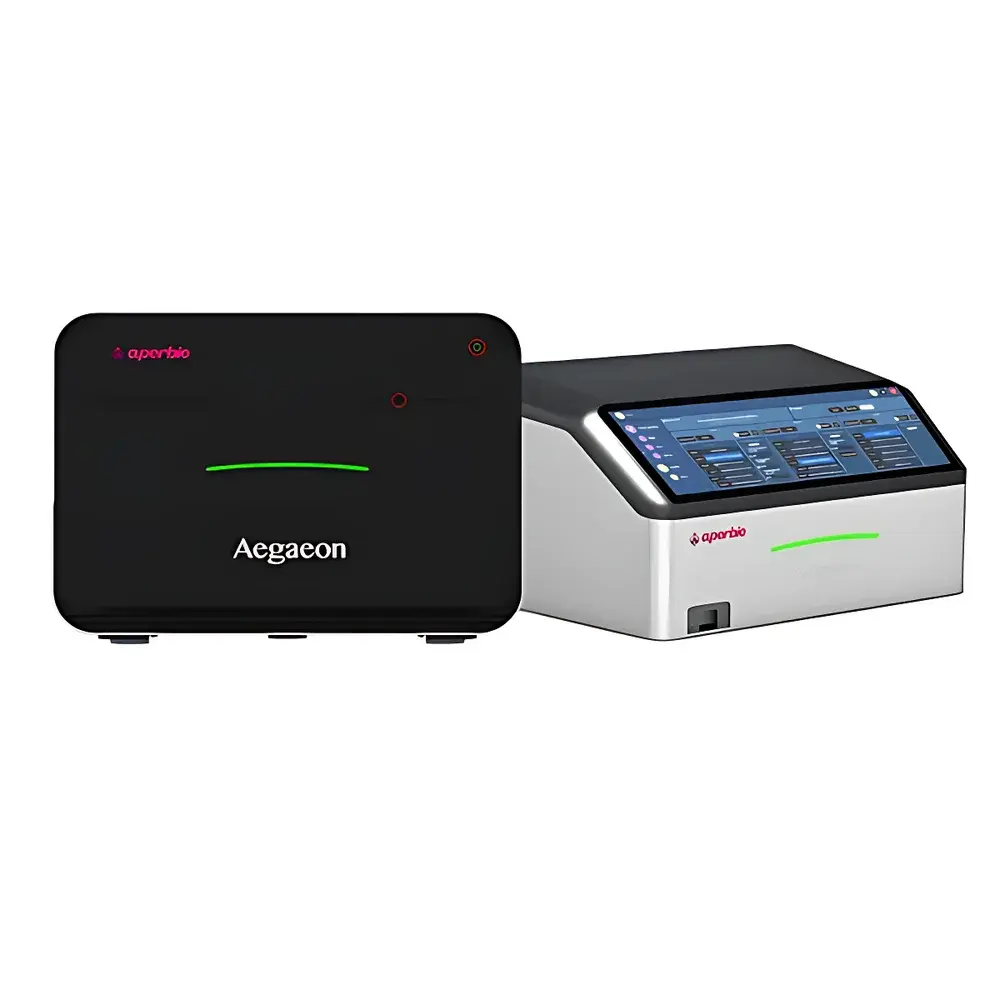
Naica® Aegaeon Digital PCR System by Aperbio
| Brand | Aperbio |
|---|---|
| Origin | Jiangsu, China |
| Manufacturer Type | Original Equipment Manufacturer (OEM) |
| Instrument Type | Digital PCR System |
| Model | NaicaEL |
| Compliance | CE-IVD, ISO 13485 certified manufacturing |
| Software | Crystal Miner™ v3.2 with FDA 21 CFR Part 11–compliant audit trail and electronic signature support |
| Detection Chemistry | TaqMan®-compatible hydrolysis probes & intercalating dyes |
| Partitioning Technology | Capillary-based microfluidic crystal formation (PRISM PCR™) |
Overview
The Naica® Aegaeon Digital PCR System is a fully integrated, capillary-based digital PCR platform engineered for absolute nucleic acid quantification with single-molecule sensitivity and high partitioning fidelity. Unlike conventional endpoint or real-time PCR instruments, the Aegaeon system leverages Aperbio’s proprietary PRISM PCR™ (Partitioned Reaction in Silica Microcrystals) technology — a microfluidic crystal formation method that generates monodisperse, thermally stable nanoliter-scale reaction chambers within fused silica capillaries. Each capillary functions as an independent array of ~20,000 individual partitions, enabling Poisson-distributed target molecule allocation and binary (positive/negative) fluorescence readout post-amplification. The system is designed for applications requiring high precision in low-abundance target detection — including rare mutation identification, copy number variation (CNV) analysis, NGS library quantification, residual DNA monitoring in bioprocesses, and liquid biopsy validation — all under a robust, walk-away workflow architecture compliant with GLP and GMP-aligned laboratory practices.
Key Features
- PRISM PCR™ Multiplexing Capability: Enables true single-tube, triplex to hexaplex target detection without spectral crosstalk, using spectrally distinct fluorophores (FAM/HEX/ROX/Cy5) and optimized thermal cycling profiles validated per ISO/IEC 17025 calibration protocols.
- Triple-Independent Thermal Cycler Modules: Three physically isolated Peltier-based reaction blocks operate simultaneously with independent ramp rates (0.1–6.0 °C/s), temperature uniformity ±0.25 °C, and programmable hold steps — allowing parallel processing of different assay conditions or sample batches without cross-contamination risk.
- AutoRuby™ Automated Sample Loading: Integrated robotic liquid handler performs precise 1–50 µL dispensing across 96-capillary arrays with CV < 3.5% intra-run and < 4.2% inter-day repeatability; completed in ≤10 minutes with barcode-scanned tube tracking and error-log generation.
- Crystal Imaging & Analysis Engine: Dual-channel widefield epifluorescence imaging (470/520 nm and 540/610 nm) coupled with AI-assisted crystal segmentation and cluster classification algorithms ensures >99.1% partition recognition accuracy and automated thresholding based on local background subtraction.
- Modular Hardware Design: Field-upgradable optics, thermal modules, and fluidics cartridges support long-term serviceability and alignment with evolving ISO 13485 quality system requirements.
Sample Compatibility & Compliance
The Aegaeon system accepts input nucleic acids from diverse sources including plasma, FFPE tissue lysates, cell-free DNA, viral RNA (with reverse transcription pre-step), and bacterial genomic DNA. Input volume ranges from 1–20 µL per capillary, compatible with standard QIAamp, MagMAX, or Zymo extraction kits. All consumables — including NaicaCapillary™ arrays and PrismSeal™ sealing films — are manufactured under ISO 13485-certified conditions and supplied with lot-specific Certificate of Analysis (CoA). The platform meets CE-IVD marking requirements for in vitro diagnostic use in the European Economic Area and supports 21 CFR Part 11 compliance through Crystal Miner™ software, including role-based access control, immutable audit trails, and electronic signature workflows aligned with FDA guidance for computerized systems in regulated environments.
Software & Data Management
Crystal Miner™ v3.2 is the native analysis suite, providing end-to-end data handling from raw image acquisition to QC-reviewed concentration reports (copies/µL) with 95% confidence intervals. The software implements MIQE-dPCR-compliant reporting templates and exports MIAME- and MAGE-TAB–compatible metadata. Raw image stacks (.czi), partition-level fluorescence intensity matrices (.csv), and analysis logs are stored in AES-256 encrypted project folders. Local deployment supports integration with LIMS via HL7 v2.5 or RESTful API endpoints; cloud backup options adhere to GDPR Article 32 technical safeguards. Audit trail records capture user ID, timestamp, action type, and pre-/post-value changes for every parameter edit or report export.
Applications
- Quantification of reference standards for NGS library preparation and qPCR calibration curves
- Detection of BRAF V600E, EGFR T790M, and KRAS G12D mutations at ≤0.05% variant allele frequency in ctDNA
- Copy number assessment of oncogenes (e.g., HER2, MYC) and pharmacogenomic loci (e.g., CYP2D6)
- Residual host cell DNA monitoring in monoclonal antibody manufacturing (ICH Q5A R2)
- Viral load measurement in HIV, HBV, and SARS-CoV-2 with reduced inter-laboratory variability vs. qPCR
- Validation of CRISPR editing efficiency and off-target assessment via targeted amplicon dPCR
FAQ
What is the minimum detectable target concentration?
The system achieves a theoretical limit of detection of 0.2 copies/µL with ≥95% confidence when using 20 µL input volume and full-capillary loading.
Can I reuse NaicaCapillary™ arrays?
No — all capillaries are single-use, sterilized, and individually barcoded to ensure traceability and prevent carryover contamination.
Is Crystal Miner™ compatible with macOS or Linux?
Crystal Miner™ is validated exclusively on Windows 10/11 (64-bit) with .NET Framework 4.8 and DirectX 12; virtualization on macOS/Linux is not supported per FDA 21 CFR Part 11 validation scope.
Does the system support reverse transcription dPCR (RT-dPCR)?
Yes — RT-dPCR is enabled via pre-loaded one-step RT-dPCR master mix protocols and thermal profile templates optimized for common reverse transcriptases (e.g., SuperScript IV, LunaScript).
How is calibration maintained across instrument lifetime?
Annual factory calibration includes optical alignment verification, thermal block homogeneity mapping, and fluorescence intensity linearity checks using NIST-traceable dye standards; calibration certificates are issued per ISO/IEC 17025.




