
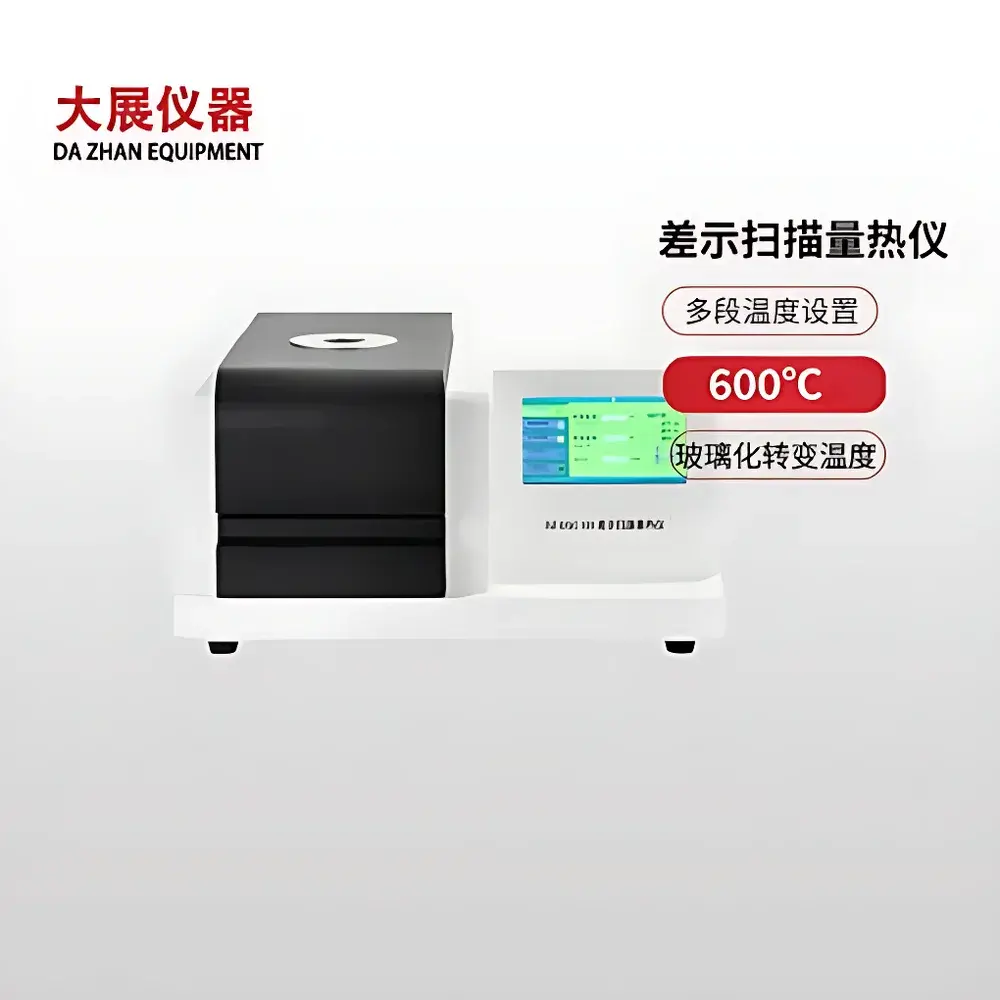
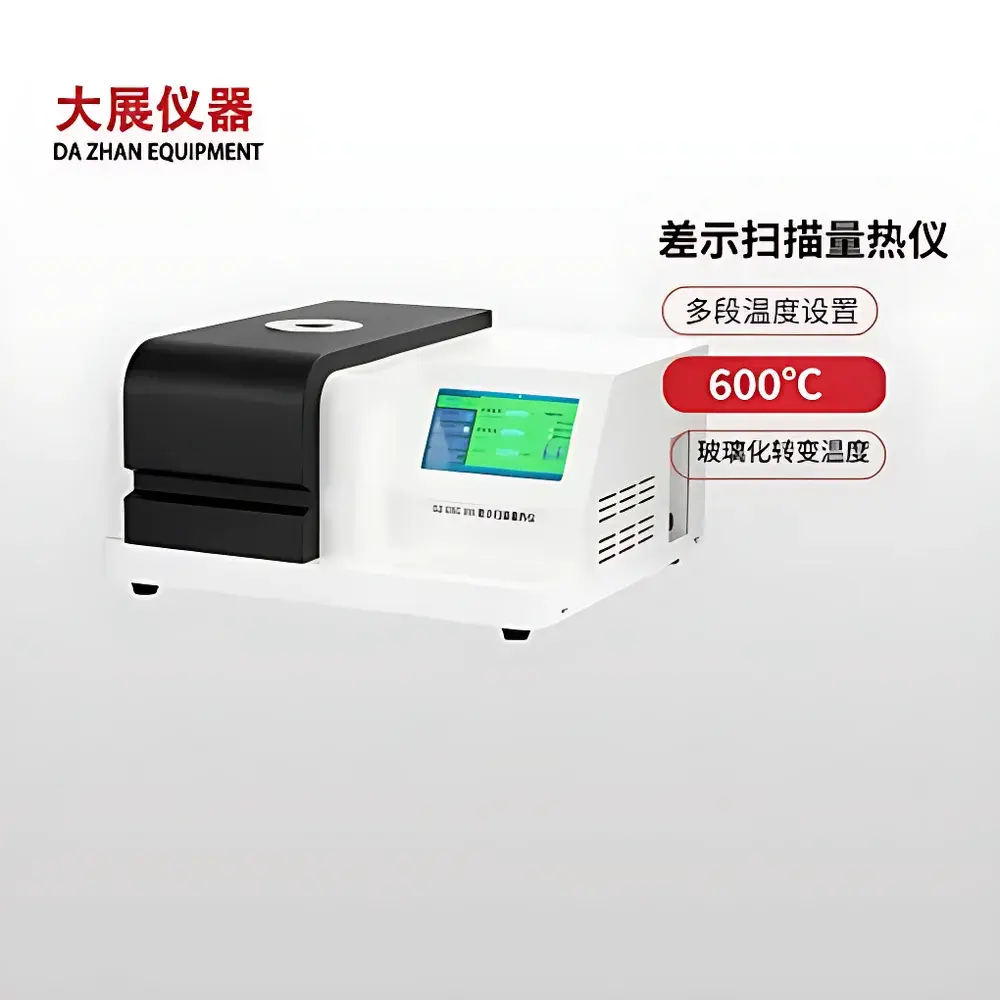
Nanjing Dazhan DZ-DSC300 Differential Scanning Calorimeter
| Brand | Nanjing Dazhan |
|---|---|
| Origin | Jiangsu, China |
| Manufacturer Type | Direct Manufacturer |
| Model | DZ-DSC300 |
| Temperature Range | Ambient to 600 °C |
| Heating Rate | 0.1–100 °C/min |
| Temperature Stability | ±0.01 °C |
| Atmosphere Control | Dual-gas automatic switching (instrument-controlled) |
| DSC Sensitivity | 0.001 mW |
| DSC Resolution | 0.01 µW |
| Temperature Accuracy | ±0.001 °C |
| Baseline Drift | <1 µW/30 min |
| Gas Flow Range | 0–300 mL/min (customizable) |
| Gas Pressure Rating | ≤5 MPa |
| Display | 7-inch 24-bit color TFT touchscreen |
| Data Interface | Standard USB 2.0 |
| Calibration Standards Included | Indium, Tin, Lead |
Overview
The Nanjing Dazhan DZ-DSC300 Differential Scanning Calorimeter is a high-precision thermal analysis instrument engineered for quantitative measurement of heat flow differences between a sample and an inert reference as a function of temperature or time. Based on the heat-flux DSC principle, it employs a symmetric furnace architecture with integrated thermal shielding and optimized sensor geometry to deliver high signal-to-noise ratio, excellent baseline stability, and reproducible thermal transition detection. Designed for routine and research-grade applications in polymer science, pharmaceutical development, metallurgy, and advanced materials engineering, the DZ-DSC300 supports dynamic and isothermal protocols under controlled atmospheres—enabling accurate determination of thermodynamic and kinetic parameters including glass transition (Tg), cold crystallization, melting enthalpy (ΔHfus), crystallization onset (Tc), oxidative induction time (OIT), and crosslinking exotherms.
Key Features
- Optimized symmetric furnace design with high-efficiency thermal insulation, minimizing radial heat loss and enhancing thermal homogeneity across the sensor platform.
- High-sensitivity thermopile-based sensor fabricated using thermal fusion bonding—eliminating micro-welding inconsistencies and improving long-term signal fidelity and thermal response time.
- Multi-segment programmable temperature control: up to six independent heating, isothermal, and cooling steps per run, with ramp rates adjustable from 0.1 to 100 °C/min and precision temperature hold accuracy of ±0.01 °C.
- Dual-gas automatic switching module with electro-pneumatic valves and mass-flow-controlled delivery (0–300 mL/min, scalable), supporting inert (N2, Ar), oxidizing (air, O2), or reducing (H2/N2) atmospheres without manual intervention.
- Embedded 7-inch 24-bit color TFT touchscreen interface with real-time curve visualization, parameter editing, and local data storage; fully compatible with external PC-based operation via USB 2.0 interface.
- Shielded analog acquisition circuitry with multi-layer EMI/RFI filtering and grounded reference planes to ensure sub-microwatt resolution (<0.01 µW) and low baseline drift (<1 µW over 30 minutes).
Sample Compatibility & Compliance
The DZ-DSC300 accommodates standard aluminum, gold-coated aluminum, and high-pressure stainless-steel crucibles (up to 10 MPa rating optional), enabling analysis of solids, powders, films, gels, and small-volume liquids (≤30 mg typical). It complies with core methodology standards including ASTM E794 (melting point), ASTM E1356 (glass transition), ISO 11357 series (polymers), and USP <1163> (thermal analysis in pharmaceuticals). The system supports GLP-compliant workflows through audit-trail-enabled software (optional), electronic signatures, and calibration traceability to NIST-traceable reference materials (indium, tin, lead) included with each unit. All firmware and control logic adhere to IEC 61000-4 electromagnetic compatibility requirements.
Software & Data Management
The bundled Windows-based analysis software provides full instrument control, real-time data acquisition at up to 10 Hz sampling rate, and post-run processing including baseline correction, peak integration, derivative (dH/dT) calculation, and multi-curve overlay. Temperature calibration includes multi-point linear and polynomial fitting with user-defined reference points. Data export conforms to ASTM E1867-compliant ASCII and universal CSV formats; raw binary files retain full metadata (gas flow, purge status, furnace voltage, thermocouple readings). Software supports 21 CFR Part 11-ready configuration (with optional password policy, role-based access, and electronic audit trail modules) for regulated environments requiring FDA-submission readiness.
Applications
- Quantification of polymer crystallinity and phase separation behavior via melting/crystallization enthalpy ratios.
- Determination of glass transition temperature (Tg) and its dependence on plasticizer content or aging history in thermoplastics and elastomers.
- Oxidative stability assessment of lubricants, fuels, and biopolymers using OIT and Oxidation Onset Temperature (OOT) under oxygen flow.
- Characterization of curing kinetics in thermosets (epoxies, phenolics) via isothermal DSC and model-free activation energy calculation (e.g., Friedman, Ozawa-Flynn-Wall).
- Thermal screening of active pharmaceutical ingredients (APIs) and excipients for polymorphic transitions, desolvation events, and compatibility studies.
- Validation of thermal degradation pathways and residue formation in composites and nanocomposites under nitrogen or air.
FAQ
What calibration standards are supplied with the DZ-DSC300?
Indium (Tm = 156.60 °C), tin (Tm = 231.93 °C), and lead (Tm = 327.50 °C) are included for temperature calibration; certified purity ≥99.99% with CoA traceable to national metrology institutes.
Can the instrument operate under vacuum or high-pressure conditions?
Standard configuration supports ambient pressure to 5 MPa via optional high-pressure cell kits; vacuum operation down to 10−2 mbar requires separate vacuum pump interface and modified crucible lid design.
Is the software compliant with 21 CFR Part 11 requirements?
Yes—when configured with the optional GxP module, the software provides electronic signatures, audit trails, user access levels, and data integrity safeguards meeting FDA expectations for regulated laboratories.
How is baseline stability maintained during extended isothermal holds?
Through active furnace symmetry compensation, low-drift thermopile design, and real-time thermal offset correction algorithms embedded in firmware—achieving baseline drift <1 µW over 30-minute isotherms at 300 °C.
Does the system support custom gas mixtures or reactive atmospheres?
Yes—the dual-channel mass flow controller allows pre-programmed gas sequences and mixing ratios; reactive gases (e.g., H2, NH3) require compatible seals and optional corrosion-resistant internal components.
Related Products



