
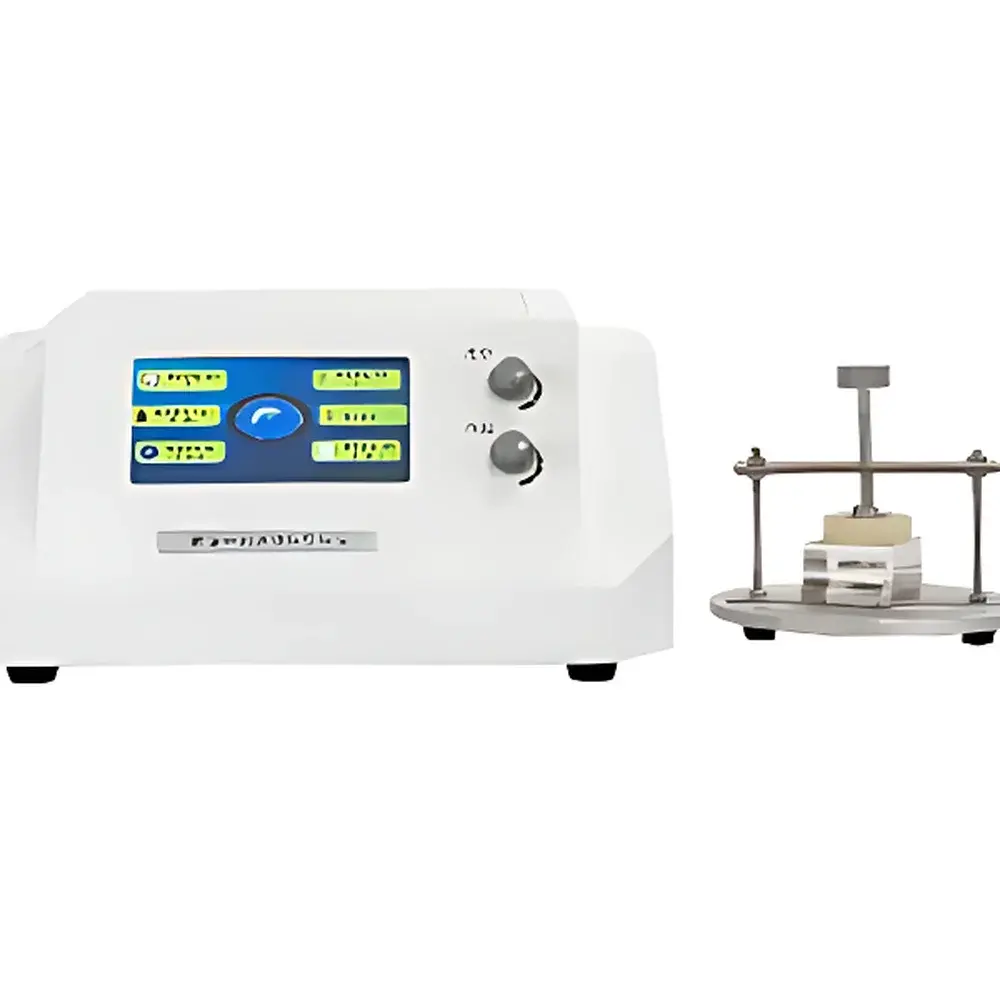
Nanjing Dazhan DZDR-S Transient Plane Source (TPS) Thermal Conductivity Analyzer
| Brand | Nanjing Dazhan |
|---|---|
| Origin | Jiangsu, China |
| Manufacturer Type | Direct Manufacturer |
| Instrument Type | Transient Plane Source Method |
| Thermal Conductivity Range | 0.0001–300 W/(m·K) |
| Accuracy | ±3% |
| Repeatability | ≤3% |
| Measurement Time | 5–160 s |
| Sample Forms | Solid blocks, pastes, granules, gels, liquids, powders, coatings, thin films |
| Probe Diameters | 7.5 mm, 15 mm, 50 mm (optional) |
| Sample Dimensions (min.) | 15×15×3.75 mm (for 7.5 mm probe), 30×30×7.5 mm (for 15 mm probe), 50×50×7.5 mm (for 50 mm probe) |
| Operating Temperature | Ambient to 130 °C |
| Power Supply | AC 220 V, <500 W |
| Dimensions (L×W×H) | 440×390×220 mm |
| Compliance | Designed for ISO 22007-2, ASTM D5470, and GB/T 32064–2015 conformance |
| Software | Embedded ARM-based control system with real-time data acquisition, GLP-compliant audit trail, and exportable CSV/Excel reports |
Overview
The Nanjing Dazhan DZDR-S Transient Plane Source (TPS) Thermal Conductivity Analyzer is a precision instrument engineered for the direct, non-destructive determination of thermal conductivity (λ), thermal diffusivity (α), and volumetric heat capacity (ρcp) across a broad spectrum of materials. It operates on the transient plane source principle—a well-established, internationally standardized method defined in ISO 22007-2 and ASTM D5470—where a thin, double-spiral nickel foil sensor acts simultaneously as both a resistive heater and a temperature sensor. Upon application of a constant electrical current, the sensor generates a controlled thermal pulse into the sample; the resulting time-dependent voltage response is recorded and analyzed using a validated physical model based on Fourier’s law and Green’s function solutions for infinite medium geometry. This approach eliminates contact resistance artifacts inherent in steady-state guarded-hot-plate or comparative cut-bar methods, enabling reliable measurements without interfacial calibration or pressure-dependent mounting.
Key Features
- Three interchangeable TPS probes (7.5 mm, 15 mm, and 50 mm diameter) optimized for diverse sample geometries—from small laboratory specimens to industrial-scale insulation panels.
- ARM-based embedded controller ensures deterministic real-time signal processing, high sampling resolution (>24-bit ADC), and low-noise thermal response capture.
- No sample preparation required beyond surface planarity; minimal dimensional constraints (e.g., ≥2× probe diameter in lateral dimensions, ≥0.5× probe radius in thickness) ensure compatibility with irregular, fragile, or composite structures.
- Non-invasive measurement protocol preserves sample integrity—enabling repeated testing, multi-point spatial mapping, and longitudinal property tracking under aging or environmental exposure studies.
- Integrated thermal management maintains ambient-to-130 °C operational stability without external ovens or cryostats, supporting routine QC of polymers, phase-change materials, thermal interface materials (TIMs), and battery electrode slurries.
- Compliance-ready firmware supports audit trails, user access levels, electronic signatures, and 21 CFR Part 11–compatible data integrity protocols for regulated environments.
Sample Compatibility & Compliance
The DZDR-S accommodates heterogeneous material classes without modification: rigid and flexible solids (e.g., ceramics, composites, foams), semi-solids (greases, adhesives, pastes), particulates (metal powders, graphite flakes), dispersions (nanofluids, colloidal suspensions), and thin-film coatings (<100 µm). Optional powder test cells enable bulk thermal characterization under controlled compaction. All measurements adhere to the physical assumptions of the TPS model—homogeneous isotropy, negligible radiative loss, and negligible lateral heat loss—which are validated during system commissioning per ISO/IEC 17025 guidelines. The instrument is routinely deployed in laboratories complying with GLP, GMP, and IEC 60601-1 (for medical device thermal safety validation).
Software & Data Management
The proprietary DZDR Control Suite runs natively on the embedded ARM platform and provides intuitive touchscreen operation. It delivers real-time curve fitting against analytical TPS solutions, automatic baseline correction, outlier detection, and uncertainty propagation per GUM (JCGM 100:2008). Export formats include timestamped CSV, Excel (.xlsx), and PDF reports containing raw voltage vs. time traces, fitted parameters, confidence intervals, and metadata (operator ID, sample ID, probe serial number, environmental conditions). Data archives support version-controlled backups, network synchronization via Ethernet/Wi-Fi, and integration with LIMS platforms through RESTful API endpoints.
Applications
- Quality assurance of thermal interface materials (TIMs) in semiconductor packaging and EV battery modules.
- R&D of aerogels, vacuum-insulated panels (VIPs), and nanostructured insulators for building envelope applications.
- Characterization of phase-change materials (PCMs) for thermal energy storage systems.
- Validation of thermal conductivity models in multiphysics simulation workflows (e.g., ANSYS Mechanical, COMSOL Heat Transfer).
- Regulatory submission support for FDA 510(k) filings requiring thermal safety documentation of implantable devices.
- Evaluation of anisotropic conduction in layered composites and printed electronics substrates.
FAQ
What standards does the DZDR-S comply with?
It is designed and verified for conformance with ISO 22007-2, ASTM D5470, and GB/T 32064–2015. Full traceable calibration certificates are available upon request.
Can the instrument measure anisotropic materials?
Yes—by orienting the probe normal to principal axes and performing orthogonal measurements, directional thermal conductivity tensors can be reconstructed with appropriate modeling extensions.
Is vacuum or inert atmosphere capability available?
Standard configuration operates in ambient air; optional environmental chambers (vacuum up to 10⁻³ mbar or N₂-purged glovebox integration) are supported via custom mechanical interfaces.
How is probe calibration performed?
Each probe is factory-calibrated using reference materials (e.g., Pyroceram 9606, copper, distilled water) across its full dynamic range; users may perform periodic verification using supplied certified standards.
Does the system support automated batch testing?
Yes—the software includes scriptable test sequences, barcode-triggered sample ID logging, and pass/fail thresholding with configurable alerts for out-of-specification results.



