
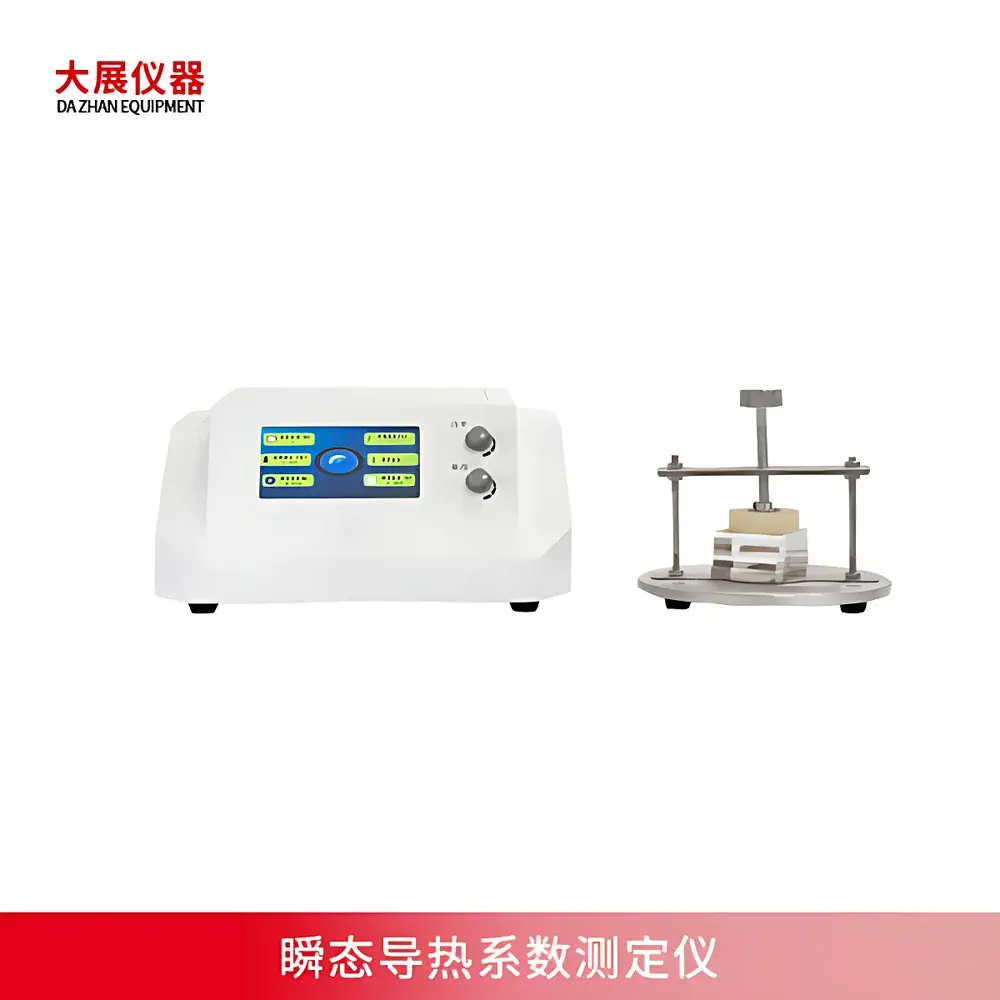
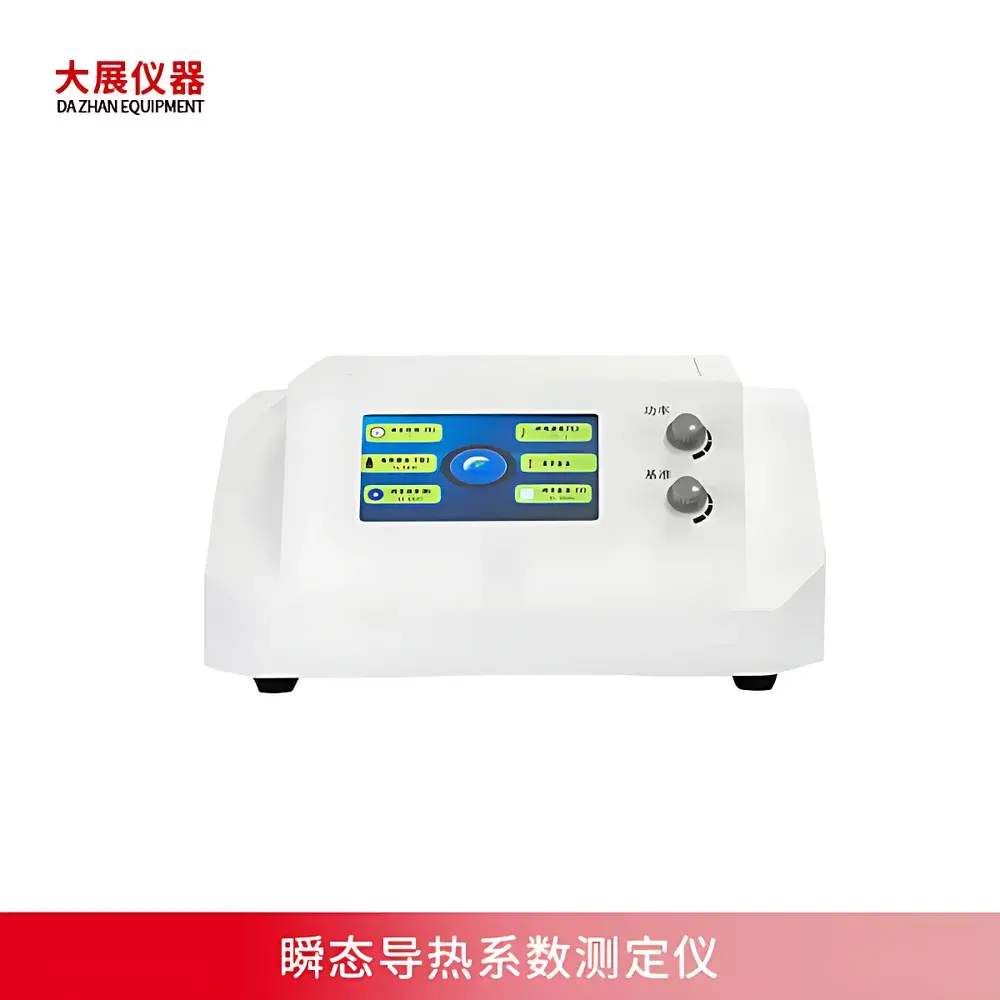
Nanjing Dazhan DZDR-S Transient Plane Source (TPS) Thermal Conductivity Analyzer
| Brand | Nanjing Dazhan |
|---|---|
| Origin | Jiangsu, China |
| Manufacturer Type | Direct Manufacturer |
| Country of Origin | China |
| Model | DZDR-S |
| Instrument Type | Transient Plane Source (TPS) Method |
| Sample Throughput | Single sample per test |
| Test Environment | Ambient temperature |
| Thermal Conductivity Range | 0.0001–300 W/(m·K) |
| Accuracy | ±3% |
| Repeatability | ≤3% |
| Temperature Range | 25–130 °C (optional extension: −40 to 300 °C) |
| Sample Forms | Liquids, thin films, coatings, metals, bulk solids, powders, gels, and insulating materials |
| Probe Diameters | 7.5 mm, 15 mm, 50 mm (modular) |
| Measurement Duration | 5–160 s (user-configurable) |
| Power Supply | AC 220 V, <500 W |
| Sample Dimensions (min.) | 15×15×3.75 mm (for 7.5-mm probe), 30×30×7.5 mm (for 15-mm probe), 50×50×7.5 mm (for 50-mm probe) |
| Optional Accessories | Powder test cell kit |
Overview
The Nanjing Dazhan DZDR-S Transient Plane Source (TPS) Thermal Conductivity Analyzer is a precision instrument engineered for rapid, contact-based measurement of thermal conductivity across an exceptionally broad range—from highly insulating aerogels (0.0001 W/(m·K)) to conductive metals and ceramics (up to 300 W/(m·K)). It operates on the well-established transient plane source principle, wherein a thin, double-helix nickel sensor—acting simultaneously as both heater and resistance thermometer—is placed in direct thermal contact with the sample. A controlled current pulse generates a transient temperature rise; the resulting voltage response over time is recorded at microsecond resolution. Using analytical solutions to the heat diffusion equation under constant-power boundary conditions, the system computes thermal conductivity, thermal diffusivity, and volumetric heat capacity from a single 5–160 second measurement. Unlike steady-state or guarded-hot-plate methods, the TPS technique eliminates interfacial contact resistance errors by embedding the sensor within the sample interface, making it especially suitable for heterogeneous, anisotropic, or low-conductivity materials where traditional contact methods introduce significant uncertainty.
Key Features
- Modular dual-sensor architecture with three interchangeable probe diameters (7.5 mm, 15 mm, 50 mm) to optimize spatial resolution and signal-to-noise ratio for diverse sample geometries and thermal properties.
- High-resolution data acquisition chipset with 24-bit ADC and sub-millisecond sampling, enabling precise capture of early-time thermal transients critical for accurate λ calculation.
- ARM-based embedded control system delivering deterministic real-time processing, eliminating latency in curve-fitting and parameter extraction.
- Non-destructive, single-sided or sandwich-mode testing: samples remain intact and reusable after analysis—essential for high-value, limited-quantity, or regulatory-controlled materials.
- No specialized sample preparation required: flatness tolerance relaxed to ±0.1 mm over probe-contact area; no polishing, coating, or vacuum sealing needed for routine measurements.
- Integrated temperature-controlled stage (standard 25–130 °C; optional extended range −40 to 300 °C) with PID regulation and NIST-traceable Pt100 sensor for thermally stabilized testing per ASTM D5470 and ISO 22007-2.
Sample Compatibility & Compliance
The DZDR-S accommodates a wide spectrum of physical states without method reconfiguration: viscous liquids (e.g., thermal greases, phase-change materials), flexible polymer films (≥25 µm thick), metallic foils, ceramic tiles, composite laminates, porous insulation boards, and loose powders (using optional calibrated cylindrical cell). Its compliance framework supports laboratory quality systems: raw measurement data includes full time-resolved voltage/temperature traces with timestamps, enabling full auditability. The system meets the instrumental requirements of ISO 22007-2 (Plastic — Determination of thermal conductivity and thermal diffusivity — Part 2: Transient plane heat source (hot disc) method), ASTM D5470 (Thermal Transmission Properties of Thermally Conductive Electrical Insulation Materials), and aligns with GLP documentation practices for material qualification in electronics thermal management, battery R&D, and building science applications.
Software & Data Management
The proprietary Windows-based analysis suite provides automated curve fitting using multi-parameter Levenberg–Marquardt optimization against the exact TPS analytical model—not simplified approximations. Each test generates a timestamped .csv file containing raw sensor voltage, calculated temperature, fitted parameters, confidence intervals, and residual error plots. Batch reporting supports customizable templates compliant with internal SOPs or external submission formats (e.g., ASTM-certified PDF reports with digital signature fields). Audit trail functionality logs all user actions, parameter changes, and calibration events in accordance with FDA 21 CFR Part 11 principles (electronic records and signatures), including role-based access control and immutable log archiving.
Applications
- Electronics packaging: thermal interface material (TIM) screening for CPU/GPU cooling modules and power semiconductor substrates.
- Battery R&D: anode/cathode composite layer conductivity mapping, separator thermal stability assessment, and pouch cell stack-level thermal modeling input.
- Advanced materials: validation of nanocomposite filler dispersion efficiency, aerogel insulation performance, and metal matrix composite homogeneity.
- Building physics: certification-grade testing of spray foam, mineral wool, and vacuum insulation panels per EN 12667 and ISO 10456.
- Academic research: fundamental studies of phonon transport mechanisms in 2D materials, polymers, and phase-change compounds under controlled thermal gradients.
FAQ
What standards does the DZDR-S comply with?
It implements the core physical model and experimental protocol defined in ISO 22007-2 and ASTM D5470, with traceable calibration against NIST SRM 1450c (fiberglass board) and SRM 1470 (alumina).
Can the system measure anisotropic materials?
Yes—by orienting the probe normal to principal axes and performing orthogonal measurements, directional thermal conductivity tensors can be reconstructed for composites and layered structures.
Is powder testing possible without compaction?
The optional powder test cell applies controlled axial load (0–5 MPa) during measurement, enabling quantification of effective conductivity vs. density—a key parameter for thermal energy storage media and additive manufacturing feedstocks.
How is calibration verified?
A certified reference material (CRM) kit—including graphite, stainless steel, and epoxy standards—is supplied with initial commissioning; annual verification follows a documented 3-point drift-check procedure logged in the audit trail.
Does the software support LIMS integration?
Yes—via configurable ODBC drivers and RESTful API endpoints, allowing seamless bidirectional data exchange with major laboratory information management systems (e.g., LabWare, Thermo Fisher SampleManager, STARLIMS).



