
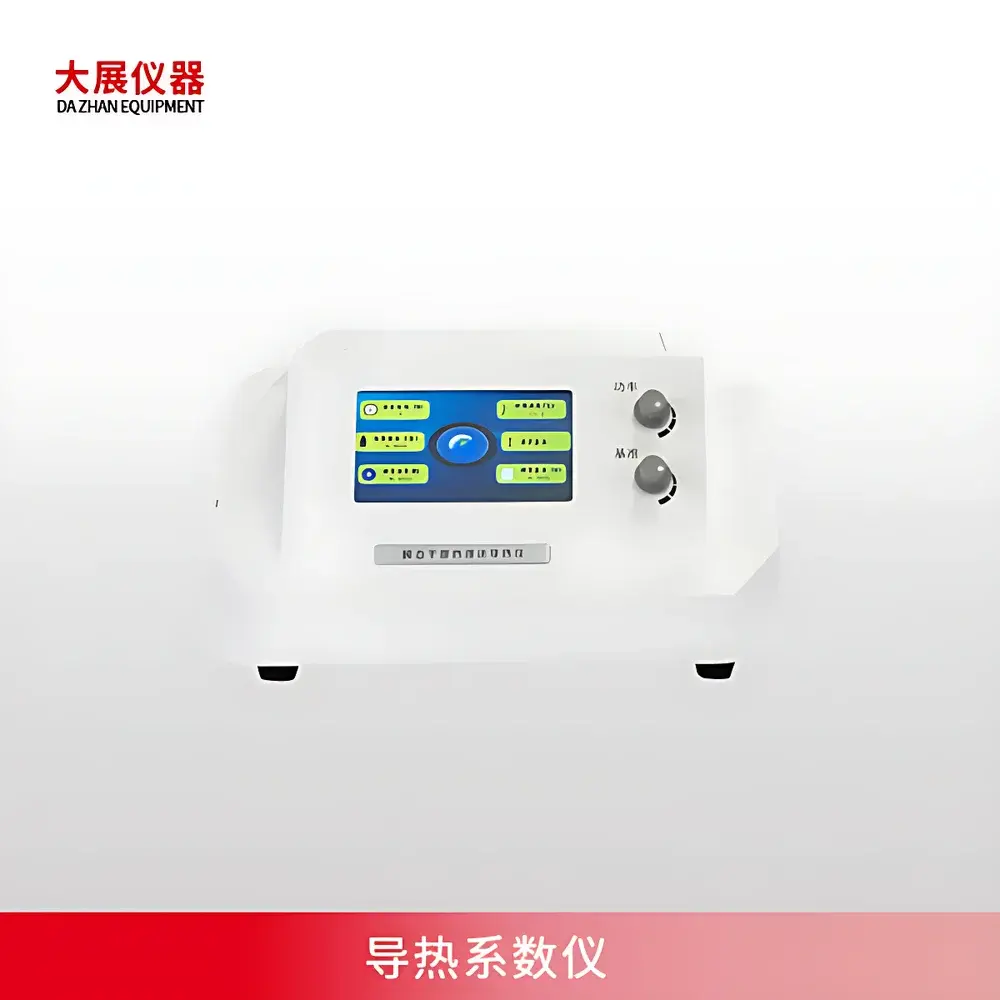
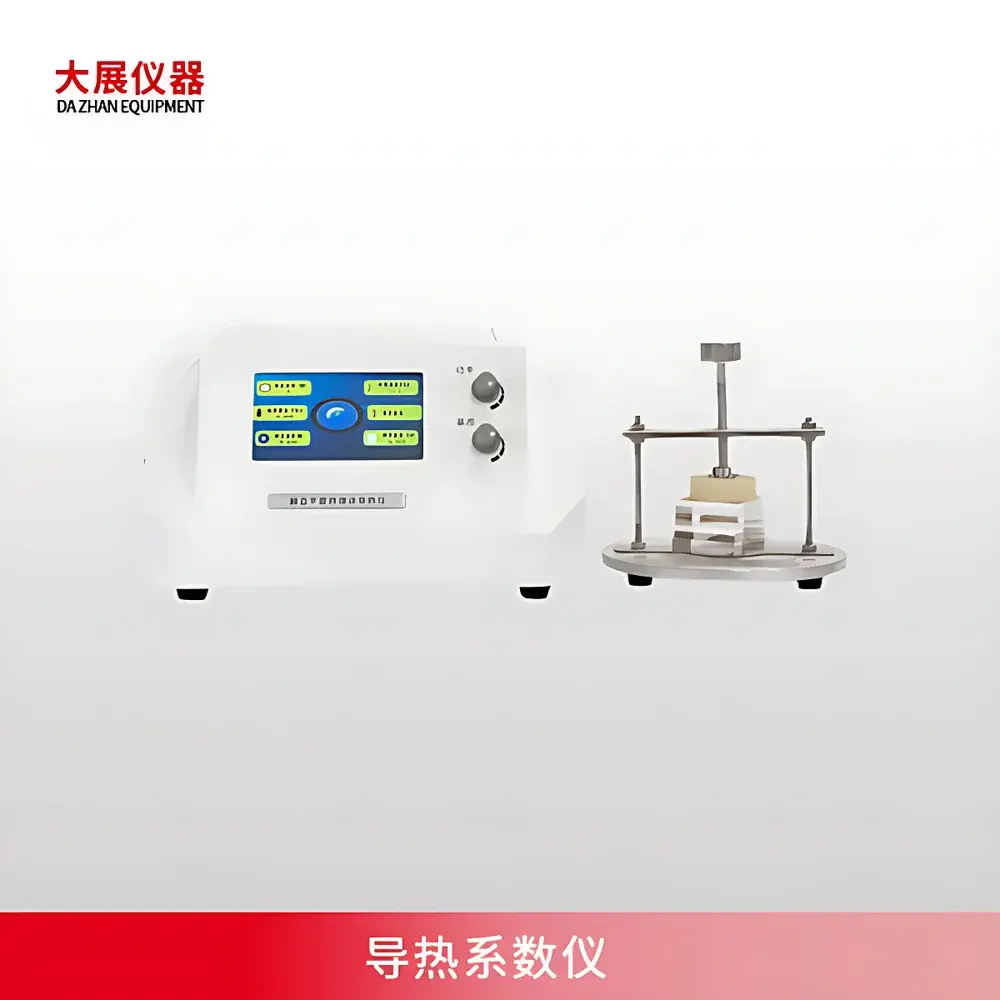
Nanjing Dazhan DZDR-S Transient Plane Source (TPS) Thermal Conductivity Analyzer
| Brand | Nanjing Dazhan |
|---|---|
| Origin | Jiangsu, China |
| Manufacturer Type | Direct Manufacturer |
| Instrument Type | Transient Plane Source Method |
| Test Sample Capacity | Single sample per measurement |
| Test Environment | Ambient temperature |
| Thermal Conductivity Range | 0.0001–300 W/(m·K) |
| Accuracy | ±3% |
| Repeatability | ≤3% |
| Sample Forms | Gels, liquids, powders, coatings, thin films, thermal insulation materials |
| Probe Options | 7.5 mm, 15 mm, and 50 mm diameter probes |
| Measurement Time | 5–160 s (user-configurable) |
| Operating Temperature Range | Room temperature to 130 °C |
| Power Supply | AC 220 V, <500 W |
Overview
The Nanjing Dazhan DZDR-S Transient Plane Source (TPS) Thermal Conductivity Analyzer is a precision instrument engineered for direct, contact-based measurement of thermal conductivity across a broad spectrum of material states—including solids, liquids, gels, powders, coatings, and thin-film composites. It operates on the transient plane source principle, wherein a sandwich-structured sensor—comprising dual-spiral nickel or platinum alloy heating elements embedded in a thin Kapton or polyimide film—acts simultaneously as both heat source and resistance thermometer. Upon application of a constant current pulse, the sensor induces a controlled temperature rise in the adjacent material; the resulting time-dependent voltage response is recorded with high temporal resolution and analyzed using analytical solutions to Fourier’s heat conduction equation under transient boundary conditions. This method eliminates systematic errors associated with interfacial contact resistance, making it particularly suitable for low-conductivity insulators, heterogeneous composites, and soft or irregularly shaped samples where traditional steady-state techniques (e.g., guarded hot plate or laser flash) face significant limitations in reproducibility and setup complexity.
Key Features
- Direct TPS-based measurement with no requirement for calibration standards or reference materials—enabling absolute determination of thermal conductivity.
- Configurable measurement duration from 5 to 160 seconds, optimized per sample thermal diffusivity to balance signal-to-noise ratio and test throughput.
- Three interchangeable probe sizes (7.5 mm, 15 mm, and 50 mm diameter) support scalable testing—from micro-scale lab samples to industrial-sized insulation panels—with corresponding minimum sample dimension guidelines ensuring lateral heat loss minimization.
- Non-destructive testing protocol preserves sample integrity; specimens may be reused across multiple measurements without structural alteration or thermal degradation.
- Integrated ARM-based microprocessor control architecture delivers real-time data acquisition, onboard signal conditioning, and embedded numerical inversion algorithms compliant with ISO 22007-2:2015 Annex A for TPS methodology.
- High-resolution analog-to-digital conversion (≥24-bit) ensures sub-millikelvin thermal resolution and robust noise rejection during low-power excitation.
- Modular sample stage accommodates variable thicknesses and surface topographies; optional accessories include standardized powder containment cells and liquid sample cups with thermal equilibration lids.
Sample Compatibility & Compliance
The DZDR-S supports heterogeneous sample forms without requiring machining, pressing, or coating—critical for R&D workflows involving fragile aerogels, phase-change slurries, or anisotropic polymer composites. Validated use cases include ASTM C1113 (standard test method for thermal conductivity of refractory materials), ISO 22007-2 (plastics—determination of thermal conductivity and thermal diffusivity), and GB/T 32064-2015 (Chinese national standard for thermal conductivity measurement of building insulation materials). All firmware and measurement logic are designed to meet GLP documentation requirements, supporting audit-ready metadata logging—including operator ID, environmental ambient reading, probe serial number, and timestamped raw voltage vs. time arrays.
Software & Data Management
The instrument interfaces via USB 2.0 with proprietary Windows-based analysis software featuring automated curve fitting, multi-probe cross-validation, and export capabilities to CSV, Excel, and XML formats. Software modules support batch processing, statistical trending (mean, SD, CV%), and generation of thermal conductivity vs. temperature plots when coupled with optional external oven integration (up to 130 °C). Audit trails comply with FDA 21 CFR Part 11 requirements for electronic records and signatures, including user authentication, change history, and immutable result archiving.
Applications
- Quality assurance of thermal interface materials (TIMs) in electronics packaging and battery module design.
- Rapid screening of novel insulating aerogels, vacuum-insulated panels (VIPs), and nanostructured foams for building envelope applications.
- Thermal property mapping of layered thin-film stacks used in flexible optoelectronics and photovoltaic encapsulation.
- Characterization of phase-change materials (PCMs) and colloidal nanofluids for thermal energy storage systems.
- Validation of computational models (e.g., finite element analysis of heat transfer paths) with experimental benchmark data.
FAQ
What sample preparation is required prior to testing?
No specialized preparation is needed. Solid samples require only two parallel surfaces of sufficient flatness and dimensions ≥2× probe diameter in length/width. Powders and liquids are loaded into supplied containment vessels; gels and pastes are tested in situ with minimal handling.
Can the DZDR-S measure anisotropic materials?
Yes—by orienting the probe normal to the direction of interest and applying appropriate geometric corrections during post-processing, directional thermal conductivity components can be resolved for layered or fiber-reinforced composites.
Is calibration traceable to national standards?
While the TPS method is inherently absolute, optional NIST-traceable validation kits (e.g., certified graphite or Pyroceram reference discs) are available for periodic performance verification.
Does the system support automated temperature ramping?
The base configuration operates at ambient temperature; integration with external programmable ovens enables isothermal stepwise or continuous thermal profiling up to 130 °C.
How is data integrity ensured during long-term deployment?
All measurements store full-resolution time-series voltage data alongside metadata. Software enforces role-based access control, digital signature logging, and encrypted local database backups—fully aligned with ISO/IEC 17025 and GMP laboratory practices.



