
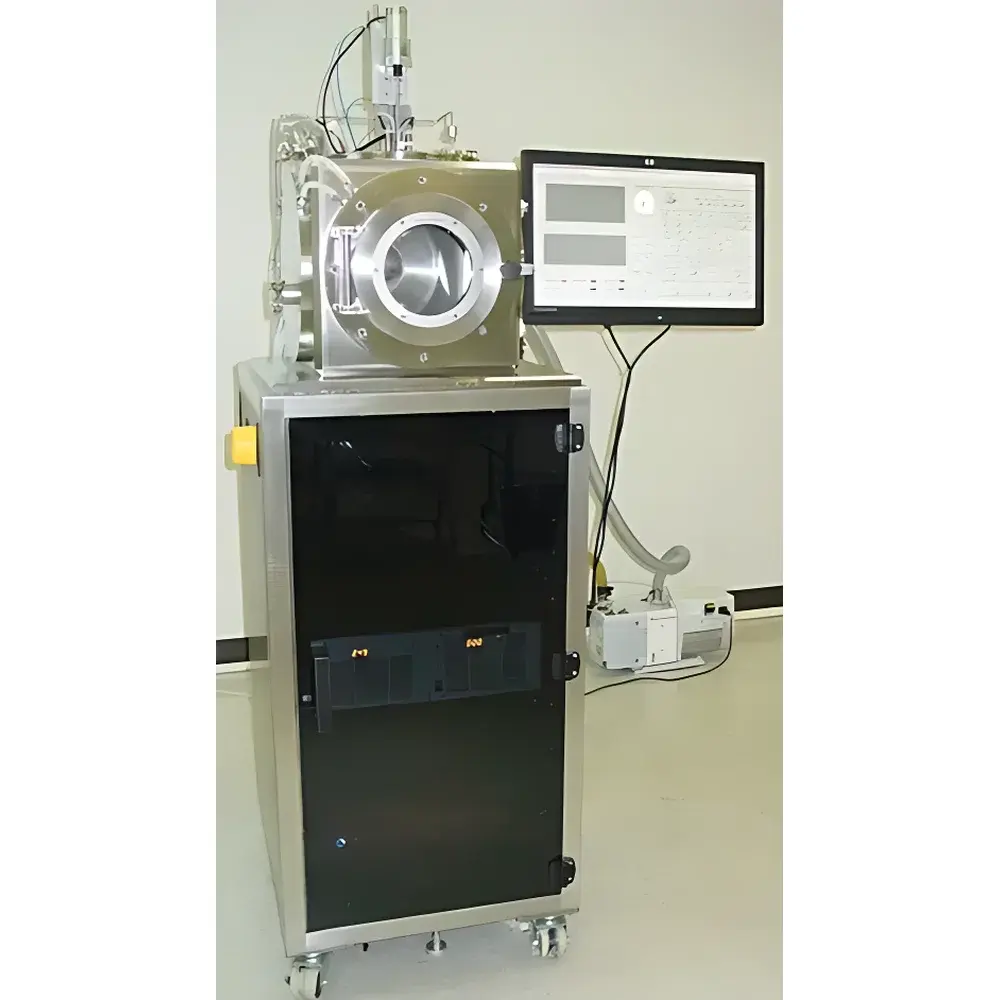
Nano-Master NTE-3500 (M) Thermal Evaporation System
| Brand | Nano-Master |
|---|---|
| Origin | USA |
| Manufacturer Type | Original Equipment Manufacturer (OEM) |
| Product Category | Imported Equipment |
| Model | NTE-3500 (M) |
| Price Range | USD 110,000 – 140,000 |
Overview
The Nano-Master NTE-3500 (M) Thermal Evaporation System is a compact, vertically oriented, PC-controlled thin-film deposition platform engineered for high-precision thermal evaporation of metals and organic materials under high vacuum conditions. Based on resistive heating principles—where electric current passes through tungsten or molybdenum filaments or crucibles to generate localized high temperatures—the system enables controlled vaporization of source materials, followed by condensation onto substrates in line-of-sight geometry. Designed for R&D laboratories and pilot-scale production environments, the NTE-3500 (M) integrates a robust stainless steel or aluminum vacuum chamber, integrated turbomolecular pumping, and a modular architecture shared with Nano-Master’s sputtering platforms (e.g., NSC-3500). This common platform ensures mechanical, electrical, and software interoperability—allowing seamless integration of plasma pre-cleaning, substrate heating, rotation, tilt, multi-source sequential/simultaneous evaporation, and in-situ quartz crystal microbalance (QCM) thickness monitoring—all without breaking vacuum. Its vertical orientation places the substrate holder above the evaporation sources, enabling downward-facing sample mounting, which improves particle-free deposition and minimizes shadowing effects for uniform film coverage on flat wafers and irregular substrates.
Key Features
- Compact vertical configuration with footprint optimized for limited cleanroom space
- Dual-source capability with independent control of two resistively heated crucibles
- 2 kVA solid-state RMS current controller—providing continuous, non-phase-chopped power regulation for precise thermal stability
- Real-time closed-loop deposition rate control via QCM feedback, dynamically adjusting RMS current to maintain constant evaporation velocity
- Substrate stage with motorized rotation (0–60 rpm), programmable tilt (±15°), and optional resistive heating (up to 300 °C)
- Integrated quartz crystal thickness monitor (Inficon XTM/2 or equivalent) with ±0.1 Å resolution and real-time rate/duration logging
- LabVIEW-based control interface supporting automated recipe execution, parameter logging, and full I/O traceability
- Vacuum architecture: base pressure ≤5×10⁻⁸ Torr (with cryo/turbo pump); process pressure range 1×10⁻⁷–1×10⁻⁵ Torr
- Compatible with standard bell jar, aluminum, or stainless steel chambers; optional load-lock and robotic sample handling
Sample Compatibility & Compliance
The NTE-3500 (M) accommodates substrates up to 200 mm (8-inch) diameter wafers or 7-inch square plates, including silicon, glass, fused silica, flexible polymers, and metallized foils. Substrate mounting utilizes kinematic clamping with thermal isolation to minimize conductive heat loss during heated depositions. The system supports ASTM F1592-21 (Standard Guide for Thin-Film Thickness Measurement by Quartz Crystal Microbalance), ISO 14644-1 (cleanroom classification), and aligns with GLP/GMP documentation requirements when configured with audit-trail-enabled LabVIEW software and electronic signature modules compliant with FDA 21 CFR Part 11. All vacuum components meet ASME BPE surface finish standards (Ra ≤ 0.4 µm) where applicable, and electrical subsystems conform to UL 61010-1 and CE EN 61326-1 for laboratory instrumentation safety and EMC.
Software & Data Management
Control and data acquisition are fully managed via a Windows-based LabVIEW application with deterministic real-time loops and synchronized hardware triggering. The software provides: (i) multi-step deposition recipes with conditional logic (e.g., “evaporate Source A until 50 nm, then switch to Source B at 0.3 nm/s”); (ii) live plotting of deposition rate, thickness, current/voltage/RMS temperature, and vacuum status; (iii) automatic generation of timestamped CSV and TDMS files containing all analog/digital channel histories; (iv) user-level access control with role-based permissions; and (v) optional integration with LIMS or MES systems via TCP/IP or OPC UA. Raw sensor data—including thermocouple (Type K) readings from crucible base, RMS voltage/current waveforms, and QCM harmonic shifts—is stored with metadata (operator ID, batch ID, chamber history) to support full traceability per ISO/IEC 17025 calibration requirements.
Applications
The NTE-3500 (M) serves critical roles across academic, industrial, and government research domains: fabrication of OLED and OPV active layers (Alq₃, NPB, LiF, Ag, Al); metallization of MEMS/NEMS devices (Cr/Au, Ti/Pt, NiFe); optical interference coatings (MgF₂, SiO₂, Ta₂O₅); seed-layer deposition for subsequent electroplating; and fundamental studies of nucleation kinetics and interfacial adhesion in bilayer metal-organic heterostructures. Its dual-source architecture enables co-evaporation of alloys (e.g., CuInGaSe₂ precursors) or graded-composition films. When paired with optional plasma etch modules, it supports in-situ surface activation prior to deposition—reducing interfacial contamination and improving film adhesion on low-energy surfaces such as PDMS or PET.
FAQ
What vacuum level can the NTE-3500 (M) achieve, and what pumping configuration is recommended?
With a standard 300 L/s turbomolecular pump and cryogenic backing, the system achieves ≤5×10⁻⁸ Torr base pressure. Optional cryopumping extends performance to ≤1×10⁻⁹ Torr for ultra-low-contamination organic deposition.
Can the system deposit temperature-sensitive organic materials without decomposition?
Yes—via precise RMS current modulation and real-time QCM feedback, deposition rates as low as 0.01 nm/s are achievable, minimizing thermal shock and enabling gentle sublimation of fragile molecules (e.g., pentacene, C₆₀).
Is remote operation and monitoring supported?
The LabVIEW interface includes built-in VNC-compatible server mode and REST API endpoints for third-party SCADA integration, allowing secure off-site supervision and alarm notification via email/SNMP.
How does the solid-state current control differ from traditional variac-based systems?
Unlike phase-angle-controlled autotransformers—which introduce harmonic distortion and thermal lag—the NTE-3500 (M) uses zero-crossing synchronized MOSFET switching to deliver true RMS current with <10 ms response time, enabling stable thermal regulation even during rapid ramping.
What maintenance intervals are recommended for the crucible heater assembly?
Crucible elements require inspection every 200 operational hours; tungsten boats typically last 50–100 cycles depending on material reactivity and peak temperature. Full preventive maintenance—including O-ring replacement and gauge calibration—is advised every 12 months or 1,000 pump-hours.



