
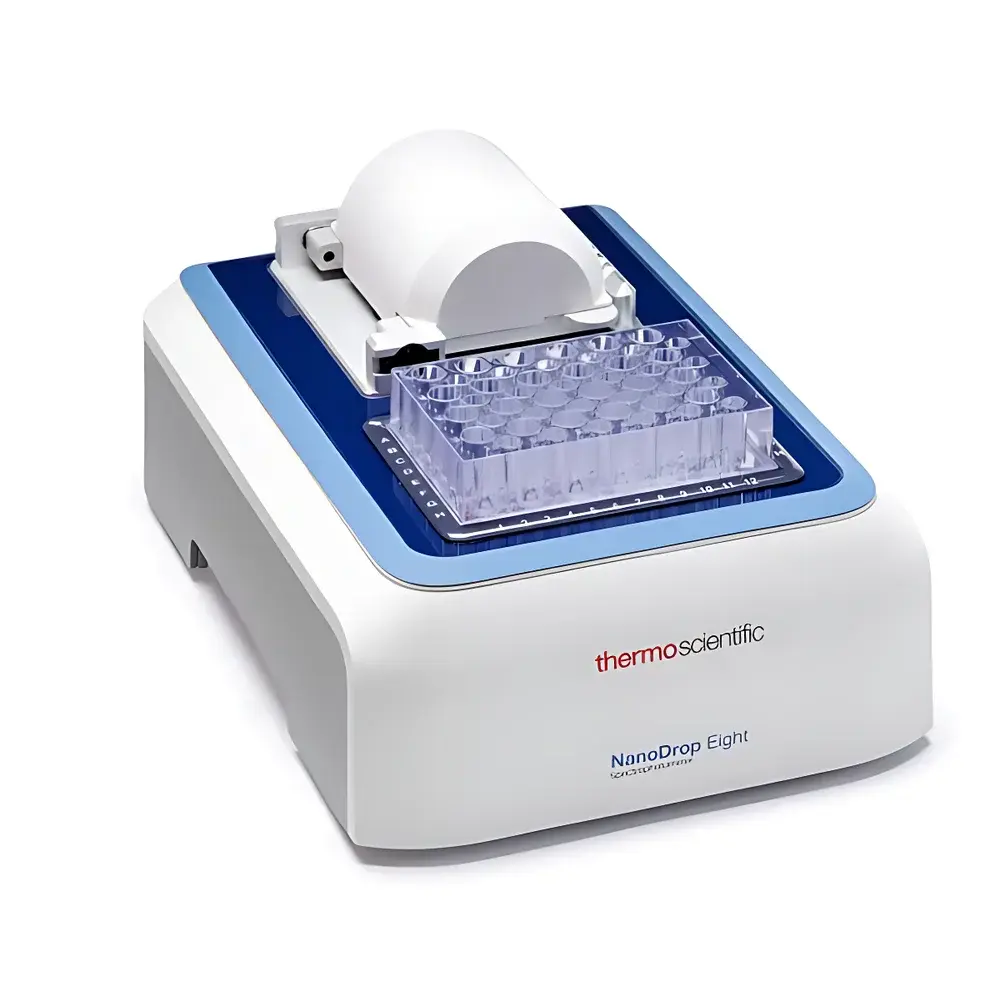
NanoDrop™ Eight UV-Vis Spectrophotometer
| Brand | Thermo Fisher Scientific |
|---|---|
| Origin | USA |
| Manufacturer Type | Original Equipment Manufacturer (OEM) |
| Product Origin | Imported |
| Model | NanoDrop Eight |
| Optical Design | Dual-beam |
| Detector | CCD Array |
| Wavelength Range | 190–850 nm |
| Wavelength Automation | Fully Automatic |
| Spectral Bandwidth | ≤1.8 nm |
| Wavelength Accuracy | ±1 nm |
| Stray Light | ≤0.01% T |
Overview
The NanoDrop™ Eight UV-Vis Spectrophotometer is an advanced, 8-channel microvolume spectrophotometer engineered for high-throughput nucleic acid and protein quantification in regulated and research-intensive laboratory environments. Leveraging dual-beam optical architecture with a high-resolution CCD array detector, it delivers precise absorbance measurements across a broad spectral range (190–850 nm), enabling reliable quantification of dsDNA, RNA, oligonucleotides, and proteins—including IgG—without dilution. Its microvolume measurement capability (0.5–2 µL sample volume) eliminates the need for cuvettes and minimizes reagent consumption, while the integrated Acclaro Sample Intelligence technology provides real-time identification and algorithmic correction of common contaminants—including phenol, guanidine, EDTA, and residual solvents—that otherwise distort A260/A280 ratios and compromise downstream assay fidelity.
Key Features
- 8-channel parallel measurement architecture for simultaneous analysis of up to eight samples—reducing total assay time by >85% compared to single-channel systems
- Dual-beam optical path with real-time reference compensation, ensuring stability against lamp drift and environmental fluctuations
- CCD-based detection system with <1.8 nm spectral bandwidth and ±1 nm wavelength accuracy—meeting ISO 8579 and ASTM E275 validation criteria for UV-Vis instrumentation
- Acclaro Contaminant Identification Engine: automatically detects and corrects for up to 12 common co-purified impurities in nucleic acid and protein workflows
- Ergonomic base array aligned perpendicular to instrument front panel—optimized for both left- and right-handed users with magnetic pipette guide rails
- Integrated position-indicating LED illumination per sample location—preventing operator error during high-throughput runs
- Auto-Blank and Auto-Measure functions triggered upon arm closure—enabling walk-away operation in automated liquid handling integrations
Sample Compatibility & Compliance
The NanoDrop Eight supports native, undiluted samples including crude lysates, column eluates, and purified preparations. It is validated for use with dsDNA (0.2–10,000 ng/µL), RNA (0.2–5,000 ng/µL), and IgG (0.05–145 mg/mL). All measurement applications—including A260, A280, A230, and ratio-based purity assessment—are compliant with ISO/IEC 17025:2017 requirements for testing laboratories. Optional Thermo Scientific™ SciVault™ software enables full 21 CFR Part 11 compliance, including role-based user access control, electronic signatures, immutable audit trails, and secure data export formats compatible with LIMS and ELN systems. IQ/OQ documentation packages and on-site qualification services are available to support GMP/GLP-regulated environments.
Software & Data Management
The embedded NanoDrop Eight Software v3.x provides intuitive workflow-driven interface with preconfigured methods for nucleic acid QC, protein quantitation (A280, BCA, Bradford), and custom assay development. Data integrity is enforced via timestamped, non-editable result logs stored locally or exported as CSV, PDF, or XML. When paired with SciVault, the system implements cryptographic hashing of all measurement records, enforces password complexity policies, and maintains granular audit logs covering user logins, method modifications, and result exports. Centralized deployment allows administrators to manage permissions and consolidate audit trails from multiple instruments across distributed lab sites—ensuring alignment with FDA, EMA, and PMDA regulatory expectations.
Applications
- High-throughput QC of plasmid preps, CRISPR gRNA, and mRNA vaccine intermediates in biomanufacturing
- Routine verification of NGS library concentration and purity prior to sequencing
- Stability studies of therapeutic antibodies under accelerated stress conditions
- Biobank sample triage—rapid assessment of nucleic acid integrity and contamination status prior to cryopreservation or archival storage
- Clinical trial sample screening where trace-level contaminant interference must be ruled out before PCR or digital PCR analysis
- Academic core facility operations requiring multi-user access, instrument sharing, and reproducible SOP execution
FAQ
Does the NanoDrop Eight require calibration with NIST-traceable standards?
Yes—factory calibration is performed using NIST-traceable holmium oxide and didymium filters. Users may perform optional performance verification using supplied quartz cuvette standards per ASTM E275.
Can the instrument be integrated into robotic liquid handling platforms?
Yes—the USB and Ethernet interfaces support bidirectional communication via standard SCPI commands; Auto-Measure activation is hardware-triggered upon arm closure, enabling seamless integration with third-party automation systems.
Is Acclaro technology applicable to modified nucleic acids (e.g., fluorophore-labeled oligos)?
Acclaro is optimized for native dsDNA, ssDNA, RNA, and standard proteins. For heavily modified analytes, users should validate recovery and correction accuracy using spiked controls prior to routine implementation.
What data security protocols does SciVault enforce for remote access?
SciVault employs TLS 1.2+ encryption for all network communications, enforces multi-factor authentication (MFA) for privileged accounts, and isolates audit trail databases from operational measurement storage per IEC 62443-3-3 guidelines.
Are IQ/OQ documents provided in English and compliant with EU Annex 15?
Yes—Thermo Fisher supplies fully bilingual (English/Spanish) IQ/OQ kits aligned with Annex 15 principles, including risk-based test scripts, acceptance criteria, and evidence templates suitable for MHRA and EMA inspections.





