
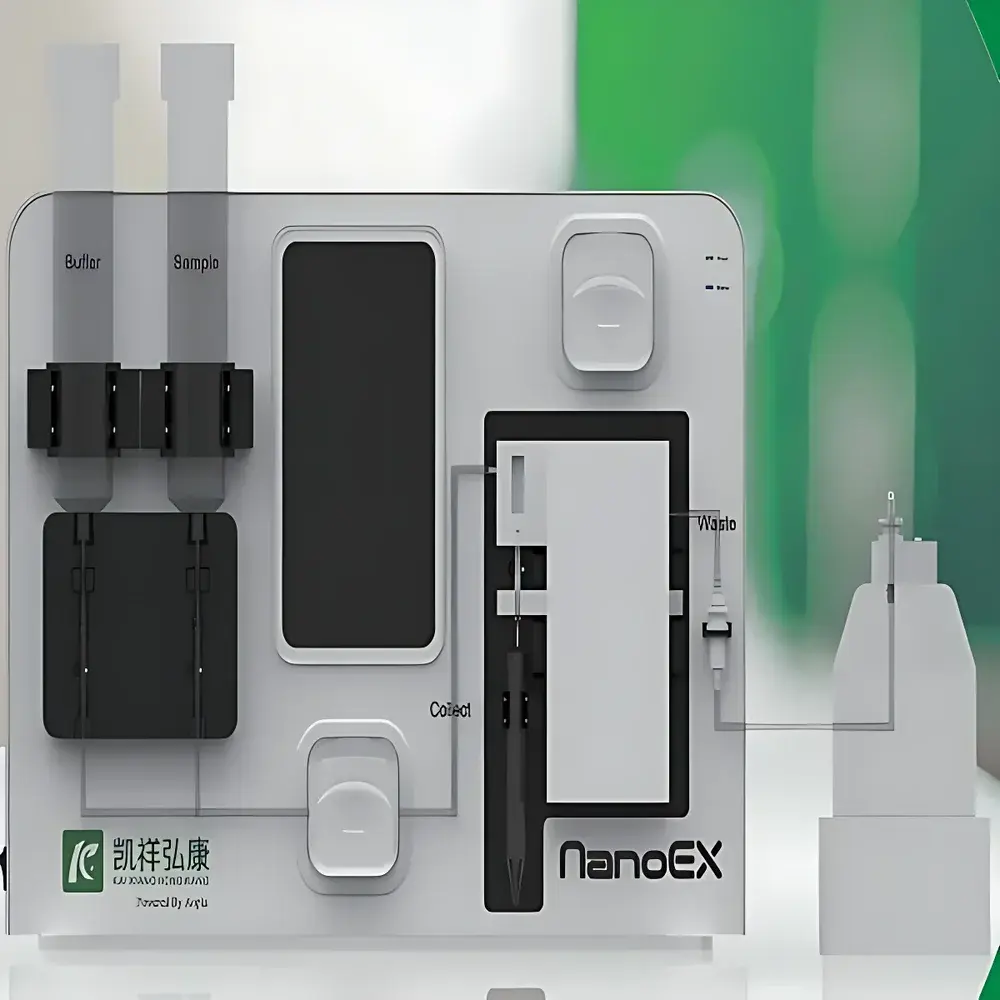
NanoEX NanoPore Exosome Purification System
| Brand | NanoEX |
|---|---|
| Origin | Beijing, China |
| Manufacturer Type | Authorized Distributor |
| Country of Origin | China |
| Model | NanoEX |
| Price Range | USD 70,000 – 140,000 |
| Dimensions | 537 × 260 × 363 mm |
| Weight | 10 kg |
| Throughput | Up to 168 mL/h |
| Sample Volume Range | 100 µL – 500 mL |
| Display | Integrated TFT touchscreen |
| Sterilization Compatibility | Autoclavable components |
| Membrane Compatibility | Interchangeable asymmetric nanopore membrane (ANM) cassettes |
Overview
The NanoEX NanoPore Exosome Purification System is an automated, closed-loop benchtop platform engineered for high-fidelity isolation of extracellular vesicles (EVs), specifically exosomes, from complex biological matrices. It leverages asymmetric nanopore membrane (ANM) filtration — a size- and charge-selective nanofiltration principle distinct from conventional tangential flow filtration (TFF), ultrafiltration (UF), or polymer-based precipitation methods. Unlike centrifugation-dependent techniques that induce shear stress and aggregation, or SEC columns limited by low recovery and column fouling, the NanoEX system applies precisely controlled transmembrane pressure and crossflow dynamics across chemically inert, low-protein-binding ANM cassettes. This enables gentle, scalable separation based on hydrodynamic diameter (typically 30–150 nm) while preserving native exosome morphology, surface marker integrity (e.g., CD63, CD81, TSG101), and functional cargo (miRNA, proteins). Designed for reproducible GMP-aligned workflows, it supports both discovery-phase research and translational process development in academic core facilities, biotech R&D labs, and contract development and manufacturing organizations (CDMOs).
Key Features
- Fully automated, unattended operation: Predefined or user-customizable protocols initiate and complete purification without manual intervention — ideal for overnight runs and multi-day batch processing.
- Multi-matrix compatibility: Validated for urine, saliva, tears, cerebrospinal fluid (CSF), aqueous humor, plasma, serum, breast milk, cell culture supernatants (adherent and suspension), bacterial lysates, plant extracts, and tissue homogenates — minimizing method re-validation across sample types.
- Modular ANM cassette architecture: Interchangeable, single-use cassettes with defined pore asymmetry (surface pore size <50 nm; support layer >200 nm) ensure consistent flux, reduced membrane fouling, and minimized exosome adhesion or deformation.
- Real-time process monitoring: Integrated TFT touchscreen displays active protocol name, elapsed time, estimated completion time, transmembrane pressure (TMP), and flow rate — all logged with timestamped metadata.
- Biosafety-integrated design: Compact footprint (537 × 260 × 363 mm) and autoclavable fluid path components allow seamless placement inside Class II biosafety cabinets (BSCs), eliminating open-handling risks during loading/unloading.
- Scalable throughput: Achieves up to 168 mL/h processing speed with maintained exosome recovery (>85% vs. ultracentrifugation benchmark) and purity (≥92% particle-to-protein ratio by NTA + BCA assay).
Sample Compatibility & Compliance
The NanoEX system accommodates input volumes ranging from 100 µL (e.g., micro-volume CSF or tear samples) to 500 mL (e.g., large-volume conditioned media), with no requirement for pre-clearing beyond standard 0.22 µm filtration. All wetted materials comply with USP Class VI biocompatibility standards and are free of leachables affecting downstream RNA integrity or functional assays. While not certified as a medical device, the system supports workflows aligned with ISO 20363:2021 (exosome characterization guidelines) and ASTM E3279-22 (standard practice for EV isolation reporting). Data audit trails, user access logs, and electronic signature support (via optional LIMS integration) facilitate adherence to GLP and 21 CFR Part 11 requirements where applicable.
Software & Data Management
The embedded control software provides intuitive protocol configuration, real-time parameter visualization, and exportable CSV/Excel logs containing pressure profiles, flow stability metrics, and cycle completion timestamps. No cloud dependency: all data remains locally stored on internal flash memory with optional USB export. Firmware updates are performed via secure signed packages. For enterprise deployment, RESTful API endpoints enable integration with laboratory information management systems (LIMS) and electronic lab notebooks (ELNs), supporting automated job scheduling and QC flagging based on predefined TMP deviation thresholds.
Applications
- Preclinical exosome biomarker discovery from minimally invasive biofluids (urine, saliva, tears)
- Manufacturing of clinical-grade exosome therapeutics under scalable, closed-system conditions
- Standardized EV isolation for single-vesicle analysis (cryo-EM, super-resolution imaging)
- Functional cargo loading studies requiring intact membrane topology and minimal protein corona disruption
- Comparative evaluation of EV subpopulations across disease models (e.g., neurodegenerative, oncologic, inflammatory)
- Process optimization for upstream bioreactor harvests and downstream formulation buffers
FAQ
What membrane specifications are supported by the NanoEX system?
The system accepts proprietary asymmetric nanopore membrane (ANM) cassettes with nominal surface pore sizes of 30 nm and 50 nm, each validated for specific sample classes and downstream applications (e.g., 30 nm for high-purity plasma-derived exosomes; 50 nm for rapid processing of cell culture supernatants).
Can the NanoEX be integrated into existing cleanroom or GMP environments?
Yes — its compact dimensions, absence of external venting, and autoclavable fluidic modules meet ISO 14644-1 Class 5 compatibility requirements when operated within a certified biosafety cabinet or laminar flow hood.
Is method transfer support available for regulatory submissions?
Comprehensive technical documentation — including IQ/OQ templates, validation protocols (recovery, repeatability, carryover), and raw data traceability reports — is provided to support IND-enabling studies and regulatory filings.
Does the system require consumables other than ANM cassettes?
No. The only required consumable is the sterile, single-use ANM cassette. No filters, columns, beads, or chemical reagents are needed — eliminating batch-to-batch variability and endotoxin risk.




