
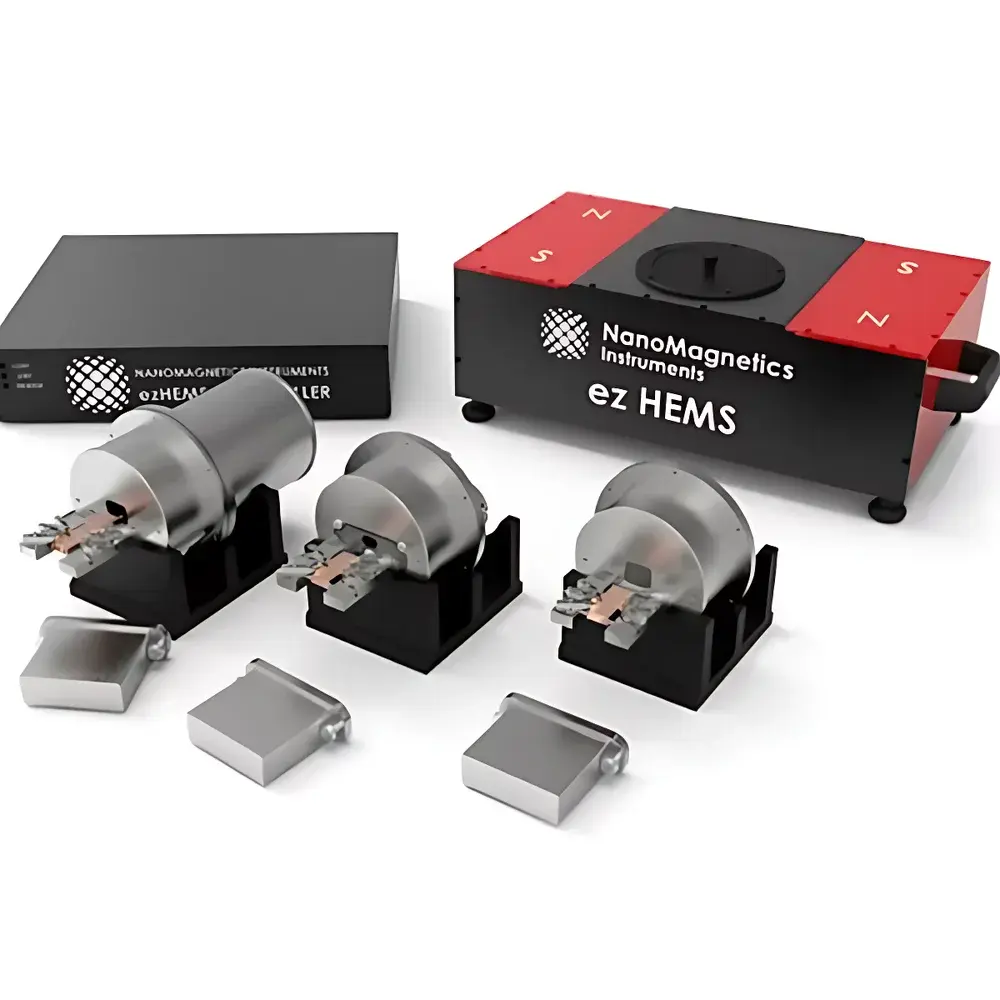


NanoMagnetics ezHEMS Compact Hall Effect Measurement System
| Brand | NanoMagnetics |
|---|---|
| Origin | UK |
| Model | ezHEMS |
| Instrument Type | Variable-Temperature Hall Effect System |
| Constant Current Source Range | ±2 nA to ±20 mA |
| Test Voltage | ±12 V |
| Maximum Voltage | ±12 V |
| Mobility Range | 1–10⁷ cm²/V·s |
| Resistivity Range | 10⁻⁴–10⁹ Ω·cm |
| Carrier Concentration Range | 10⁷–10²¹ cm⁻³ |
| Magnetic Field Options | 0.6 T or 1.0 T permanent magnets (±1.0 T adjustable option available) |
| Temperature Range | 4 K–800 K (with LT, RT, and HT measurement heads) |
| Minimum Detectable Hall Voltage | 0.10 µV |
| Sample Geometry Support | van der Pauw and Hall bar configurations |
| Sample Size | 5 mm × 5 mm to 15 mm × 15 mm, thickness < 2 mm |
| Temperature Control | Pt-100 sensor, 750 K heater, PID controller |
| Interface | USB |
| Software Platform | LabVIEW-based, Windows® compatible |
Overview
The NanoMagnetics ezHEMS Compact Hall Effect Measurement System is a fully integrated, benchtop-grade platform engineered for precise determination of fundamental electronic transport parameters in semiconductor, 2D material, and thin-film samples. Based on the classical Hall effect principle—where charge carriers experience a Lorentz force under orthogonal magnetic and electric fields—the system quantifies carrier type (n- or p-type), concentration, mobility, and electrical resistivity through simultaneous current injection, voltage sensing, and controlled magnetic field application. Unlike conventional cryostat-integrated setups, the ezHEMS employs modular, interchangeable measurement heads (LT, RT, HT) to cover a continuous temperature range from 4 K to 800 K, enabling high-reproducibility characterization across quantum, mesoscopic, and high-temperature regimes without hardware reconfiguration. Its architecture follows standardized Hall measurement protocols defined in ASTM F76–22 and ISO/IEC 17025-accredited methodologies, supporting both van der Pauw and Hall bar geometries with four-point probe compatibility.
Key Features
- Modular thermal architecture: Interchangeable Low-Temperature (LT), Room-Temperature (RT), and High-Temperature (HT) measurement heads—enabling seamless operation from 4 K (liquid nitrogen or cryocooler-compatible) to 800 K with ±0.2 K stability at low T and ±1 K at high T.
- Precision current sourcing: Bipolar constant-current source with programmable range from ±2 nA to ±20 mA (±100 mA optional), delivering sub-nA resolution and <0.02% linearity error over full scale.
- High-sensitivity voltage acquisition: Differential electrometer-grade inputs capable of resolving Hall voltages down to 0.10 µV, with 24-bit ADC resolution and noise floor <50 nV RMS (1 kHz bandwidth).
- Permanent magnet field options: Standard 0.6 T and 1.0 T NdFeB magnets; ±1.0 T tunable configuration available via motorized magnet translation stage, fully synchronized with software control.
- 3-axis micropositioning probe stage: Integrated XYZ motion (±5 mm travel, 1 µm repeatability) inside each measurement head, allowing precise alignment of four-point probes on irregular or small-area samples (5 × 5 mm to 15 × 15 mm, <2 mm thick).
- Minimalist cabling architecture: All inter-unit communication handled via two shielded multi-pin cables; host computer interface requires only a single USB 2.0 connection—reducing EMI susceptibility and simplifying lab integration.
Sample Compatibility & Compliance
The ezHEMS supports planar conductive and semiconducting materials including Si, GaAs, InSb, graphene, transition metal dichalcogenides (e.g., MoS₂, WSe₂), perovskite thin films, and oxide heterostructures. It complies with standard sample preparation requirements for Hall metrology: uniform thickness, ohmic contact formation (Au/Ti, Cr/Au, or Ni/Ge/Au metallization recommended), and geometric symmetry for van der Pauw validity (RAB,CD/RBC,DA ≤ 1.05). The system satisfies traceability requirements under ISO/IEC 17025 for calibration of resistance standards and meets essential criteria for GLP-compliant electronic property reporting. Optional audit-trail logging and user-access controls align with FDA 21 CFR Part 11 readiness when deployed in regulated R&D environments.
Software & Data Management
Control and analysis are executed via a native LabVIEW-based application running on Windows® 10/11 (64-bit). The software implements automated measurement sequences—including I–V sweeps, field-dependent Hall scans, and temperature ramping—with real-time parameter feedback and live plot overlays. Raw data (voltage, current, field, temperature, time) are saved in HDF5 format with embedded metadata (sample ID, operator, date/time, instrument configuration, calibration coefficients). Export modules support CSV, MATLAB (.mat), and Origin-compatible formats. Advanced analysis tools include automatic carrier type identification, mobility vs. temperature fitting (Arrhenius, variable-range hopping models), and resistivity tensor decomposition for anisotropic samples. All software updates and calibration files are digitally signed and version-controlled via NanoMagnetics’ secure customer portal.
Applications
- Characterization of emerging 2D semiconductors and topological insulators—quantifying gate-tunable carrier density and anomalous Hall contributions.
- Process development monitoring for epitaxial growth (MBE, CVD) and post-deposition annealing—tracking mobility degradation due to defect formation or interfacial scattering.
- Quality assurance of thermoelectric materials (e.g., Bi₂Te₃, SnSe)—correlating Seebeck coefficient trends with Hall-derived carrier concentration.
- Fundamental studies of metal–insulator transitions, Mott physics, and carrier localization in correlated oxides (e.g., VO₂, La₁₋ₓSrₓMnO₃).
- Validation of TCAD simulation inputs—providing experimentally grounded values for doping profiles, interface trap densities, and scattering mechanisms.
FAQ
What temperature ranges does the ezHEMS support, and how is cooling/heating achieved?
The system operates continuously from 4 K to 800 K using three dedicated heads: LT (cryogen-free or LN₂-cooled), RT (ambient-stabilized), and HT (resistive heating with PID-controlled 750 K heater and Pt-100 feedback).
Can the ezHEMS measure anisotropic or layered materials?
Yes—by rotating the sample stage (optional add-on) or applying field orientation control (in ±1.0 T tunable configuration), the system supports angular-dependent Hall measurements for effective mass tensor extraction.
Is the software compliant with 21 CFR Part 11 for regulated laboratories?
The core software supports electronic signatures, audit trails, and role-based access control; full Part 11 compliance requires deployment within a validated IT environment and documented SOPs per institutional QA policy.
What sample contact configurations are supported?
Standard four-point collinear and van der Pauw geometries are fully automated; Hall bar layouts require manual probe placement but are supported via coordinate referencing in the software GUI.
Are calibration standards included with the system?
A NIST-traceable Si reference wafer (known resistivity/mobility at 300 K) is supplied with initial commissioning; annual recalibration services and uncertainty budgets are available through NanoMagnetics’ UKAS-accredited calibration laboratory.





