
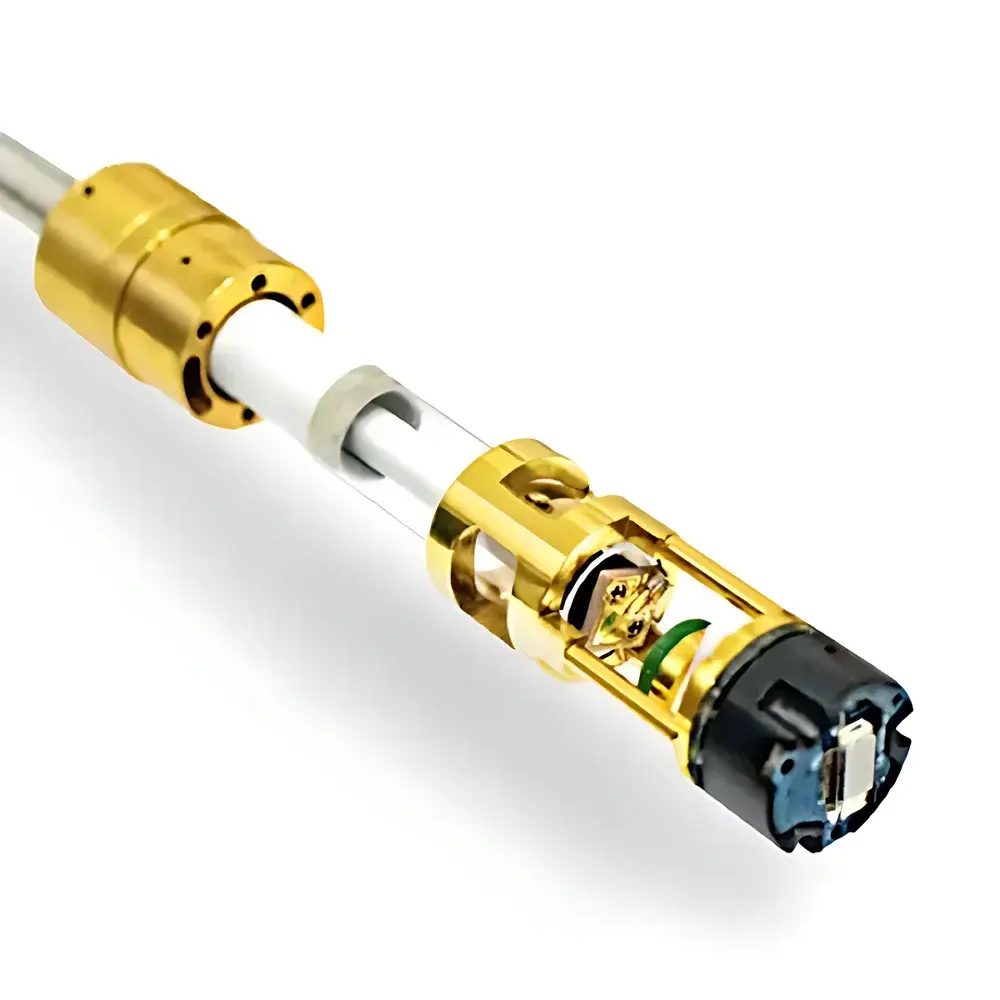
NanoMagnetics LT-AFM/MFM Cryogen-Free Low-Temperature Atomic Force and Magnetic Force Microscope
| Brand | NanoMagnetics |
|---|---|
| Origin | United Kingdom |
| Model | LT-AFM/MFM |
| Cooling System | Cryogen-Free Closed-Cycle Cryostat |
| Temperature Range | 1.5 K – 400 K (base temperature ≤1.5 K) |
| Maximum Magnetic Field | 20 T |
| Vibration Isolation | Active + Passive Vibration-Free Design |
| Operation Mode | Fully Dry, Helium-Free |
| Sample Stage Travel (Z) | 10 mm |
| Sample Stage Travel (XY) | Ø3 mm |
| Sample Positioning Resolution | 2 µm (capacitive encoder) |
| Sample Dimensions (max) | 15 × 15 × 5 mm |
| Electrical Interface | 5-pin sample holder (1 bias + 4 auxiliary channels) |
| Environmental Compatibility | UHV-compatible, exchange-gas capable, PPMS®-integrated, Evercool®-compatible, dilution refrigerator & He-3 system adaptable |
Overview
The NanoMagnetics LT-AFM/MFM is a high-stability, cryogen-free low-temperature scanning probe microscope engineered for nanoscale correlative imaging and quantitative property mapping under extreme thermal and magnetic conditions. Built upon a rigid, monolithic AFM platform, it integrates atomic force microscopy (AFM), magnetic force microscopy (MFM), scanning Hall probe microscopy (SHPM), electrostatic force microscopy (EFM), piezoresponse force microscopy (PFM), scanning spreading resistance microscopy (SSRM), and scanning tunneling microscopy (STM) within a single vacuum-compatible, vibration-isolated architecture. Its core measurement principle relies on dynamic or static cantilever deflection detection—combined with phase-sensitive lock-in amplification—to resolve topographic, magnetic, electrostatic, ferroelectric, and electronic transport contrasts at sub-nanometer spatial resolution. Designed specifically for condensed matter physics, quantum materials research, and spintronics development, the system operates across a continuous temperature range from 1.5 K to 400 K and supports magnetic fields up to 20 T—enabling studies of superconductivity, skyrmion dynamics, domain wall pinning, and emergent magnetoelectric coupling in van der Waals heterostructures and topological insulators.
Key Features
- Cryogen-free closed-cycle refrigeration: Eliminates liquid helium dependency while maintaining base temperatures ≤1.5 K and thermal stability <±10 mK over 24 h.
- Vibration-free mechanical design: Combines passive damping via granite optical table integration with active inertial cancellation, achieving sub-Å RMS displacement noise floor below 10 Hz.
- Multi-modal SPM capability: Seamless switching between AFM, MFM, SHPM, EFM, PFM, SSRM, and STM without realignment or hardware reconfiguration.
- High-field compatibility: Optimized for integration with superconducting magnets; field homogeneity >99.5% over 1 mm² scan area at 20 T.
- Precision sample positioning: Capacitive-encoded XY stage (Ø3 mm range) and stepper-driven Z approach (10 mm travel), enabling repeatable tip-sample engagement with 50–800 nm approach accuracy.
- Modular electrical interface: 5-pin sample holder supports DC bias, AC excitation, and four auxiliary signal lines—fully compatible with external lock-in amplifiers, impedance analyzers, and low-noise preamplifiers.
Sample Compatibility & Compliance
The LT-AFM/MFM accommodates samples up to 15 × 15 × 5 mm in dimension and interfaces directly with industry-standard cryogenic platforms including Quantum Design PPMS® and Evercool® systems. It maintains full functionality when integrated into dilution refrigerators or He-3 cryostats, provided mechanical clearance and wiring access are preserved. The vacuum chamber meets ISO-UHV Class 10⁻⁹ mbar specifications and supports both ultra-high vacuum (UHV) operation and controlled exchange-gas environments (e.g., He, N₂). All control electronics comply with IEC 61326-1 (EMC for laboratory equipment) and IEC 61010-1 (safety requirements for electrical equipment). Data acquisition protocols support audit-trail logging per GLP/GMP guidelines, and optional firmware modules enable 21 CFR Part 11–compliant electronic signatures and user-access controls.
Software & Data Management
Control and analysis are performed via NanoMagnetics’ proprietary SPM Suite v4.x—a modular, Python-extendable platform supporting real-time feedback loop optimization, multi-channel spectral acquisition, and synchronized field/temperature sweeps. The software provides native export to HDF5 and ASCII formats, ensuring interoperability with MATLAB, Python (NumPy/SciPy), and commercial packages such as Gwyddion and WSxM. All raw sensor data—including photodiode quadrants, lock-in outputs, and stage encoder signals—are time-stamped and stored with metadata (temperature, field, setpoint, gain, filter settings). Integrated scripting API allows automation of complex measurement sequences (e.g., field-cooled magnetization loops coupled with PFM hysteresis mapping), while built-in FFT and cross-correlation tools facilitate quantitative analysis of domain dynamics and noise spectra.
Applications
- Imaging vortex lattices and flux pinning in high-Tc superconductors at sub-Kelvin temperatures.
- Mapping stray field distributions from skyrmions, chiral domain walls, and antiferromagnetic order in MnSi, FeGe, and CrI₃ monolayers.
- Quantifying piezoelectric coefficients and polarization switching behavior in multiferroic thin films under simultaneous magnetic field and thermal cycling.
- Characterizing carrier concentration gradients and local Schottky barriers in 2D semiconductor heterojunctions using SSRM and Kelvin probe force microscopy (KPFM) extensions.
- Correlating magnetic domain evolution with structural strain fields via simultaneous MFM and AFM phase imaging during in situ thermal quenching.
FAQ
Is the LT-AFM/MFM compatible with existing PPMS® systems?
Yes—the system is mechanically and electrically designed for drop-in integration with Quantum Design PPMS® platforms, including Evercool® configurations where the compressor may be powered down during measurements.
What vacuum level is required for optimal MFM performance?
For high-sensitivity MFM and STM modes, an operating pressure ≤1×10⁻⁷ mbar is recommended; the chamber achieves base pressures <5×10⁻⁹ mbar with ion pump + titanium sublimation pump combination.
Can the system be upgraded to operate below 1 K?
While the standard configuration reaches 1.5 K, custom integration with adiabatic demagnetization refrigerators (ADR) or hybrid He-3/He-4 stages enables operation down to ~20 mK—subject to mechanical redesign and additional shielding validation.
Does the software support automated parameter sweeps across temperature and field?
Yes—SPM Suite includes a hierarchical sweep engine that coordinates synchronized ramping of cryostat temperature, magnet current, and SPM setpoints, with full error handling and pause/resume capability.
Are third-party probes supported?
All standard AFM/MFM cantilevers with reflective coatings (e.g., BudgetSensors, Nanoworld, Bruker) are compatible; SHPM and STM probes require custom mounting fixtures available upon request.





