
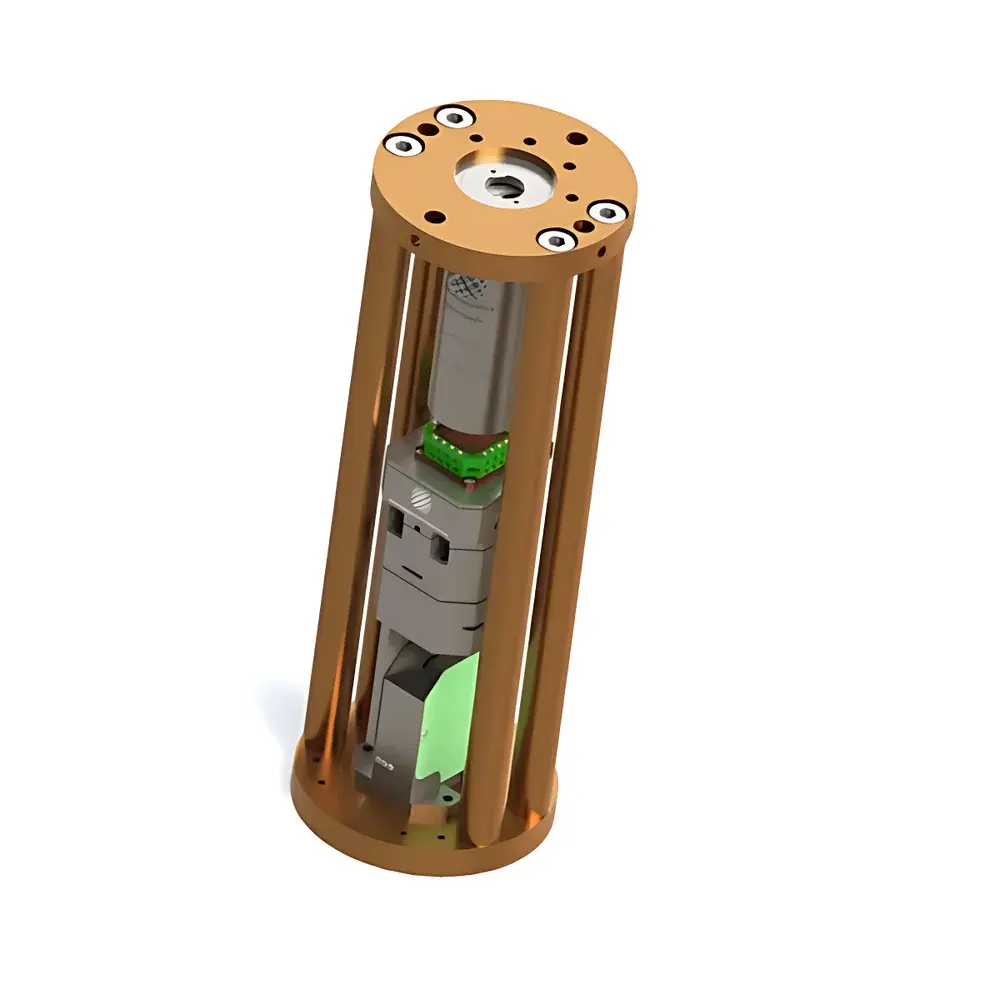
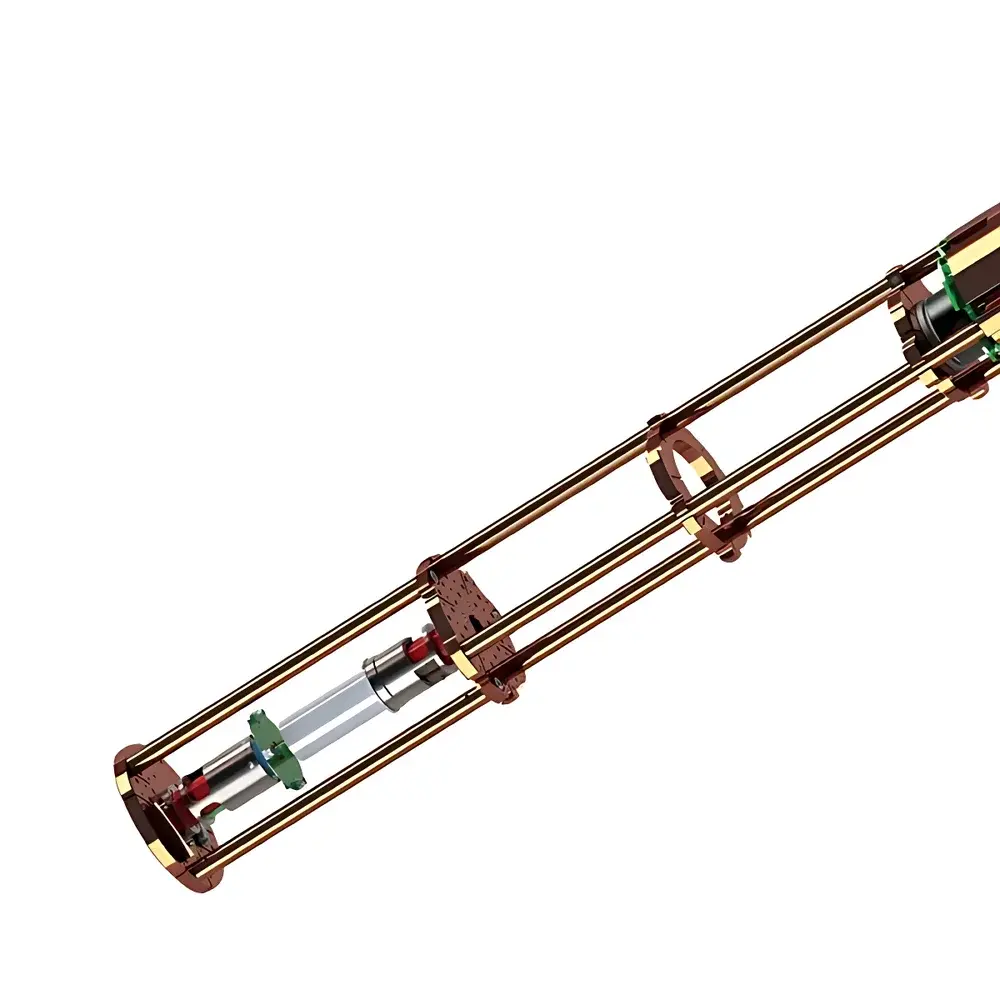
NanoMagnetics mK-CFM/RAMAN Cryogenic Confocal Raman Microscope
| Brand | NanoMagnetics |
|---|---|
| Origin | United Kingdom |
| Model | mK-CFM/RAMAN |
| Temperature Range | 10 mK – 300 K |
| Magnetic Field | Up to 31 T |
| Objective | 0.82 NA, 0.95 mm Working Distance APO Cryo-Objective |
| Scan Range (300 K) | 50 × 50 × 25 µm |
| Scan Range (4 K) | 30 × 30 × 15 µm |
| Coarse Approach Range | 6 × 6 × 12 mm (XYZ), Step Size: 50–700 nm |
| Closed-Loop Encoder Resolution | 200 nm |
| Fine Scan Range (300 K) | 7.5 µm |
| Fine Scan Range (4.2 K) | 1 µm |
| Max Sample Dimensions | 10 × 10 × 5 mm |
| Sample Holder | 8-pin electrical feedthrough |
| Environmental Compatibility | Ultra-high vacuum (UHV) or purged gas atmosphere |
| Cryostat Compatibility | Compatible with standard 50 mm cold-finger dilution refrigerators and most commercial cryogenic platforms |
Overview
The NanoMagnetics mK-CFM/RAMAN is a fully integrated cryogenic confocal Raman microscope engineered for high-spatial-resolution spectroscopic imaging under extreme physical conditions—specifically, temperatures down to 10 millikelvin and magnetic fields up to 31 tesla. Unlike conventional room-temperature Raman systems, this platform combines quantum-limited thermal stability with sub-micron mechanical precision to enable correlative nanoscale characterization of quantum materials. Its core architecture leverages confocal optical design with a high-numerical-aperture (0.82 NA), low-thermal-drift apochromatic objective optimized for cryogenic operation (0.95 mm working distance), ensuring diffraction-limited focusing across the full temperature range. The system operates within UHV or inert-gas-purged environments, minimizing thermal noise and surface contamination—critical for studying fragile quantum phases such as superconductivity, topological order, and correlated electron states in 2D materials like monolayer graphene.
Key Features
- Ultra-low-temperature capability: Stable operation from 10 mK to 300 K, calibrated and verified using primary thermometry standards traceable to the International Temperature Scale of 1990 (ITS-90).
- High-field magnet integration: Designed for seamless coupling with 31 T hybrid magnets (superconducting + resistive), with active field homogeneity compensation and real-time field monitoring via Hall probe feedback.
- Dual-stage scanning architecture: Combines coarse XYZ piezo-driven approach (6 × 6 × 12 mm range, 50–700 nm step resolution) with fine closed-loop piezoelectric scanners (200 nm encoder resolution) for reproducible positioning at sub-100 nm accuracy even at base temperature.
- Cryogenic optical path: All internal optics—including dichroics, filters, and fiber-coupled spectrometer interfaces—are mounted on thermally anchored stages to minimize drift-induced misalignment during thermal cycling.
- Electrical interfacing: 8-pin hermetic sample holder supports simultaneous DC/AC transport measurements, gate biasing, and low-noise current/voltage readout—enabling true multimodal correlative studies (Raman + transport + magneto-optics).
Sample Compatibility & Compliance
The mK-CFM/RAMAN accommodates samples up to 10 × 10 × 5 mm in volume, with mechanical and thermal mounting configurations compatible with industry-standard dilution refrigerator cold fingers (50 mm diameter). It meets ISO 14644-1 Class 5 cleanroom handling requirements for sample loading and has been validated for use in GLP-compliant laboratories conducting materials qualification per ASTM E2847 and ISO/IEC 17025. The system’s vacuum envelope conforms to UHV specifications (<1×10⁻⁹ mbar base pressure), supporting long-duration experiments without hydrocarbon contamination. Electrical shielding and grounding protocols comply with IEC 61326-1 for electromagnetic compatibility in sensitive low-signal environments.
Software & Data Management
Control and data acquisition are managed through NanoMagnetics’ proprietary CryoControl Suite—a modular, Python-extendable platform supporting synchronized hardware triggering across laser excitation, spectrometer gating, stage positioning, and magnet ramping. All experimental metadata (temperature, field, laser power, integration time, spectral calibration) are embedded in HDF5-formatted files compliant with the NeXus data standard (NXraman definition). Audit trails, user authentication, and electronic signatures satisfy FDA 21 CFR Part 11 requirements for regulated research environments. Batch processing pipelines include automated baseline correction, peak fitting (Voigt convolution), and spatial mapping of FWHM, intensity, and frequency shifts—essential for quantitative defect density analysis in graphene and transition metal dichalcogenides.
Applications
This instrument serves as a primary characterization tool in quantum materials laboratories conducting fundamental and applied research in: strain-engineered 2D heterostructures; phonon-mediated superconductivity in twisted bilayer graphene; magnetic domain evolution in van der Waals antiferromagnets; and carrier localization dynamics in topological insulator surfaces. Its ability to acquire Raman hyperspectral cubes (x, y, ω) at fixed T/B conditions—or perform dynamic sweeps while maintaining sub-100 mK thermal stability—makes it uniquely suited for mapping phase boundaries in quantum critical regimes. Peer-reviewed applications include in situ observation of Mott transitions in Sr₂IrO₄ under 25 T fields and layer-dependent exciton lifetime quantification in WSe₂/MoS₂ moiré superlattices.
FAQ
What vacuum level is required for optimal Raman signal-to-noise ratio?
A base pressure ≤1×10⁻⁹ mbar is recommended to suppress rotational Raman background from residual gases and prevent ice formation on cold optics.
Can the system be retrofitted with time-resolved capabilities?
Yes—via optional integration of a synchronized pulsed laser source (e.g., Ti:Sapphire oscillator) and gated ICCD or SPAD array detector, enabling pump-probe Raman with <1 ps temporal resolution.
Is remote operation supported for multi-user facility deployment?
Fully supported via TLS-secured web interface with role-based access control, real-time video streaming of sample view, and asynchronous job queuing for overnight spectral mapping.
How is thermal drift compensated during long-duration mapping?
Through continuous reference-beam interferometry coupled with adaptive stage recalibration every 5 minutes, maintaining positional fidelity within ±3 nm over 12-hour acquisitions.
Does the system support third-party spectrometers?
Yes—standard SMA905 and FC/PC fiber interfaces allow direct coupling to Horiba, Andor, or Princeton Instruments spectrometers, with driver-level integration into CryoControl Suite.





