
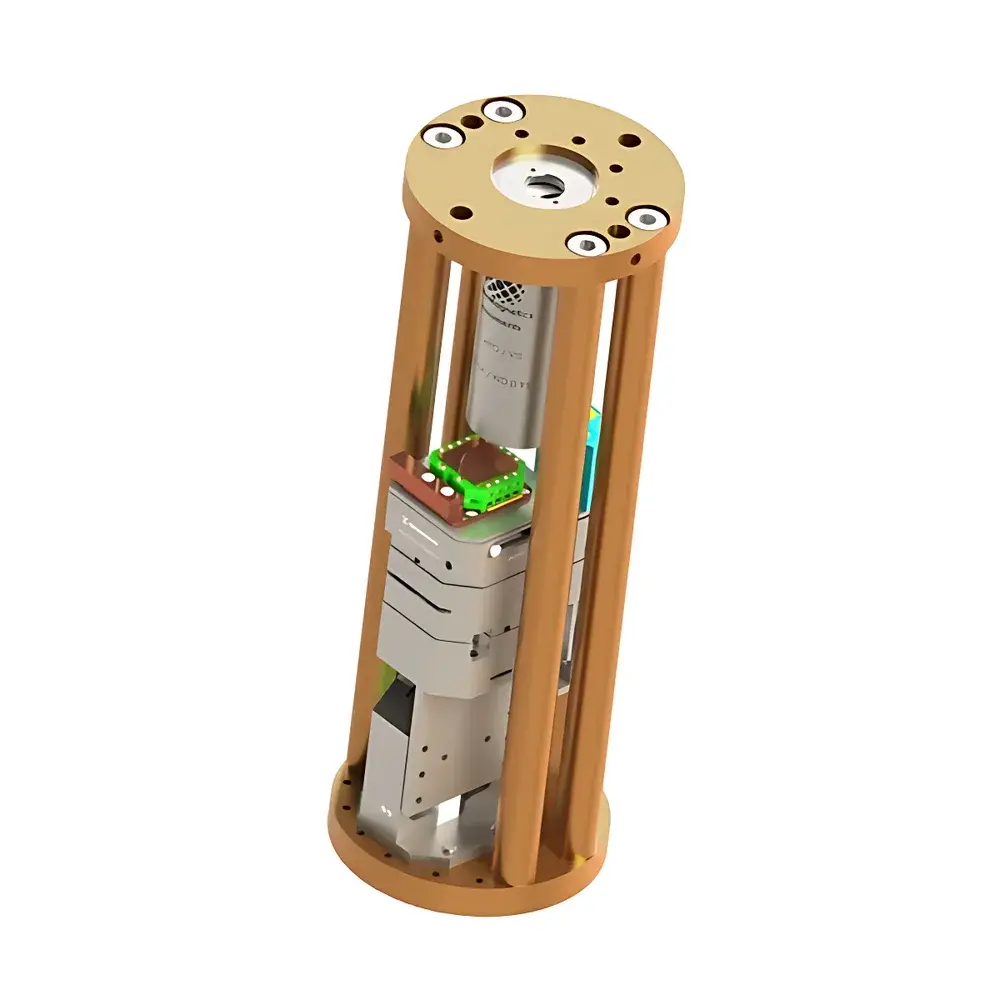
NanoMagnetics NV Center Confocal Cryogenic Microscope
| Brand | NanoMagnetics |
|---|---|
| Origin | United Kingdom |
| Manufacturer Type | Authorized Distributor |
| Origin Category | Imported |
| Model | NV |
| Pricing | Upon Request |
| Objective NA | 0.82 (Achromatic Apochromatic, 0.95 mm clear aperture) |
| Excitation Laser | 532 nm single longitudinal mode, 10 mW |
| Operating Temperature Range | 10 mK – 300 K |
| Scan Range (at 4 K) | 30 × 30 × 15 µm |
| Detector | Avalanche Photodiode (APD) for optical readout |
| Sample Stage | 6 × 6 × 12 mm XYZ piezo nanopositioner |
| NV/QTF Sensor Stage | 4 × 4 × 6 mm XYZ nanopositioner |
| Position Sensing | Resistive sensor, 200 nm resolution |
| Controller | FPGA-based AFM/SPM controller with USB 3.0 interface |
| Real-time Processor | 32-bit, 128 MB DDR SDRAM |
| ADC | Dual-channel 16-bit @ 100 MHz |
| DAC | Dual-channel 16-bit @ 100 MHz |
| On-FPGA PID Loops | 7 independent channels |
| Piezo Driver Channels | 19-channel high-voltage piezo controller |
| Auxiliary ADC | 16-channel 24-bit @ 175 kHz |
| Scan DAC | 24-bit for XYZ raster scanning |
| High-Voltage Amplifier | Low-noise, wide-bandwidth |
Overview
The NanoMagnetics NV Center Confocal Cryogenic Microscope is a purpose-built platform for quantum sensing and nanoscale magnetic imaging at ultra-low temperatures. Engineered around the nitrogen-vacancy (NV) center in diamond—a solid-state spin defect with exceptional coherence properties at cryogenic conditions—the system integrates confocal optical microscopy, atomic force microscopy (AFM), and precision nanomechanical actuation within a dilution refrigerator-compatible architecture. Its core measurement principle relies on optically detected magnetic resonance (ODMR), where microwave excitation modulates the spin-dependent photoluminescence of NV centers under 532 nm laser illumination. The microscope operates across a continuous temperature range from 10 mK to 300 K, enabling studies of quantum phase transitions, spin-lattice relaxation dynamics, and low-temperature magneto-optical coupling phenomena. Designed for integration into existing cryostat infrastructure—including wet and dry dilution refrigerators—the system maintains sub-micron optical alignment stability and sub-nanometer mechanical reproducibility under thermal cycling.
Key Features
- High-numerical-aperture (NA = 0.82) apochromatic objective optimized for visible transmission and minimal chromatic aberration at 532 nm, with 0.95 mm clear aperture for compatibility with cryogenic vacuum windows.
- Dual-stage nanopositioning architecture: a coarse 6 × 6 × 12 mm XYZ piezo stage for sample positioning and a dedicated 4 × 4 × 6 mm high-stiffness stage for NV-center or quartz tuning fork (QTF) sensors, both equipped with resistive position feedback (200 nm resolution).
- FPGA-based real-time controller featuring a 32-bit processor, 128 MB DDR SDRAM, dual 16-bit 100 MHz ADC/DAC channels, and seven fully configurable digital PID loops for simultaneous feedback control of multiple degrees of freedom.
- 19-channel high-voltage piezo driver with low-noise amplification, supporting complex multi-axis scanning and active vibration compensation in ultra-low-noise environments.
- Integrated 16-channel 24-bit 175 kHz auxiliary ADC and 24-bit XYZ scan DACs for synchronized acquisition of photoluminescence, microwave reflection, AFM deflection, and cantilever resonance signals.
- Optimized optical path with avalanche photodiode (APD) detection, 8-pin electrical interface for cryogenic wiring, and modular design for rapid reconfiguration between ODMR, AFM, and scanning probe magnetometry modes.
Sample Compatibility & Compliance
The NV Center Confocal Cryogenic Microscope supports a broad range of quantum material systems, including bulk diamond wafers, nanodiamonds, van der Waals heterostructures, superconducting thin films, and topological insulator surfaces. Sample mounting follows standard cryogenic protocols compatible with Oxford Instruments, BlueFors, and Leiden Cryogenics dilution refrigerators. All electronic subsystems meet IEC 61326-1:2013 requirements for electromagnetic compatibility in laboratory environments. Firmware and data acquisition modules are structured to support audit-ready operation under GLP-compliant workflows; timestamped metadata, hardware-calibrated signal scaling, and non-volatile configuration logging are natively embedded. While not certified for FDA 21 CFR Part 11, the system’s deterministic real-time architecture and full traceability of control parameters enable straightforward validation for regulated research applications.
Software & Data Management
Control and analysis are managed through NanoMagnetics’ proprietary QuantumScan Suite—a Python-based, open-API platform supporting both script-driven automation and GUI-assisted experiment sequencing. Core modules include PulseSequence Designer (for arbitrary microwave pulse trains), ODMR Spectrum Analyzer (with Lorentzian fitting and strain-field deconvolution), and Multi-Channel Correlator (for cross-spectral analysis of spin, topography, and thermal noise). Raw data are stored in HDF5 format with embedded SI-unit metadata, compliant with FAIR data principles. The software stack supports direct export to common scientific formats (MATLAB .mat, NumPy .npy, CSV) and integrates with third-party tools such as LabVIEW via TCP/IP and with Igor Pro via dynamic link libraries. All firmware updates are digitally signed and verified prior to installation.
Applications
- Quantum metrology: nanoscale DC and AC magnetometry with field sensitivity below 1 nT/√Hz at 4 K.
- Spin diffusion mapping in magnetic multilayers and skyrmion lattices.
- Coherence time (T₂) imaging of spin ensembles in proximity to superconducting circuits.
- Correlative AFM–ODMR: simultaneous topographic, mechanical, and spin-resolved characterization of 2D magnets.
- Thermally activated spin relaxation studies across quantum critical points (10 mK–30 K range).
- Calibration-free vector magnetometry using multi-axis NV orientation reconstruction.
FAQ
What cryostat configurations is the NV microscope compatible with?
The system is mechanically and electrically designed for integration into horizontal or vertical cold-finger dilution refrigerators with ≥49 mm bore diameter. Standard flange interfaces follow ISO-KF40 and CF63 specifications.
Can the controller synchronize microwave pulses with AFM scanning?
Yes—hardware-level triggering is supported via FPGA-registered TTL signals; microwave burst timing can be locked to pixel dwell time with sub-100 ns jitter.
Is the APD detector cooled?
No—the APD operates at room temperature with fiber-coupled input; its quantum efficiency (>65% at 532 nm) and dark count rate (<50 cps) are specified for ambient conditions.
Does the system support closed-loop scanning at 10 mK?
Yes—resistive position sensors remain functional down to 10 mK, and all piezo drivers are characterized for linearity and hysteresis compensation at base temperature.
Are calibration certificates provided for position and optical intensity?
Traceable calibration reports for XYZ stage linearity, laser power stability, and APD responsivity are supplied with each system; NIST-traceable reference standards are available upon request.





