
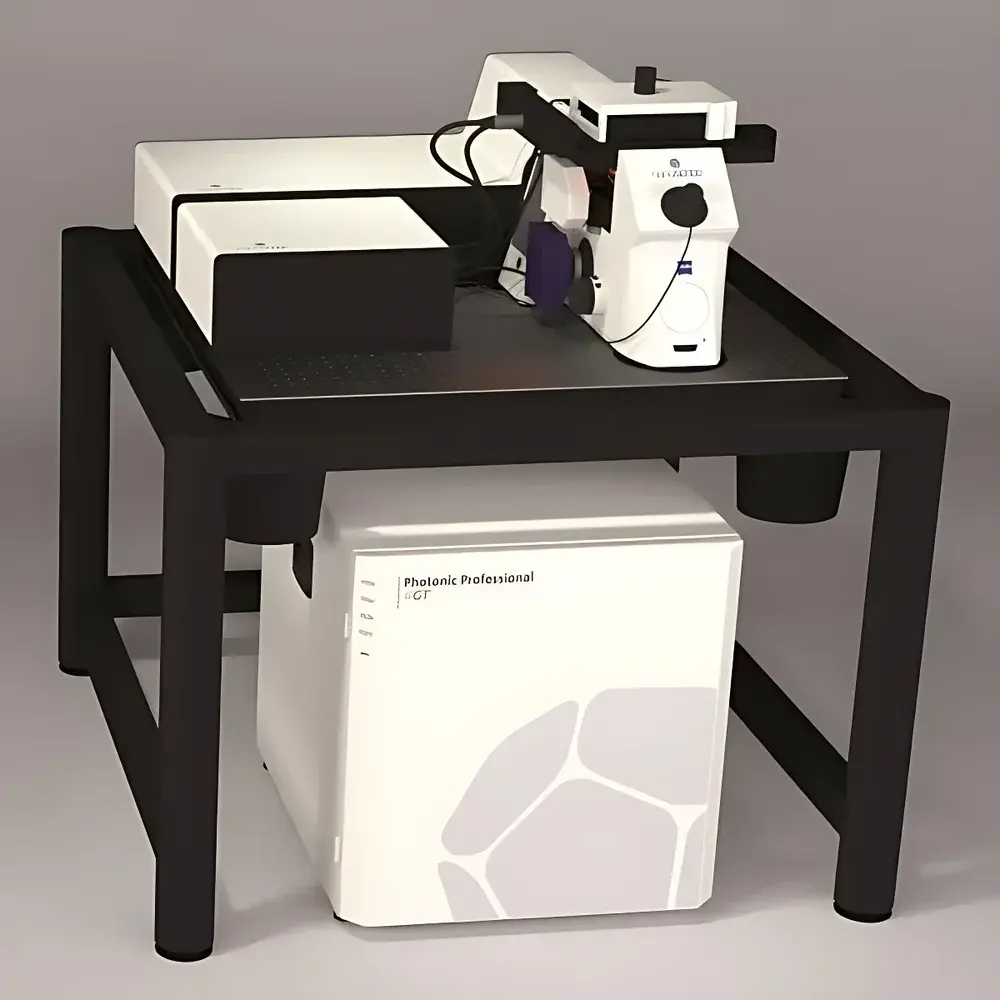
Nanoscribe Professional GT2 Two-Photon Polymerization 3D Printer
| Brand | Nanoscribe |
|---|---|
| Country of Origin | Germany |
| Model | Professional GT2 |
| Laser Wavelength | 405 nm |
| Printing Resolution | < 1 µm |
| Maximum Structure Height | 10 mm |
| Build Chamber Dimensions | 120 mm × 70 mm |
| Pressure Control Range | −800 to +1000 mbar |
| Bidirectional XY Repeatability | < 500 nm |
| Printing Method | Two-Photon Polymerization (2PP) |
| Compatible Materials | Photoresists (e.g., IP-L, IP-S, OrmoComp), conductive nanocomposites, metal precursor-loaded resins |
| Functional Capabilities | Electrochemical deposition integration, 2D/3D hybrid patterning, sub-micrometer dose-controlled liquid dispensing, surface functionalization |
Overview
The Nanoscribe Professional GT2 is a high-precision two-photon polymerization (2PP) microfabrication system engineered for research-grade additive manufacturing at the sub-micrometer scale. Unlike conventional stereolithography or laser sintering platforms, the Professional GT2 leverages femtosecond pulsed laser excitation at 405 nm to induce nonlinear photopolymerization exclusively within the focal volume of a high-numerical-aperture objective. This enables true 3D voxel-by-voxel writing with isotropic resolution below 1 µm—without reliance on layer-by-layer stacking or post-processing development steps typical of photolithographic methods. The system is purpose-built for laboratories engaged in metamaterials design, micro-optics prototyping, microfluidic device fabrication, and direct-write nanofabrication of hybrid metallic-dielectric architectures. Its open architecture supports integration with electrochemical deposition modules, allowing sequential printing and metallization—critical for fabricating freestanding conductive microstructures such as RF antennas, plasmonic resonators, and microelectrode arrays.
Key Features
- Sub-1 µm isotropic resolution enabled by diffraction-limited focusing and adaptive galvo-scanning optics
- Bidirectional XY stage repeatability better than 500 nm across full 120 mm × 70 mm build envelope
- Integrated pressure-controlled print chamber (−800 to +1000 mbar) for solvent vapor management and photoresist viscosity stabilization
- Modular optical path supporting interchangeable objectives (40× to 100×, NA ≥ 1.4) and optional IR-compatible beam delivery
- Real-time monitoring via coaxial CCD imaging with 1 µm pixel resolution and autofocus feedback loop
- Electrochemical deposition interface compatible with potentiostat synchronization for in situ metal seeding and growth
Sample Compatibility & Compliance
The Professional GT2 accommodates a broad spectrum of commercially available and custom-synthesized photoresists—including IP-L, IP-S, SZ2080, and OrmoComp—as well as nanoparticle-loaded formulations containing Au, Ag, Ni, or Cu precursors. It supports both negative-tone and positive-tone chemistries, enabling grayscale lithography and graded refractive index structures. All hardware and firmware comply with CE marking requirements under Directive 2014/30/EU (EMC) and 2014/35/EU (LVD). The system’s motion control subsystem conforms to ISO 9283:1998 standards for industrial robot performance testing. While not certified for GMP production environments, its audit-ready log generation and parameter traceability align with GLP documentation practices required for preclinical device prototyping and academic reproducibility reporting.
Software & Data Management
Nanoscribe’s Quantum X software suite provides a unified workflow—from CAD import (STL, OBJ, GDSII) to path planning, exposure calibration, and real-time process logging. The software implements deterministic voxel placement algorithms with adaptive dose compensation based on local intensity distribution and material absorption depth. All print jobs generate timestamped metadata logs including laser power, scan velocity, Z-step height, environmental pressure, and stage position history. Export formats include HDF5 for quantitative morphology analysis and CSV for statistical process control (SPC) integration. Optional API access enables Python-based automation and linkage to laboratory information management systems (LIMS), satisfying traceability requirements under ISO/IEC 17025:2017 clause 7.7.
Applications
- Direct-write fabrication of plasmonic nanoantennas and photonic crystal slabs with lattice constants down to 300 nm
- Rapid prototyping of micro-optical elements: freeform microlenses, waveguides, and diffractive optical elements (DOEs)
- Microfluidic chip fabrication with embedded 3D channels, valves, and mixing junctions fabricated monolithically
- Biomedical scaffolds with controlled pore geometry and surface chemistry gradients for stem cell differentiation studies
- Hybrid microelectronics: printed dielectric frames followed by electrodeposition of copper interconnects for MEMS packaging
- Nanomechanical test structures—tensile bars, cantilevers, and phononic crystals—for in situ SEM mechanical characterization
FAQ
What photoresists are validated for use with the Professional GT2?
Nanoscribe provides full compatibility data sheets for IP-L, IP-S, IP-Q, and OrmoComp series resins. Custom formulations containing up to 30 wt% metal nanoparticle dispersions (e.g., Ag NPs in PEGDA) have been successfully processed under optimized exposure parameters.
Can the system perform true 3D metal printing without post-processing?
No standalone metal printing is possible. However, combined 2PP + electrochemical deposition enables direct-write of metallic microstructures with feature sizes < 500 nm and aspect ratios > 20:1, eliminating lift-off or etching steps.
Is remote operation supported for multi-user lab environments?
Yes—Quantum X supports concurrent user sessions via Windows Remote Desktop Protocol (RDP) with role-based access control. Audit trails record all login events, parameter changes, and job submissions per ISO/IEC 27001 Annex A.8.2.3.
What maintenance intervals are recommended for the 405 nm laser source?
The solid-state diode-pumped laser module requires no consumables and is rated for >20,000 hours MTBF. Annual alignment verification and objective cleaning are advised per Nanoscribe Service Manual Rev. 4.2.
Does the system support batch processing of identical structures across multiple substrates?
Yes—via “Array Mode” in Quantum X, users define substrate grid coordinates and assign individual STL files per position, enabling unattended serial fabrication of up to 96 samples per run.
Related Products



