
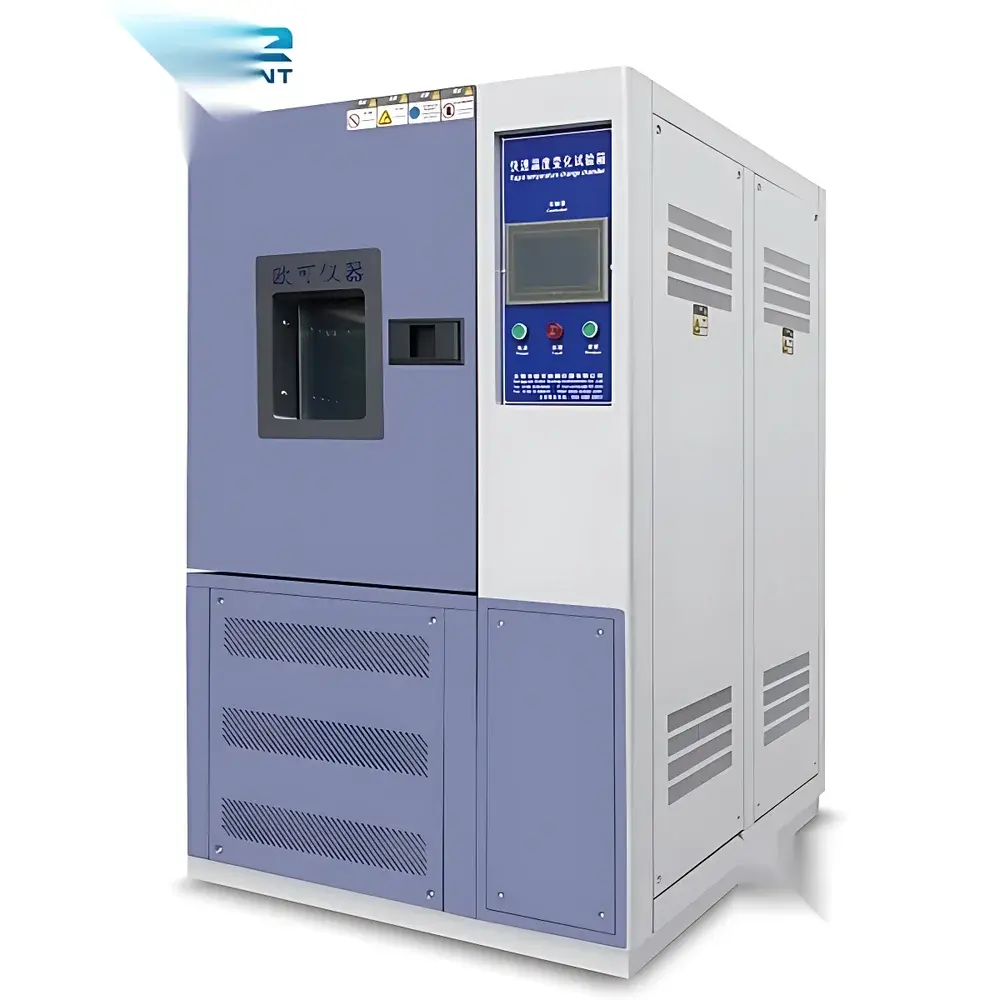
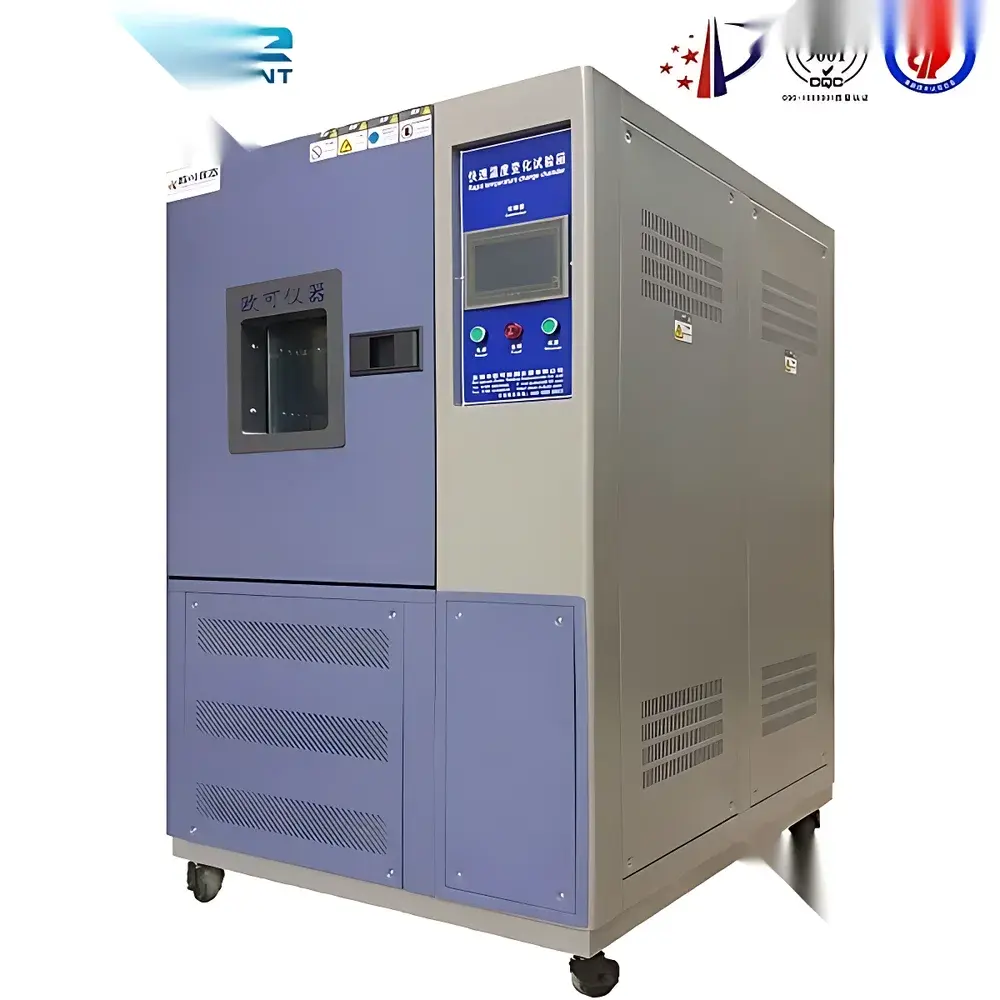
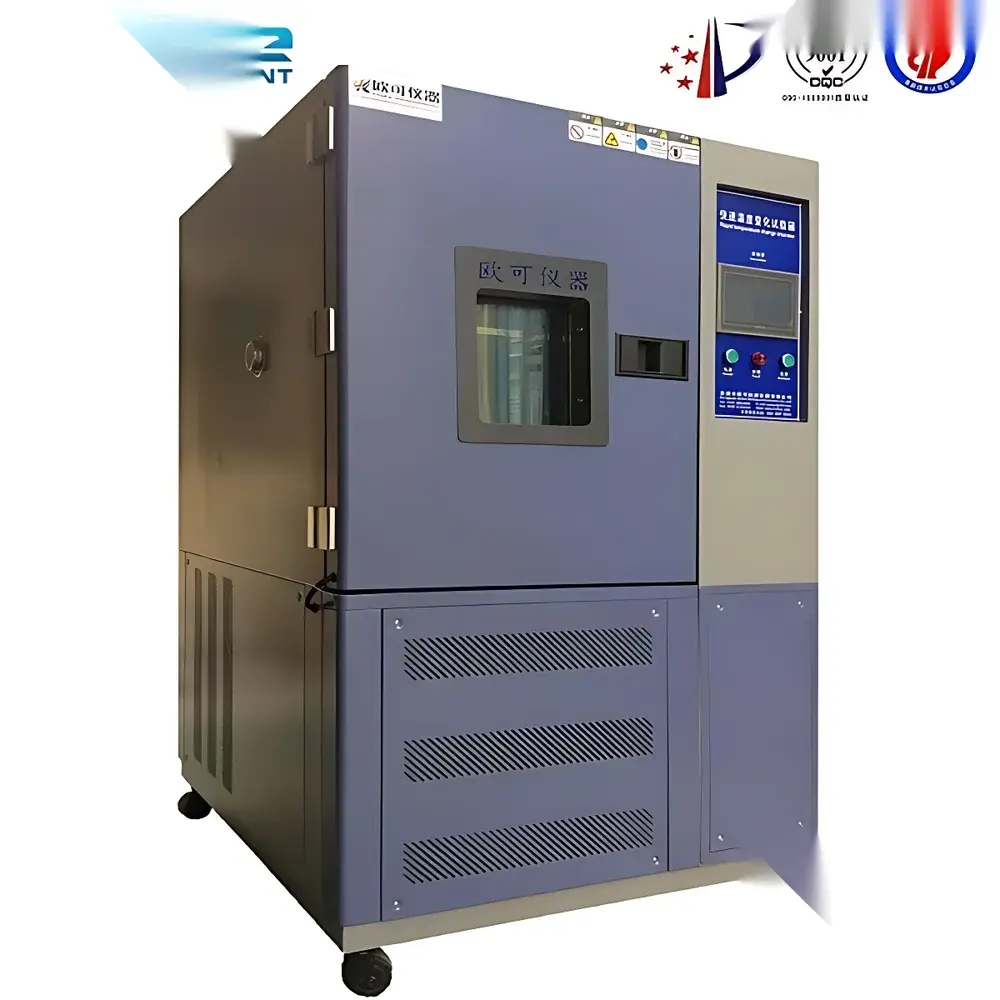
Nantong Rapid Temperature Change Environmental Test Chamber
| Brand | OEM / Custom Manufacturer |
|---|---|
| Origin | China (Manufactured in Nantong) |
| Supplier Type | Authorized Distributor |
| Import Status | Domestic Production (Not Imported) |
| Price | USD 14,000–18,000 (FOB Nantong) |
Overview
The Nantong Rapid Temperature Change Environmental Test Chamber is an engineered thermal stress screening system designed for accelerated reliability testing of electronic components, automotive modules, aerospace assemblies, and industrial materials. It operates on the principle of controlled, high-rate thermal cycling—inducing repetitive expansion and contraction within test specimens to expose latent defects such as microcracks in solder joints, delamination in multilayer PCBs, interfacial weaknesses in bonded materials, or inconsistencies in coating adhesion. Unlike standard temperature-humidity chambers, this system delivers programmable ramp rates up to 25 °C/min across a wide operational envelope (–70 °C to +150 °C; 5–98% RH), enabling compliance-driven qualification per MIL-STD-810H Method 503.5 (Temperature Shock), IEC 60068-2-14 (Change of Temperature), and JEDEC JESD22-A104F (Temperature Cycling).
Key Features
- Programmable rapid thermal transition: selectable ramp rates of 5, 10, 15, 20, or 25 °C/min between –45 °C ↔ +85 °C or –20 °C ↔ +85 °C profiles
- Wide operating range: –70 °C to +150 °C temperature; optional humidity control from 5% to 98% RH (standard: 20–98% RH)
- Precision climate control: temperature uniformity ±2 °C, stability ±0.5 °C; humidity uniformity ±3.0% RH (≥75% RH), stability ±2.5% RH
- Robust chamber construction: interior and exterior walls fabricated from SUS#304 stainless steel with double-wall vacuum insulation and anti-condensation heating
- Energy-efficient dual-stage refrigeration: hermetically sealed compressors using environmentally compliant R404A/R23 mixed refrigerant (GWP-compliant per EU F-Gas Regulation)
- Intuitive human-machine interface: 7-inch color LCD touchscreen controller with bilingual (English/Chinese) menu navigation, real-time curve plotting, and USB data export
- Electrical configuration: 3-phase 5-wire AC380 V ±5%, 50 Hz ±0.5 Hz; rear-mounted power inlet with 2.5 m cable
Sample Compatibility & Compliance
This chamber accommodates diverse sample geometries through four standardized internal volumes: KS-TH-225 (225 L), KS-TH-408 (408 L), KS-TH-800 (800 L), and KS-TH-1000 (1000 L). Internal dimensions are fully customizable to match customer-specific DUT (Device Under Test) footprints and airflow requirements. The system meets critical national and international standards including GB/T 2423.1–2023 (Cold Test), GB/T 2423.2–2023 (Dry Heat), GB/T 2423.22–2012 (Temperature Change), GJB 150.3A–2009 (High Temperature), GJB 150.4A–2009 (Low Temperature), and GB/T 10589–2018 (Low-Temp Chamber Specifications). All units undergo factory calibration traceable to CNAS-accredited reference standards and support GLP/GMP audit readiness via configurable event logging and password-protected parameter locking.
Software & Data Management
The embedded controller supports ISO/IEC 17025-aligned data integrity protocols. Real-time monitoring includes timestamped temperature/humidity profiles, alarm history (over-temperature, sensor fault, door open), and cycle completion reports. Data export is available in CSV format via USB flash drive. Optional Ethernet connectivity enables remote supervision via Modbus TCP or custom SCADA integration. For regulated environments, optional software add-ons provide 21 CFR Part 11-compliant electronic signatures, user access levels (admin/operator/auditor), and immutable audit trails—including all setpoint modifications, manual overrides, and calibration events.
Applications
- Automotive electronics: ECUs, ADAS sensors, battery management systems (BMS), and infotainment modules subjected to thermal shock per ISO 16750-4
- Aerospace avionics: flight-critical components undergoing DO-160 Section 4.5 (Temperature Variation) validation
- Consumer electronics: smartphones, wearables, and IoT devices tested per IPC-9701A (Performance Classes for CCA Thermal Cycling)
- Medical device packaging: sterile barrier systems evaluated under ASTM F1980 (Accelerated Aging)
- Materials R&D: polymer composites, thermal interface materials (TIMs), and conformal coatings assessed for coefficient of thermal expansion (CTE) mismatch failure modes
FAQ
What is the maximum achievable ramp rate for thermal cycling?
The chamber supports up to 25 °C/min between –45 °C and +85 °C under no-load conditions, verified per IEC 60068-3-5:2018 Annex B.
Can humidity be controlled simultaneously during rapid temperature transitions?
Yes—optional integrated humidification/dehumidification subsystem maintains specified RH levels throughout dynamic temperature ramps, with dedicated PID control loops for independent regulation.
Is third-party calibration certification included with delivery?
Each unit ships with a factory calibration report traceable to national metrology institutes; optional CNAS-certified calibration with uncertainty budget is available upon request.
How is thermal uniformity validated across the working volume?
Uniformity is verified using a 9-point thermocouple mapping procedure per IEC 60068-3-5, conducted at three representative setpoints (–40 °C, +25 °C, +85 °C) prior to shipment.
Does the controller support automated test sequence programming?
Yes—the built-in sequencer allows up to 999 steps per profile, including dwell times, ramp rates, humidity setpoints, and conditional branching based on elapsed time or sensor feedback.



