
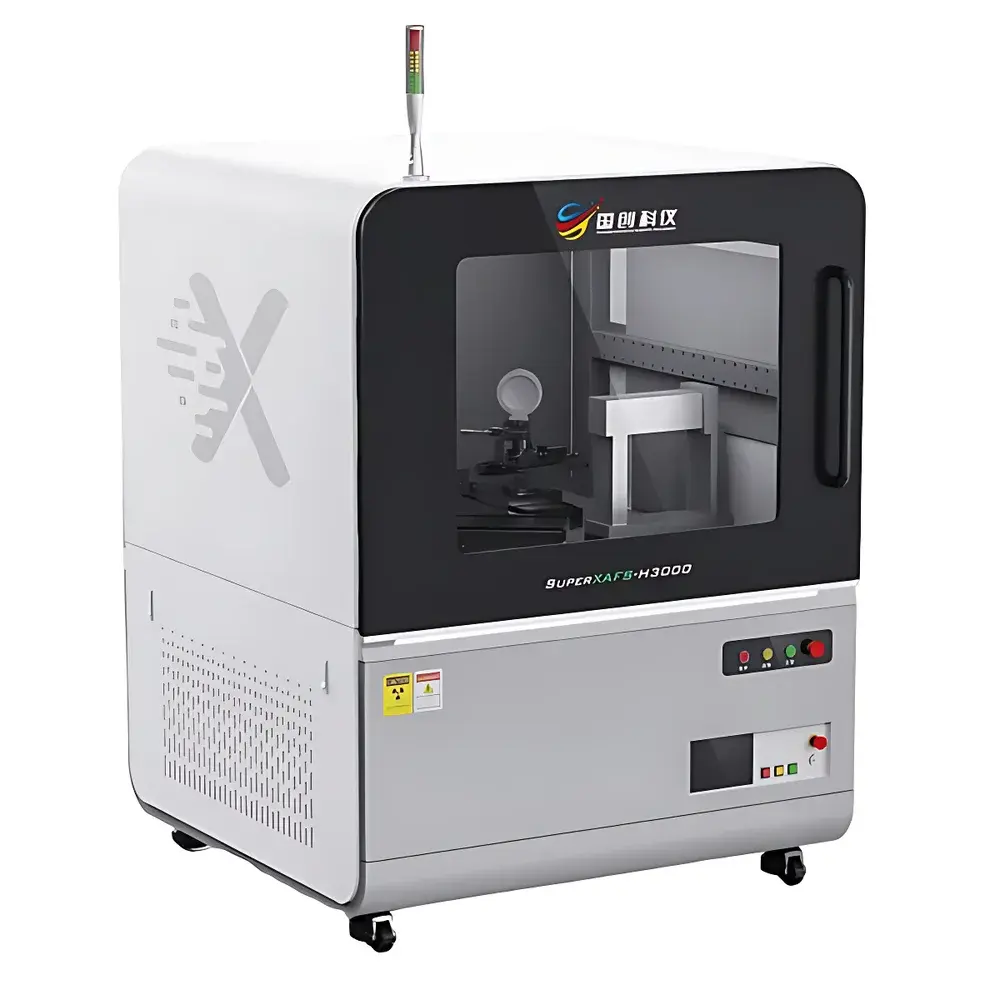
National Innovation Scientific Instruments SuperXAFS M9000 X-ray Absorption Fine Structure Spectrometer
| Brand | National Innovation Scientific Instruments |
|---|---|
| Origin | Jiangsu, China |
| Manufacturer Type | Authorized Distributor |
| Origin Category | Domestic (PRC) |
| Model | SuperXAFS M9000 |
| Price Range | USD 560,000 – 1,400,000 |
| Energy Range | 4.5–20 keV (upgradable to 25 keV) |
| Photon Flux at Sample | ≥4×10⁶ photons/s @ 7–9 keV |
| Energy Resolution | 0.5–1.5 eV @ 7–9 keV |
| Energy Reproducibility | ≤30 meV over 24 h |
| Minimum Energy Step Size | 0.1 eV |
Overview
The National Innovation Scientific Instruments SuperXAFS M9000 is a high-performance, laboratory-scale X-ray Absorption Fine Structure (XAFS) spectrometer engineered for quantitative local-structure characterization of materials across chemistry, catalysis, energy storage, environmental science, and metallurgy. Operating on synchrotron-compatible principles, the system employs a fixed-exit double-crystal monochromator (DCM) with Si(111) or Si(311) crystals, enabling precise energy scanning across the soft-to-hard X-ray regime (4.5–20 keV, extendable to 25 keV). It supports both transmission and fluorescence detection geometries—critical for dilute or heterogeneous samples—and integrates X-ray emission spectroscopy (XES) capability for complementary electronic-structure analysis. Unlike conventional benchtop XRF or XRD systems, the SuperXAFS M9000 delivers element-specific, coordination-sensitive data without long-range crystalline order requirements, making it indispensable for amorphous catalysts, battery electrode interfaces, metalloproteins, and speciation studies in complex matrices.
Key Features
- High-flux beamline architecture delivering ≥4×10⁶ photons/s at the sample position within the 7–9 keV range—enabling rapid acquisition of high signal-to-noise XANES and EXAFS spectra.
- Sub-eV energy resolution (0.5–1.5 eV @ 7–9 keV) and exceptional long-term stability (≤30 meV drift over 24 h), ensuring reproducible edge-jump quantification and fine-structure fitting across repeated measurements.
- Motorized, sub-micron precision goniometric stage with <0.1 eV minimum energy step size—supporting high-resolution near-edge scanning (XANES) and extended fine-structure collection (EXAFS) with optimal k-space sampling.
- Automated multi-sample carousel compatible with standard XAFS sample holders (e.g., Kapton tape, borosilicate capillaries, pellet dies), reducing manual handling and enabling unattended overnight data collection.
- Integrated hardware synchronization for simultaneous XAFS/XES acquisition, facilitating resonant inelastic scattering (RIXS)-adjacent workflows and oxidation-state cross-validation.
Sample Compatibility & Compliance
The SuperXAFS M9000 accommodates solid powders, thin films, frozen solutions, and in situ/operando cells—including gas-flow reactors, electrochemical flow cells, and temperature-controlled cryostats (80–500 K). Its dual-mode detection (transmission and fluorescence) ensures robust performance across concentration ranges from ppm-level dopants to bulk metallic phases. All firmware and control logic comply with IEC 61508 functional safety standards for industrial instrumentation. Data acquisition and metadata logging adhere to FAIR principles (Findable, Accessible, Interoperable, Reusable), with optional audit-trail configuration meeting GLP and ISO/IEC 17025 documentation requirements for accredited testing laboratories.
Software & Data Management
The instrument is controlled via XAFS Studio—a modular, Python-based platform supporting real-time spectrum visualization, automated energy calibration (using reference foils: Cu, Ni, Fe, Zn), and batch processing pipelines compliant with Demeter (Athena/Artemis) file formats (.chi, .dat). The embedded spectral library includes >120 reference compounds covering transition metals, lanthanides, and light elements (S, P, Cl), enabling rapid fingerprinting and linear combination fitting (LCF). Raw and processed datasets are stored in HDF5 format with embedded NeXus-compatible metadata, ensuring traceability and compatibility with third-party analysis tools (e.g., Larch, PyXAFS, GSAS-II). Optional 21 CFR Part 11-compliant user authentication, electronic signatures, and immutable audit logs are available for regulated environments.
Applications
- Catalysis research: Tracking dynamic changes in Pt–O/N coordination during CO oxidation or Ni–Fe bond length evolution in OER anodes under applied bias.
- Battery materials: Quantifying Mn valence distribution and local disorder in NMC cathodes after cycling; probing Li–S bond formation in polysulfide intermediates.
- Environmental geochemistry: Speciating As(III)/As(V) adsorption states on iron oxyhydroxides or identifying Se redox forms in contaminated soils.
- Biological metalloproteins: Determining Zn–S/N bond distances in carbonic anhydrase active sites without crystallization.
- Industrial QC: Verifying Co–O coordination integrity in cobalt oxide pigments or detecting Cr⁶⁺ contamination in stainless-steel passivation layers.
FAQ
What X-ray source options are compatible with the SuperXAFS M9000?
The system is optimized for rotating-anode Cu or Mo sources (e.g., Rigaku MicroMax-007HF, Xenocs GeniX3D) and supports integration with liquid-metal-jet sources (e.g., Excillum MetalJet D2+). Synchrotron beamline emulation mode is available for method transfer.
Can the system perform time-resolved XAFS measurements?
Yes—when coupled with a fast chopper and gated detector (e.g., silicon drift detector with 100 ns gating), the M9000 achieves millisecond time resolution for pump-probe experiments under controlled atmospheres or electrochemical modulation.
Is remote operation and data reduction supported?
Full remote access is enabled via TLS-secured VNC and RESTful API endpoints. Athena-style batch reduction, including background subtraction, normalization, and k³-weighting, can be executed server-side with configurable job queues.
Does the system meet international calibration traceability standards?
Energy calibration is traceable to NIST SRM 1976b (Cu foil) and SRM 1977 (Ni foil); flux measurements follow ISO 18541-2:2020 protocols for X-ray beam characterization.
What maintenance intervals and service contracts are recommended?
Monochromator crystal alignment verification every 6 months; detector Peltier cooling and vacuum system inspection annually. Extended warranty and preventive maintenance plans include on-site engineer support and spare-part provisioning aligned with ISO 55001 asset management frameworks.




