
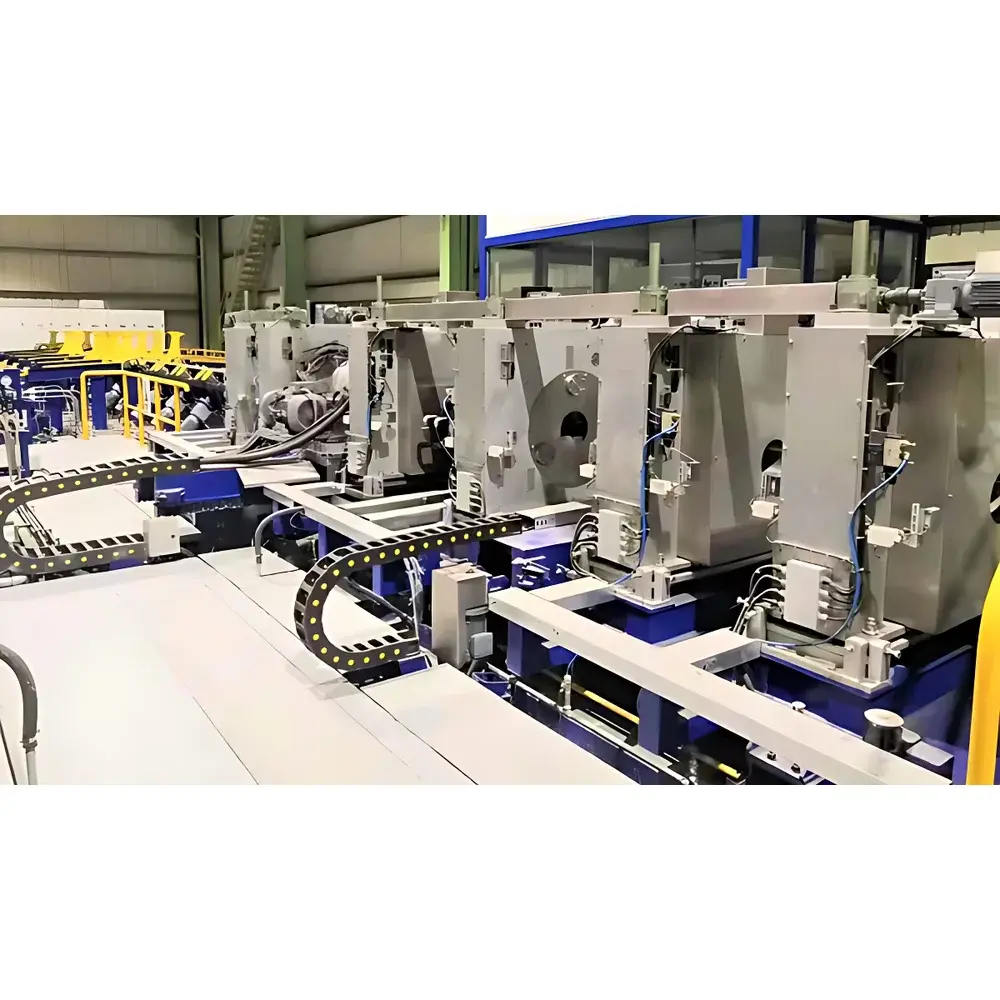
NC-RGET Series Rotational Water-Tank Ultrasonic and Through-Feed Eddy Current Testing System
| Brand | NCS (China Iron and Steel Research Institute Group) |
|---|---|
| Origin | Beijing, China |
| Manufacturer Type | Direct Manufacturer |
| Country of Origin | China |
| Model | NC-RGET Series |
| Pricing | Available Upon Request |
| Inspection Mode | Automated Inspection |
Overview
The NC-RGET Series Rotational Water-Tank Ultrasonic and Through-Feed Eddy Current Testing System is an integrated non-destructive testing (NDT) platform engineered for high-throughput, high-reliability inspection of seamless and welded metallic tubular products. It combines two complementary electromagnetic and acoustic modalities—through-feed eddy current testing (ECT) and immersion ultrasonic testing (UT) using a rotating water-coupled probe carriage—to deliver simultaneous surface, near-surface, and volumetric defect detection in a single pass. The system operates on the principle of electromagnetic induction for ECT, detecting conductivity and permeability variations caused by cracks, pits, inclusions, or wall-thinning; and on pulse-echo and through-transmission ultrasonics for UT, identifying internal discontinuities such as voids, laminations, and lack-of-fusion zones. Designed for continuous production line integration, it supports real-time signal acquisition, synchronized motion control, and multi-channel data fusion—enabling comprehensive defect characterization without compromising throughput.
Key Features
- Integrated dual-modality architecture: Simultaneous through-feed eddy current and rotational immersion ultrasonic inspection in one machine footprint.
- Water-tank immersion UT module with precision motorized rotation stage (0–360° continuous indexing), ensuring full circumferential coverage and consistent acoustic coupling across variable tube diameters.
- High-frequency eddy current array sensors (operating range: 10 kHz–10 MHz) with differential and absolute probe configurations for optimized sensitivity to both axial and circumferential flaws.
- Automated tube handling system with servo-controlled feed, centering, and exit mechanisms—compatible with OD ranges from 6 mm to 219 mm and wall thicknesses up to 25 mm.
- Rugged mechanical frame with vibration-damped base and IP54-rated enclosure for industrial environments; designed for 24/7 operation under ambient temperatures of 5–40°C and relative humidity ≤85% (non-condensing).
- Real-time digital signal processing (DSP) engine supporting adaptive filtering, phase analysis, and impedance plane display for ECT; time-of-flight diffraction (TOFD) and C-scan reconstruction capabilities for UT.
Sample Compatibility & Compliance
The NC-RGET system is validated for ferrous and non-ferrous metallic tubes including carbon steel, stainless steel, aluminum alloys, copper, titanium, and nickel-based superalloys. It meets the geometric and performance requirements of multiple international and industry-specific standards, including API RP 5L (Line Pipe), ASTM A53/A500 (Standard Specifications for Pipe), ASTM A578/A578M (Straight-Beam Ultrasonic Examination), JIS G3444 (Carbon Steel Pipes for General Structural Purposes), GB/T 3091 (Galvanized Steel Pipes), GB/T 5777 (Ultrasonic Testing of Seamless Steel Tubes), YB/T 4082 & YB/T 4083 (Eddy Current Testing of Steel Tubes), and Q/SY GJX101 (CNPC Specification for Pipeline Tubular Goods). All test procedures are documented per ISO/IEC 17025:2017 principles, and calibration traceability follows national metrological standards (CNAS-accredited reference blocks and shims).
Software & Data Management
The system runs on NCS proprietary NDT-Studio v4.x software, compliant with FDA 21 CFR Part 11 for electronic records and signatures. It provides role-based user access control, audit trail logging (with timestamped operator actions and parameter changes), and automated report generation in PDF and CSV formats. Raw ECT impedance data and UT A-scan/B-scan waveforms are stored in HDF5 format for long-term archival and post-processing. Integration options include OPC UA for MES/SCADA connectivity and RESTful API for custom LIMS interfacing. All inspection records support GLP/GMP-compliant review workflows—including independent operator verification, supervisor approval, and revision history tracking.
Applications
- Production-line quality assurance for oil & gas transmission tubing (e.g., OCTG, line pipe, casing) meeting API 5L PSL2 requirements.
- In-process inspection of heat exchanger tubes, boiler tubes, and nuclear fuel cladding in power generation facilities.
- Final acceptance testing of aerospace-grade titanium and Inconel tubing per ASME BPVC Section V and NADCAP AC7114.
- Recycled material verification in scrap metal processing plants to detect subsurface segregation or intergranular corrosion precursors.
- R&D validation of new alloy extrusions and cold-drawn tube manufacturing processes, supporting statistical process control (SPC) via Cp/Cpk metrics derived from defect density histograms.
FAQ
What tube materials can be inspected with the NC-RGET system?
It supports carbon steel, low-alloy steel, stainless steel, aluminum, copper, titanium, and nickel-based alloys—including duplex and super-austenitic grades.
Does the system provide certification documentation for compliance audits?
Yes—factory calibration certificates, traceable reference block reports, IQ/OQ documentation, and standard operating procedures (SOPs) are supplied with each installation.
Can the system be retrofitted into existing production lines?
The modular design allows integration with third-party conveyors, marking systems, and sorting chutes via standardized mechanical interfaces and Ethernet/IP communication protocols.
Is remote diagnostics and software update support available?
NCS offers secure remote maintenance via encrypted VPN connection, with version-controlled firmware updates and annual software subscription including regulatory change notifications.
What is the typical lead time for delivery and commissioning?
Standard configuration delivery is 16–20 weeks from PO; site commissioning, operator training, and FAT/SAT execution require an additional 3–5 days onsite.



