
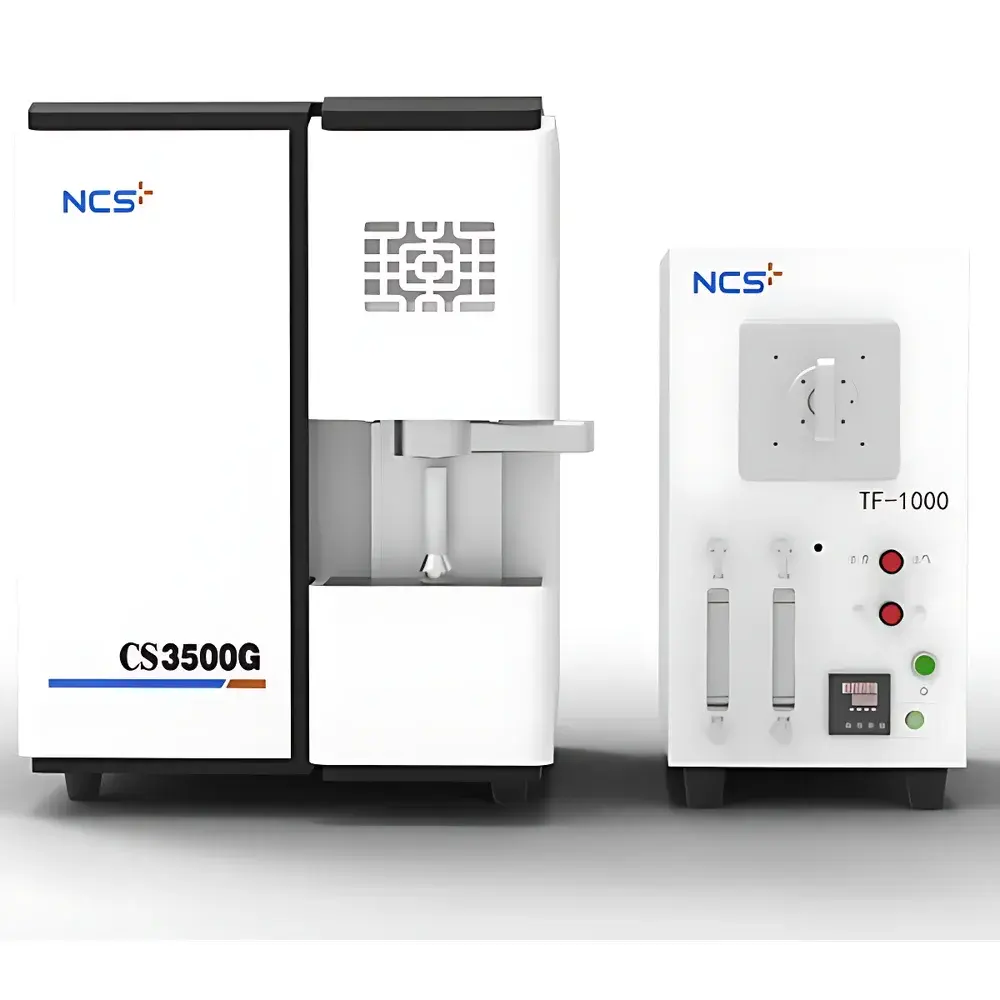
NCS CS3500G Dual-Furnace Infrared Carbon-Sulfur Analyzer
| Brand | NCS |
|---|---|
| Origin | Beijing, China |
| Manufacturer | NCS Jiangsu Testing Technology Institute Co., Ltd. |
| Model | CS3500G |
| Measurement Principle | Infrared Absorption |
| Combustion Systems | High-Frequency Induction Furnace (18 MHz, 2.7 kVA) & Tube-Type Resistance Furnace (up to 1550 °C, max. 20 A) |
| Carbon Range | HF furnace — low C: 0.6 ppm–0.1 wt% |
| high C | 0.1–50 wt% |
| Sulfur Range | HF furnace — low S: 0.6 ppm–0.3 wt% |
| high S | 0.3–30 wt% |
| Resistance furnace — C | 0.01–100 wt%, S: 0.005–100 wt% |
| Sensitivity | 0.01 ppm |
| Precision | Low-C: ±1 ppm or RSD ≤1% |
| High-C | RSD ≤0.5% |
| Analysis Time | HF furnace — 30–40 s |
Overview
The NCS CS3500G Dual-Furnace Infrared Carbon-Sulfur Analyzer is an advanced elemental combustion analyzer engineered for high-precision, trace-to-major-level quantification of total carbon and sulfur in solid inorganic materials. It employs dual independent combustion modules—high-frequency induction heating and programmable tube-type resistance heating—coupled to a shared, multi-channel infrared detection system based on the fundamental principle of non-dispersive infrared (NDIR) absorption spectroscopy. Each gaseous analyte (CO2 and SO2) exhibits characteristic vibrational absorption bands in the mid-infrared region; the instrument measures absorbance intensity at specific wavelengths (e.g., 4.26 µm for CO2, 7.35 µm for SO2) to determine concentration via Beer-Lambert law calibration. The CS3500G is designed to meet rigorous analytical requirements in metallurgical QC labs, R&D centers, and accredited third-party testing facilities where method flexibility, regulatory traceability, and cross-material applicability are critical.
Key Features
- Dual Combustion Architecture: Integrates a 2.7 kVA, 18 MHz high-frequency induction furnace optimized for rapid, complete oxidation of metallic matrices (e.g., steels, alloys, powders), and a programmable resistance furnace with SiC heating elements capable of sustained operation up to 1550 °C—enabling quantitative analysis of refractory ceramics, carbides, sulfides, and geological samples resistant to HF ignition.
- Four-Channel NDIR Detection System: Standard configuration includes three independent infrared absorption cells (CO2, SO2, reference); optional fourth channel supports extended high-sulfur measurement. All detectors utilize imported pyroelectric solid-state sensors (Germany), IR sources (USA), and precision synchronous motors (Switzerland), housed in thermally stabilized gas cells to minimize thermal drift.
- Optimized Gas Handling: Micro-differential pressure flow control ensures stable, reproducible carrier gas (helium/oxygen) delivery across both furnaces. Integrated valve island architecture eliminates dead volume and enables seamless switching between combustion modes within <5 s. PID-controlled pneumatic regulation achieves flow stability within ±0.5% after 5 min post-gas initiation.
- Catalytic Conversion & Emission Control: Pre-detection catalytic oxidation (CuO furnace, optional) converts residual CO to CO2, ensuring stoichiometric carbon recovery. Post-detection SO2 oxidation to SO3 followed by SO3 trapping guarantees compliance with ISO 14001 environmental protocols and eliminates acidic exhaust emissions.
- Automated Maintenance Intelligence: Real-time diagnostics include electromagnetic valve actuation testing, analog signal acquisition monitoring, HF preheat status tracking, baseline stability assessment, and software-initiated auto-zero routines—all accessible via embedded maintenance interface without hardware disassembly.
Sample Compatibility & Compliance
The CS3500G accommodates diverse solid sample forms—including cast metals, sintered powders, battery cathode precursors (e.g., LiFePO4, NMC), rare-earth magnets (NdFeB), oxide ceramics, mineral ores, and soil digests—without requiring matrix-specific hardware modifications. Its dual-furnace design satisfies ASTM E1019 (Standard Test Methods for Determination of Carbon, Sulfur, Nitrogen, and Oxygen in Steel, Iron, Nickel, and Cobalt Alloys), ISO 4935 (Steel—Determination of Carbon Content—Infrared Absorption Method), and GB/T 20123–2006 (Chinese national standard for carbon/sulfur analysis). The system supports full audit trails compliant with FDA 21 CFR Part 11 when operated under validated software configurations, including electronic signatures, user-access controls, and immutable data logging. All calibration curves, method parameters, and raw spectral data are stored with timestamped metadata to support GLP/GMP laboratory audits.
Software & Data Management
Operating on Windows 10/11, the CS3500G’s native software provides fully localized Chinese GUI with English language toggle, eliminating localization barriers in multinational labs. It implements flexible mass input protocols: automatic balance integration (RS-232/USB), manual entry, or crucible tare-by-press. Auto-ranging logic dynamically selects optimal detector gain and integration time based on real-time signal amplitude—eliminating manual range selection errors. Calibration libraries support unlimited method storage, each with custom combustion parameters (e.g., oxygen flow, power ramp, hold time), catalyst activation settings, and blank subtraction profiles. Data management conforms to LIMS interoperability standards: SQL-based relational database enables filtered queries by date, operator, material grade, or statistical outliers; reports export directly to Excel (.xlsx); and secure TCP/IP communication allows bidirectional data exchange with enterprise laboratory information systems. All release curves, peak integrals, and baseline corrections are archived with raw ADC values for retrospective reprocessing.
Applications
- Quality control of carbon content in low-alloy steels, stainless grades, and tool steels per ASTM A751 specifications.
- Trace sulfur quantification in ultra-low-sulfur pipeline steels (≤10 ppm) and nuclear-grade zirconium alloys.
- High-temperature combustion of silicon carbide (SiC) and tungsten carbide (WC) powders using the resistance furnace, achieving full carbon recovery without graphitization artifacts.
- Routine analysis of sulfur in lithium-sulfur battery cathodes and transition-metal sulfides (e.g., MoS2, FeS2) for energy storage R&D.
- Multi-element correlation studies in geological survey labs, where CS3500G data integrates with ICP-OES or XRF results for comprehensive ore grade modeling.
FAQ
What combustion methods does the CS3500G support?
The instrument supports two independent combustion techniques: high-frequency induction heating (optimized for conductive metals and alloys) and resistive tube furnace heating (suitable for non-conductive, refractory, or volatile-rich samples such as ceramics, sulfides, and organometallics).
Can the CS3500G analyze samples requiring oxygen addition during combustion?
Yes—the resistance furnace is equipped with dedicated oxygen inlet ports enabling controlled O2 dosing for crucible pre-burning, ash-free combustion of organic contaminants, or enhanced oxidation of recalcitrant sulfur species.
How is calibration traceability maintained?
Calibration relies on NIST-traceable certified reference materials (CRMs) such as SS 461–1 (steel), GBW 01301 (iron), and CRM 312 (sulfide ore). Software enforces calibration verification checks before each batch and logs all drift corrections with operator ID and timestamp.
Is the infrared detection system field-serviceable?
All optical components—including IR source, filter wheels, and detectors—are modular and replaceable without optical realignment. Factory calibration coefficients are stored in EEPROM and automatically loaded upon module replacement.
Does the system support remote diagnostics?
Yes—via secure HTTPS-enabled web interface, authorized technicians can remotely monitor real-time sensor health, gas flow stability, furnace temperature profiles, and error logs while preserving data integrity and network security per ISO/IEC 27001 guidelines.




