
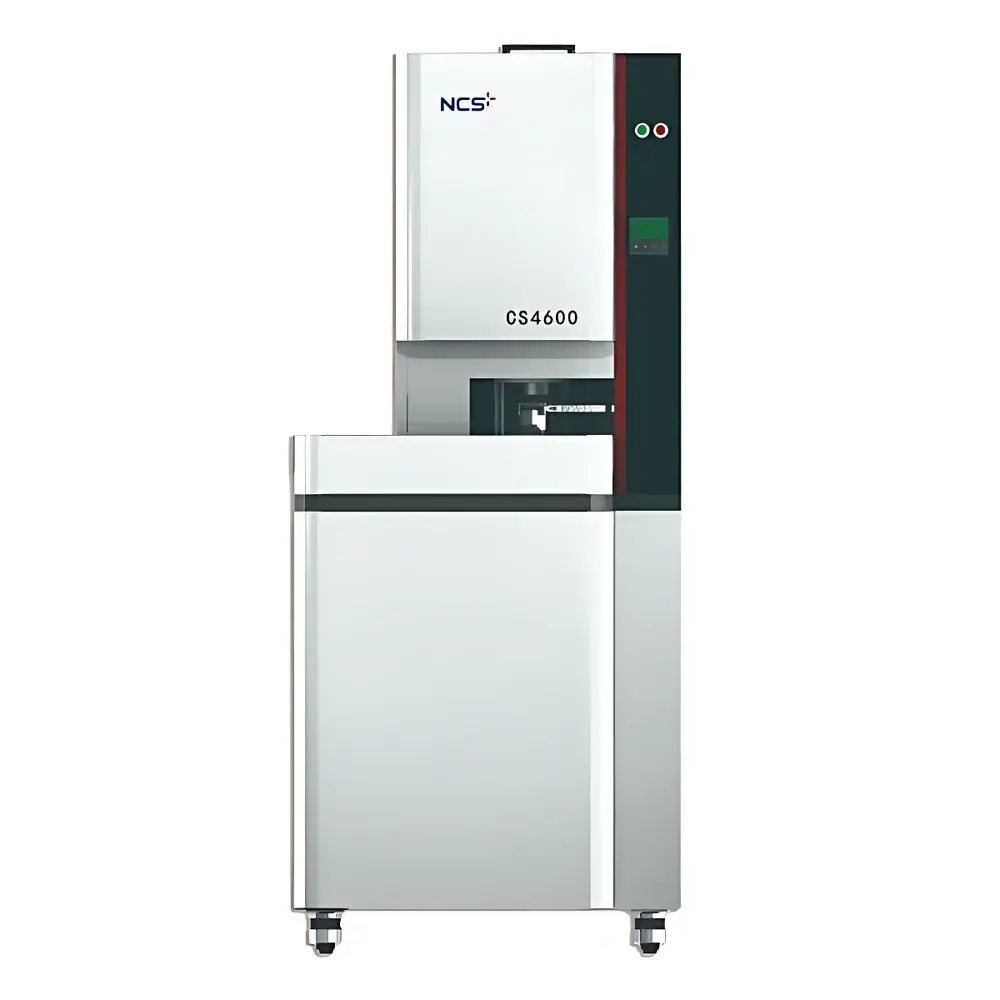
NCS CS4600 Vertical Tube-Furnace Carbon-Sulfur Analyzer
| Brand | NCS |
|---|---|
| Origin | Beijing, China |
| Manufacturer Type | Direct Manufacturer |
| Model | CS4600 |
| Measurement Principle | Non-Dispersive Infrared (NDIR) Absorption |
| Heating System | Vertical Tube Resistance Furnace (Max. 1500 °C, 1 °C Adjustable) |
| Carbon Range | 0.01–100 wt% |
| Sulfur Range | 0.005–100 wt% |
| Sensitivity | 0.1 ppm |
| Precision | C: RSD ≤ 0.5% |
| S | RSD ≤ 1.0% |
| Analysis Time | 60–180 s (user-configurable) |
| Sample Mass | 200–500 mg (coal, typical) |
| Power Supply | 220 VAC ±10%, 50 ±1 Hz, 20 A |
| Dimensions (L×W×H) | 814 × 710 × 1629 mm |
| Weight | ~170 kg |
Overview
The NCS CS4600 Vertical Tube-Furnace Carbon-Sulfur Analyzer is a high-performance elemental analyzer engineered for precise, reproducible quantification of total carbon and sulfur in solid inorganic materials—including coal, coke, iron sulfide ores, graphite, refractory ceramics, and metallurgical alloys. It operates on the principle of high-temperature combustion followed by non-dispersive infrared (NDIR) absorption spectroscopy. Samples are combusted quantitatively in a vertically oriented ceramic tube furnace under controlled oxygen flow, converting carbon and sulfur into CO2 and SO2, respectively. These gaseous oxides are then swept through thermally stabilized, multi-channel infrared absorption cells where concentration is determined via Beer-Lambert law-based photometric detection. The vertical furnace architecture eliminates thermal stress-induced deformation of heating elements (e.g., SiC rods), ensures uniform temperature distribution, and prevents mechanical contact between the crucible and combustion tube—thereby enhancing system longevity and measurement robustness.
Key Features
- Vertical Tube Resistance Furnace: Rated to 1500 °C with 1 °C programmable resolution; intelligent software feedback enables real-time temperature monitoring and method-specific thermal profiling.
- Dual-Stream Gas Delivery System: Combines coaxial oxygen jet injection and chamber-level oxidant flow to maximize sample oxidation efficiency and minimize incomplete combustion artifacts.
- Triple-Channel NDIR Detection Module: Standard configuration includes two dedicated sulfur channels and one high-carbon channel; modular design supports user-selectable channel combinations (e.g., low-sulfur/high-sulfur dual-range) without hardware modification.
- Imported Critical Components: German-made pyroelectric solid-state IR detectors; Swiss-sourced synchronous drive motors; U.S.-manufactured oxidation-resistant IR sources; fully temperature-stabilized optical gas cells with O2-purged detector/source compartments.
- Automated Sample Handling (Optional): 60-position carousel with precision optical positioning sensors; full sequence automation (loading, combustion, analysis, ash disposal); dynamic queue editing (insert/delete/append) during run; aluminum alloy structural platform for dimensional stability.
Sample Compatibility & Compliance
The CS4600 is validated for routine analysis of heterogeneous solid matrices requiring high-temperature oxidative decomposition. It complies with national and international reference methods including GB/T 25214–2010 (Determination of Total Sulfur in Coal—Infrared Spectrophotometric Method) and ASTM D4239–21 (Standard Test Method for Sulfur in Coal and Coke by High-Temperature Tube Furnace Combustion–Infrared Absorption). Its measurement uncertainty profile meets GLP-aligned validation requirements for QC/QA laboratories in energy, mining, and metallurgy sectors. The instrument supports audit-ready data integrity features—including electronic signatures, parameter change logs, and time-stamped result archives—consistent with FDA 21 CFR Part 11 expectations when deployed in regulated environments.
Software & Data Management
NCS Analytical Suite v5.2 provides integrated control, real-time visualization, and traceable data handling. Key functions include: automatic acquisition and storage of sample mass (via RS232/USB-connected analytical balances), dynamic release curve plotting with overlay capability, multi-criteria data retrieval (by date range, sample ID, operator, or method), and customizable analysis protocols (flush duration, integration window, blank correction strategy). The software enforces method-driven parameter constraints, triggers audible/visual alerts upon thermal anomaly or communication failure, and maintains a tamper-evident event log covering all critical operational states—including furnace external surface temperature monitoring and internal combustion tube thermal feedback.
Applications
- Quality control of coal and coke in power generation and coking plants
- Grade verification of ferroalloys, pig iron, and steel scrap
- Sulfur speciation screening in mineral concentrates and tailings
- Carbon content validation in synthetic graphite and carbon composites
- Regulatory compliance testing for ISO 17025-accredited environmental and geological labs
- R&D support for catalyst development and refractory material formulation
FAQ
What combustion temperature range does the CS4600 support?
The vertical tube furnace is programmable from ambient to 1500 °C in 1 °C increments, with stable operation at maximum temperature for ≥30 minutes per cycle.
Can the instrument analyze samples with ultra-low sulfur content (e.g., <10 ppm)?
Yes—the 0.1 ppm sensitivity specification applies to sulfur detection under optimized conditions (e.g., 500 mg sample mass, low-blank reagents, and calibrated high-sensitivity channel configuration).
Is the software compliant with 21 CFR Part 11 for electronic records?
The NCS Analytical Suite supports role-based access control, electronic signature capture, and immutable audit trails—enabling Part 11 compliance when deployed on validated IT infrastructure and governed by appropriate SOPs.
How is calibration maintained across extended operation?
The system incorporates automated baseline drift compensation, periodic zero/gain verification using certified reference gases, and optional daily performance checks against CRM-certified solid standards (e.g., NIST SRM 1632e coal).
Does the CS4600 require multiple carrier gases?
No—it operates exclusively on high-purity oxygen (≥99.995%) as both combustion oxidant and carrier gas, eliminating complexity associated with mixed-gas systems.





