
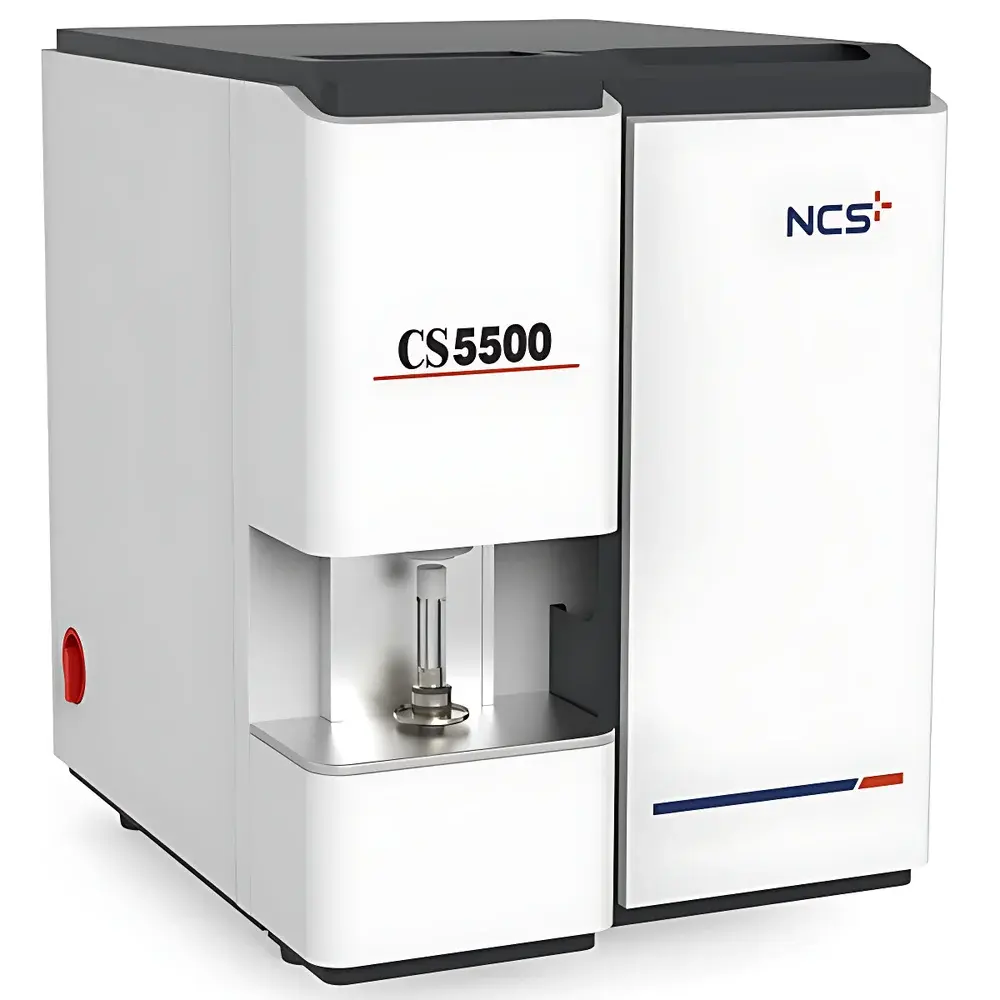
NCS CS5500 High-Frequency Infrared Carbon-Sulfur Analyzer
| Brand | NCS |
|---|---|
| Origin | Jiangsu, China |
| Manufacturer Type | Direct Manufacturer |
| Product Category | Domestic |
| Model | CS5500 |
| Measurement Principle | Infrared Absorption Spectroscopy |
| Heating System | High-Frequency Induction Furnace (13.56 MHz, 2.7 kVA, Adjustable Power) |
| Carbon Range | 0.6 ppm – 6.0% (0.0006–60 mg absolute, based on 1000 mg sample) |
| Sulfur Range | 0.6 ppm – 6.0% (0.0006–60 mg absolute, based on 1000 mg sample) |
| Sensitivity | 0.01 ppm |
| Precision | C: ±0.3 ppm or RSD ≤ 0.5% |
| S | ±0.3 ppm or RSD ≤ 0.5% |
| Analysis Time | Minimum 60 s per cycle |
| Sample Mass Recommendation | 0.1–0.5 g |
| Carrier Gas | Oxygen ≥99.5% purity |
| Assist Gas | Nitrogen or inert gas |
| Power Supply | 220 VAC ±10%, 50/60 Hz ±1 Hz, 16 A |
| Dimensions | 620 × 760 × 800 mm (W × D × H) |
| Weight | 107 kg |
Overview
The NCS CS5500 High-Frequency Infrared Carbon-Sulfur Analyzer is a precision elemental combustion analyzer engineered for quantitative determination of total carbon and sulfur in solid inorganic materials. It operates on the principle of high-frequency induction combustion followed by non-dispersive infrared (NDIR) spectroscopic detection. Solid samples are combusted quantitatively in a controlled oxygen-rich atmosphere within a 13.56 MHz high-frequency induction furnace, converting carbon and sulfur into CO2 and SO2, respectively. These gaseous oxides are then swept through optimized optical cells where their characteristic infrared absorption bands at 4.26 µm (CO2) and 7.35 µm (SO2) are measured with high signal-to-noise ratio photodetectors. The system incorporates real-time multi-parameter compensation—including CO interference correction, barometric pressure normalization, and thermal drift stabilization—to ensure metrological integrity across variable environmental and sample matrix conditions.
Key Features
- High-frequency induction furnace (13.56 MHz, 2.7 kVA) with fully adjustable power output for optimized combustion of diverse matrices—from low-carbon steels to refractory alloys and ceramic precursors.
- Patented dual-inlet/mid-extraction dust removal architecture (“top-bottom inlet, central suction”) minimizes particulate carryover to the IR cell, extending optical path lifetime and reducing maintenance frequency.
- Integrated halogen trap system enables robust analysis of halogen-containing samples (e.g., PVC-filled composites, fluorinated metallurgical slags) without detector poisoning or baseline drift.
- Dedicated physical water removal module allows direct injection of high-moisture samples (e.g., soils, sediments, hydrated ores) without pre-drying—eliminating analyte loss risks associated with thermal dehydration.
- Embedded guided maintenance video interface accessible via touchscreen, providing step-by-step visual instructions for routine tasks including filter replacement, IR cell cleaning, and furnace crucible alignment.
- Optional 120-position automated sample loader supports unattended batch analysis, improving laboratory throughput while minimizing operator variability and exposure to high-temperature components.
Sample Compatibility & Compliance
The CS5500 is validated for use with ferrous and non-ferrous metals (steels, cast irons, aluminum alloys, titanium alloys), high-temperature superalloys, cemented carbides, geological materials (ores, soils, sands, clays), ceramics, glasses, and battery cathode/anode precursors. Its measurement performance conforms to internationally recognized standards for combustion-based elemental analysis, including ASTM E1019 (Standard Test Methods for Determination of Carbon, Sulfur, Nitrogen, and Oxygen in Steel, Iron, Nickel, and Cobalt Alloys), ISO 15350 (Steel — Determination of total carbon content — Infrared absorption method after combustion in high-frequency induction furnace), and GB/T 20123–2006 (Chinese national standard equivalent). The instrument’s firmware supports audit-trail logging and user-access controls aligned with GLP and GMP documentation requirements; optional 21 CFR Part 11-compliant software modules are available for regulated environments requiring electronic signature validation and data integrity assurance.
Software & Data Management
Control and data acquisition are managed via NCS Analytical Suite v4.x—a Windows-based platform featuring intuitive workflow navigation, real-time spectral visualization, and automated calibration curve generation using certified reference materials (CRMs). All raw absorbance signals, temperature profiles, gas flow logs, and diagnostic flags are time-stamped and stored in encrypted SQLite databases. Export options include CSV, PDF analytical reports (with customizable templates), and XML for LIMS integration. The software implements automatic outlier rejection based on statistical process control (SPC) rules (e.g., Grubbs’ test), and supports multi-point calibration with up to eight CRMs per element. Method files include embedded metadata for traceability: operator ID, instrument serial number, calibration date, and environmental sensor readings (ambient temperature, pressure, humidity).
Applications
- Quality control of incoming raw materials and finished metal products in foundries and rolling mills.
- Research-grade quantification of C/S segregation in additive manufacturing feedstocks and recycled powder blends.
- Environmental geochemical screening of contaminated soils and mine tailings under EPA Method 6010D and ISO 11466 protocols.
- Process development for lithium-ion battery cathode synthesis, where residual sulfur impurities impact SEI layer formation and cycle life.
- Verification of low-carbon certification claims in stainless steel and specialty alloy production per EN 10204 Type 3.1 documentation requirements.
FAQ
What sample mass is recommended for optimal precision?
For routine analysis, 0.2–0.3 g is recommended for most metallic and mineral matrices. Lower masses (0.1 g) may be used for ultra-trace applications; higher masses (up to 0.5 g) improve precision for sub-ppm level sulfur in high-purity copper or nickel.
Can the CS5500 analyze liquid or paste samples?
No—the instrument is designed exclusively for solid, dry, or moderately hydrated inorganic solids. Liquids, oils, or organic polymers require prior ashing or solid-phase conversion before analysis.
Is carrier gas purification integrated?
Yes—the system includes a dual-stage oxygen purifier (copper-based deoxidizer + molecular sieve) and optional zero-air generator for assist gas lines, ensuring consistent baseline stability and eliminating interference from ambient CO2 and moisture.
How often does the IR detector require recalibration?
Under normal operating conditions and proper maintenance, the NDIR detectors maintain calibration for ≥12 months. Annual verification using NIST-traceable CO2/SO2 standard gases is recommended as part of scheduled instrument qualification.






