
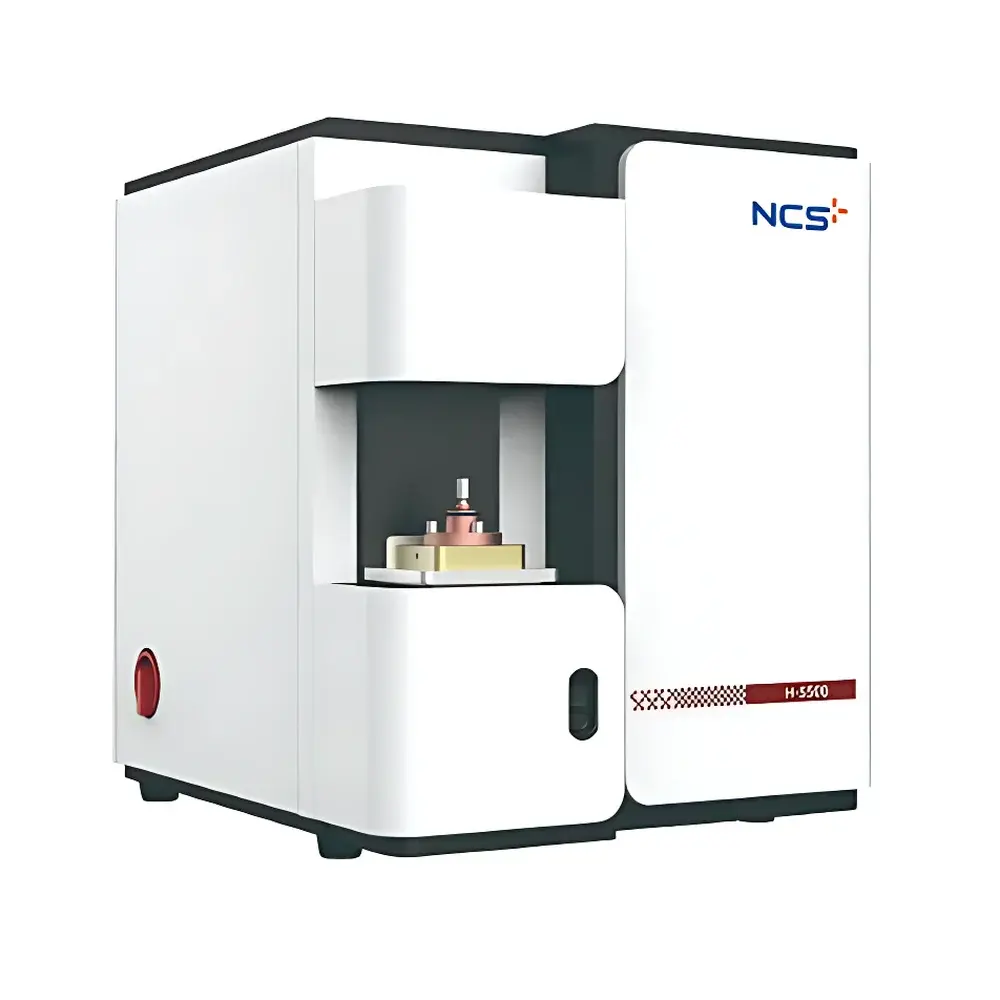
NCS H5500 Hydrogen Analyzer
| Brand | NCS |
|---|---|
| Origin | Beijing, China |
| Manufacturer Type | Manufacturer |
| Product Category | Domestic |
| Model | H5500 |
| Instrument Type | Oxygen-Nitrogen-Hydrogen Analyzer |
| Hydrogen Analysis Range | Low-H: 0.1–200 ppm |
| High-H | 200–5000 ppm |
| Hydrogen Precision | ±0.2 ppm or RSD ≤ 2.0% |
| Sensitivity | 0.01 ppm |
| Analysis Time | 3 min |
| Pulse Furnace | 0–1500 A, 8.5 kVA, Max Temp: 3500 °C |
| Carrier Gas | Ultra-High-Purity N₂ (≥99.9995%) |
| Dimensions | 63 × 76 × 76 cm (W×D×H) |
| Weight | ~180 kg |
Overview
The NCS H5500 Hydrogen Analyzer is a high-performance, fully integrated inert gas fusion analyzer engineered for the quantitative determination of hydrogen in solid inorganic materials. It operates on the principle of inert gas fusion coupled with non-dispersive infrared (NDIR) detection—a robust and widely accepted methodology for trace hydrogen analysis in metallurgical and advanced ceramic applications. In this process, a precisely weighed sample is rapidly heated to ultra-high temperatures (up to 3500 °C) in a graphite crucible within a pulse-heated furnace under high-purity nitrogen atmosphere. Hydrogen liberated from the matrix forms molecular hydrogen (H₂), which is swept through a dust trap and moisture removal system before entering the NDIR cell. The detector measures H₂ concentration via characteristic infrared absorption at 2.7 µm, delivering high specificity and minimal interferences from CO, CO₂, or NO. Designed for laboratory environments requiring GLP-compliant trace gas analysis, the H5500 supports full-range quantification—from ultra-trace levels (0.1 ppm) to mid-percentage concentrations (5000 ppm)—without hardware reconfiguration.
Key Features
- Non-dispersive infrared (NDIR) detection optimized for H₂—ensures high selectivity, long-term stability, and minimal calibration drift
- High-efficiency low-flow gas circuit design reduces N₂ consumption by up to 40% compared to conventional systems, lowering operational cost and environmental footprint
- Pulse furnace with programmable current control (0–1500 A), 8.5 kVA power rating, and verified thermal uniformity up to 3500 °C—enabling complete decomposition of refractory matrices including Ti alloys, Nb-based superalloys, and silicon nitride ceramics
- Real-time monitoring of critical parameters (furnace temperature, gas flow rate, pressure differential, detector signal baseline) via embedded sensor network
- Automated leak-check protocol initiated directly from software interface—validates system integrity prior to each analysis sequence per ASTM E144-22 guidelines
- Modular flow path with sintered metal filters, chemical scrubbers (for H₂O and CO₂ removal), and thermally stabilized NDIR cell—designed for >10,000 analyses without maintenance
- Imported high-stability mass flow controllers (MFCs) and IR detectors ensure repeatability of ≤2.0% RSD across multi-day validation runs
Sample Compatibility & Compliance
The H5500 accommodates diverse solid samples including ferrous and non-ferrous metals (e.g., stainless steels, aluminum alloys, titanium grades), metal powders (additive manufacturing feedstocks), geological specimens (ores, slags), and technical ceramics (SiC, Al₂O₃, ZrO₂). Sample mass ranges from 0.1 g to 2.0 g, enabling dynamic range extension via gravimetric scaling—fully supported by method templates in the instrument software. The system complies with key international standards for elemental gas analysis: ISO 14284 (steel—determination of oxygen, nitrogen and hydrogen), ASTM E144 (standard practice for sampling and preparation of metals for spectrochemical analysis), and JIS G 1228 (hydrogen in steel). All data acquisition and processing routines are structured to support 21 CFR Part 11 audit trails, electronic signatures, and secure user role management—meeting requirements for regulated QC/QA laboratories operating under GMP or ISO/IEC 17025 frameworks.
Software & Data Management
The NCS SmartTrace™ software platform provides intuitive, wizard-driven method setup with preconfigured templates for common material classes (e.g., “Ti-6Al-4V”, “Inconel 718”, “WC-Co powder”). Each analysis generates a timestamped, digitally signed report containing raw detector output, furnace thermal profile, gas flow log, and uncertainty estimation based on certified reference material (CRM) performance. Data export options include CSV, XML, and PDF formats compatible with LIMS integration. Built-in statistical tools enable trend analysis, control charting (X-bar/R), and automated pass/fail evaluation against user-defined specification limits. Audit logs record all operator actions—including method edits, calibration events, and result overrides—with immutable timestamps and user ID attribution.
Applications
- Quality control of hydrogen-sensitive aerospace alloys where embrittlement thresholds lie below 2 ppm
- Process validation for powder metallurgy and additive manufacturing workflows—monitoring H retention after atomization and HIP cycles
- Research into hydrogen trapping mechanisms in high-strength steels using incremental heating protocols
- Geochemical characterization of hydrogen-bearing minerals (e.g., hydrous silicates, clays) for isotopic studies
- Failure analysis of hydrogen-induced cracking (HIC) in pipeline steels and sour-service components
- Regulatory compliance testing for nuclear-grade zirconium alloys per ASTM B913
FAQ
What carrier gas is required, and what purity level is mandatory for valid results?
Ultra-high-purity nitrogen (≥99.9995% N₂, O₂ & H₂O < 0.1 ppm) is required. Lower purity compromises baseline stability and increases detection limit uncertainty.
Can the H5500 analyze liquid or volatile samples?
No. The instrument is designed exclusively for solid, non-volatile inorganic materials stable under inert gas fusion conditions.
Is method transfer possible between older NCS instruments and the H5500?
Yes—SmartTrace™ supports import of legacy method files (.mth) from NCS ONH-3000 and ONH-2000 platforms with automatic parameter mapping.
How often must the NDIR detector be recalibrated?
Factory calibration is valid for 12 months under normal use; annual verification using certified H₂-in-N₂ standard gases (e.g., 10 ppm, 100 ppm) is recommended per ISO/IEC 17025 Clause 6.6.
Does the system support remote diagnostics and firmware updates?
Yes—via encrypted HTTPS connection to NCS Cloud Services; remote support sessions require explicit operator authorization and comply with IEC 62443-3-3 security requirements.



