
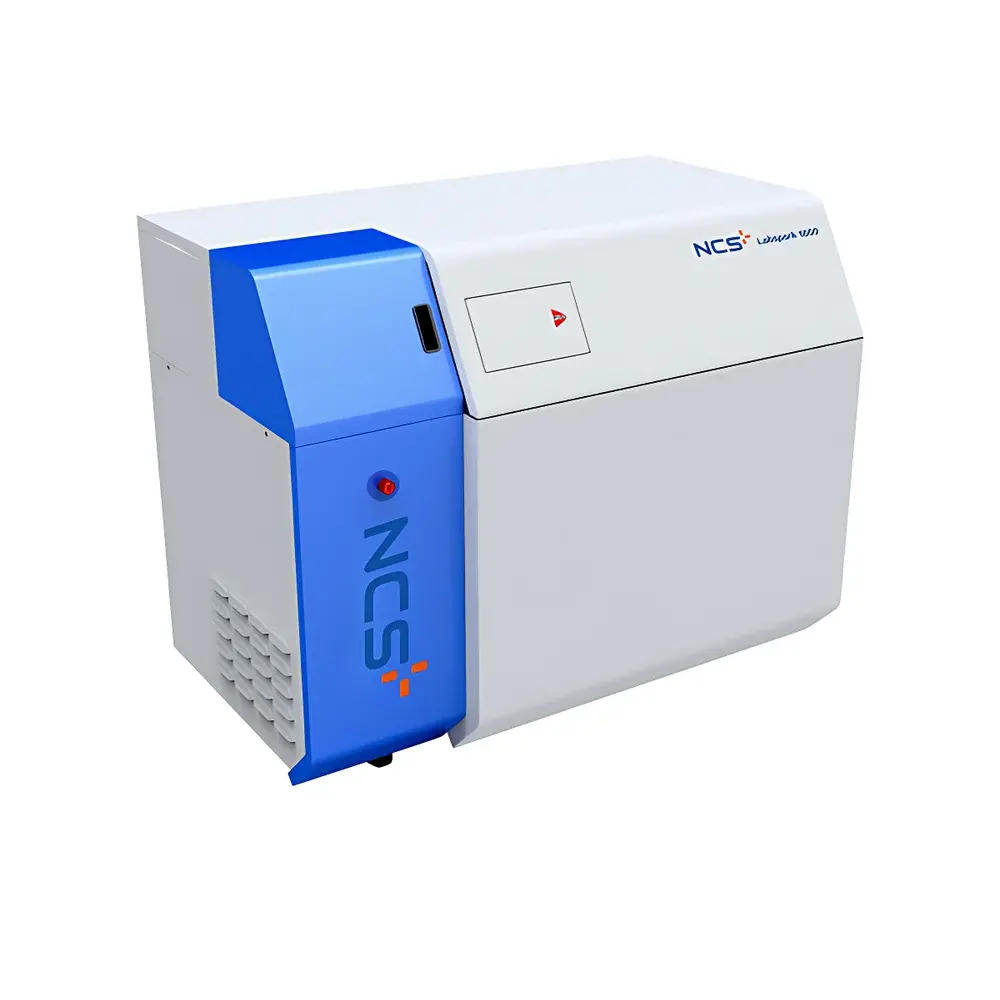
NCS Labspark 1000 Precision Spark Optical Emission Spectrometer (OES) with PMT Detection
| Brand | NCS |
|---|---|
| Origin | Jiangsu, China |
| Manufacturer | NCS (National Center for Steel & Iron Research) |
| Instrument Type | Floor-standing |
| Excitation Method | Spark Discharge |
| Detector Type | Photomultiplier Tube (PMT) |
| Focal Length | 750 mm |
| Grating Line Density | 2400 lines/mm |
| Wavelength Range | 120–800 nm |
| Number of Analytical Channels | 48 |
| Dispersion | 0.55 nm/mm (1st order), 0.275 nm/mm (2nd order) |
| Optical Resolution | < 0.01 nm |
| Selectable Spectral Lines | 240 |
| Dimensions (W×D×H) | 139 cm × 80 cm × 117 cm |
| Weight | ~400 kg |
| Power Supply | 220 V ±10%, Single-phase, 10 A, 2.5 kVA |
Overview
The NCS Labspark 1000 is a high-performance floor-standing spark optical emission spectrometer engineered for precise, rapid, and reliable elemental analysis of metallic samples in industrial and laboratory environments. Based on the Paschen-Runge optical configuration, it employs a large-format 750 mm focal length holographic grating with 2400 lines/mm to deliver exceptional spectral dispersion and resolution (< 0.01 nm). The instrument operates on the principle of spark-induced atomic emission: a controlled high-energy spark vaporizes and excites surface material from a solid metal sample, generating element-specific line spectra in the vacuum ultraviolet to near-infrared range (120–800 nm). These emissions are dispersed by the grating and simultaneously detected across up to 48 fixed PMT channels—each optimized for a specific analytical line—enabling multi-element quantification with high signal-to-noise ratio and low detection limits. Designed and manufactured in-house by NCS—a national leader in metallurgical instrumentation and contributor to GB/T 4336–2016—the Labspark 1000 meets rigorous requirements for production control, incoming inspection, and R&D validation in foundries, steel mills, aerospace component suppliers, and certified testing laboratories.
Key Features
- Ultra-high-resolution Paschen-Runge optical system with 750 mm focal length and 2400 lines/mm holographic grating, enabling simultaneous coverage of critical spectral lines from Li (610.3 nm) to S (180.7 nm), P (178.2 nm), N (149.2 nm), B (182.6 nm), and Sb (231.0 nm).
- Patented Single Discharge Analysis (SDA) technology—derived from NCS’ metal micro-analyzers—acquires and statistically evaluates individual spark pulses to identify and suppress inclusion-related spectral anomalies, improving measurement reproducibility and accuracy.
- Hardware-adjustable time-delayed integration per channel, minimizing background continuum and inter-element interference, particularly beneficial for low-intensity or overlapping lines (e.g., C 193.0 nm, S 180.7 nm, P 178.2 nm).
- Dedicated fatigue-compensated background lamp system reduces PMT dark current drift, enhancing long-term signal stability and extending detector service life.
- Fully digital, frequency-tunable spark source (up to 1000 Hz) with adaptive energy delivery for optimal excitation across Fe-, Al-, Cu-, Ni-, Mg-, Ti-, Zn-, and Co-based alloys.
- Coaxial spark stand with optimized argon flow dynamics—reducing gas consumption by >30% versus conventional designs—while minimizing metal dust accumulation and improving plasma stability and repeatability.
- Real-time ARM9-based hardware monitoring system continuously tracks photomultiplier high voltage, vacuum level, optical chamber temperature (±0.1 °C), and spark stand thermal load—supporting predictive maintenance and GLP-compliant operation logs.
Sample Compatibility & Compliance
The Labspark 1000 supports solid conductive metallic samples—including cast iron, carbon and low-alloy steels, stainless steels, aluminum and magnesium alloys, copper and nickel base alloys, titanium, zinc, lead, and tin—without requiring matrix-matched standards for routine calibration. It complies with ASTM E415, ASTM E1086, ISO 11577, and GB/T 4336–2016 for spark OES analysis of metals. Its vacuum optical path eliminates atmospheric absorption below 190 nm, ensuring accurate quantification of light elements (C, P, S, N, B, Be, As) essential for high-strength alloy certification. All firmware and software modules support audit trail generation, user access control, and electronic signature functionality aligned with FDA 21 CFR Part 11 and ISO/IEC 17025 documentation requirements.
Software & Data Management
The instrument is operated via NCS SpectraLink™ v5.x software—a Windows-based platform featuring intuitive workflow-driven interface, method editor with multi-matrix calibration management, real-time spectral visualization, and automated quality control (QC) flagging. Calibration models include type-standard, certified reference material (CRM), and synthetic standard options with polynomial and inverse regression algorithms. Data export supports CSV, XML, and LIMS-compatible formats (ASTM E1382, ASTM E1489). Built-in statistical tools enable Gage R&R, CPK, trend analysis, and SPC charting. All analytical sessions, parameter changes, and user actions are logged with timestamp, operator ID, and reason-for-change fields—fully traceable for internal audits or regulatory inspections.
Applications
- Primary and secondary metallurgy: melt shop process control, ladle analysis, and continuous casting composition verification.
- Foundry QA/QC: rapid sorting of scrap, verification of alloy grade conformity (e.g., EN 10027, ASTM B209), and rejection of off-spec castings.
- Aerospace & power generation: certification of Ni-superalloys (Inconel®, Waspaloy®), Ti-6Al-4V, and cobalt-chromium grades per AMS 2277, AMS 2355, and ASME BPVC Section II.
- Automotive supply chain: incoming inspection of engine blocks, transmission housings, and structural components per IATF 16949 requirements.
- Research & development: compositional mapping of novel high-entropy alloys, additive manufacturing powders, and recycled metal streams.
FAQ
What elements can the Labspark 1000 quantify with certified detection limits?
It delivers validated detection limits for C (≤8 ppm), P (≤10 ppm), S (≤10 ppm), N (≤30 ppm), B (≤5 ppm), and Sn/Sb/As (≤1–3 ppm) in steel matrices, and sub-ppm levels for major alloying elements (Cr, Ni, Mo, Mn, Si, Al, Cu, V, Nb, Ti) across Fe, Al, Cu, Ni, Mg, and Ti base materials.
Is vacuum pumping required during operation?
Yes—the optical chamber is maintained under high vacuum (≤1 Pa) to transmit VUV radiation below 190 nm; the integrated turbomolecular pump operates automatically with pressure feedback control and requires no user intervention.
Can the instrument be upgraded to add new analytical channels post-purchase?
No—channel configuration is fixed at manufacture due to PMT physical placement and associated high-voltage cabling; however, spectral line selection within the 240-line library can be reconfigured via software without hardware modification.
What maintenance intervals are recommended for routine operation?
Spark stand cleaning every 500–1000 analyses; PMT gain recalibration quarterly; vacuum pump oil replacement annually; full optical alignment verification biannually or after relocation.
Does the system support remote diagnostics and firmware updates?
Yes—via secure TLS-encrypted Ethernet connection, authorized service engineers can initiate remote session-based diagnostics, log review, and controlled firmware updates compliant with IEC 62443-3-3 cybersecurity guidelines.





