
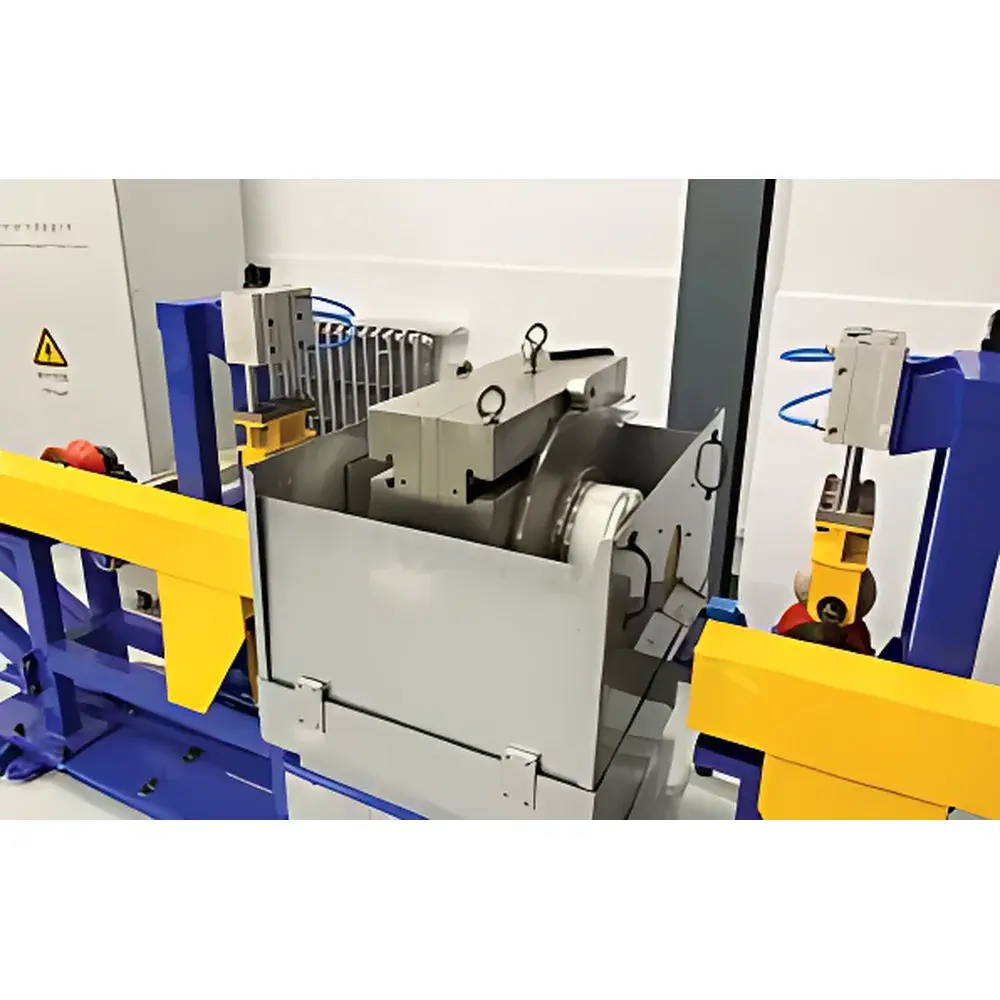
NCS NC-Series Phased Array Ultrasonic Testing (PAUT) System
| Brand | NCS |
|---|---|
| Origin | Beijing, China |
| Manufacturer Type | Original Equipment Manufacturer (OEM) |
| Country of Origin | Domestic (China) |
| Model | NC-Series |
| Pricing | Available Upon Request |
Overview
The NCS NC-Series Phased Array Ultrasonic Testing (PAUT) System is an advanced non-destructive testing (NDT) instrument engineered for high-fidelity volumetric inspection of metallic, composite, and welded structures. Based on the principle of controlled time-delayed excitation of multiple piezoelectric elements within a single probe assembly, the system generates steerable, dynamically focused ultrasonic beams without mechanical movement. This enables real-time beam steering (±70°), electronic focusing across variable depths (1–500 mm range typical), and sectorial or linear scanning modes—fundamental capabilities required for ISO 13588-compliant weld inspection, ASTM E2700 implementation, and aerospace-grade component verification. Designed for integration into production line QA/QC workflows and field-deployable inspection protocols, the NC-Series delivers deterministic signal-to-noise ratio enhancement and spatial resolution optimized for detection of sub-millimeter planar indications—including lack of fusion, cracking, and porosity—in thick-section forgings and multi-pass welds.
Key Features
- Independent element control across up to 128-channel phased array probes, supporting full matrix capture (FMC) and total focusing method (TFM) reconstruction
- Real-time beam forming with programmable focal laws for dynamic depth focusing, lateral beam steering, and sectorial scanning (S-scan), linear scanning (L-scan), and C-scan imaging
- Integrated pulser-receiver architecture with 10-bit A/D conversion, ≥60 dB signal dynamic range, and adjustable pulse voltage (up to 400 V)
- Ruggedized industrial enclosure rated IP65 for operation in harsh environments including fabrication shops, offshore platforms, and pipeline right-of-ways
- Reduced mechanical dependency: eliminates need for precision-encoded wedge mounts or motorized scanners in many applications, lowering setup time and calibration frequency
- Onboard hardware-accelerated TFM processing enabling near-real-time image reconstruction at frame rates exceeding 15 Hz for standard 64-element arrays
Sample Compatibility & Compliance
The NC-Series accommodates a broad spectrum of test specimens—from thin-walled tubing (≥1.5 mm wall thickness) to heavy-section pressure vessel components (up to 300 mm thickness). Probe coupling supports conventional wedge-based immersion and contact techniques, as well as custom-designed encoded encoders for automated rail-guided scanning. The system complies with international NDT standards including ISO 2400 (ultrasonic equipment characterization), ISO 16810 (general requirements for ultrasonic testing), and EN 1330-4 (terminology for phased array). It supports generation of audit-ready reports compliant with ASME BPVC Section V, API RP 1104 Annex A, and EN ISO 17640, with embedded metadata traceability for probe ID, calibration date, operator ID, and environmental conditions.
Software & Data Management
The NC-Series operates with NCS PAUT Studio—a Windows-based application developed in accordance with IEC 62591 (WirelessHART) interoperability principles and aligned with FDA 21 CFR Part 11 requirements for electronic records and signatures. Software features include customizable focal law libraries, automatic gain compensation (AGC) mapping, delta-Tof analysis for time-of-flight diffraction (TOFD) hybrid inspections, and integrated data export to ASTM E2371-compliant .udx binary format. All raw A-scan data, processed images, and configuration logs are stored with SHA-256 hashing for integrity verification. Audit trails record user actions—including parameter changes, report generation, and calibration events—with timestamped, role-based access control.
Applications
- Weld inspection in power generation (boiler tubes, turbine casings), oil & gas (pipelines, flare stacks), and shipbuilding (fillet welds, butt joints)
- In-service inspection of rail axle shafts, aircraft landing gear components, and wind turbine tower weldments
- Manufacturing process validation for additive manufactured (AM) metal parts, including pore and lack-of-fusion mapping
- Thickness mapping and corrosion monitoring in storage tanks and heat exchanger tubesheets
- Research-grade material characterization, including grain structure analysis in nickel-based superalloys and anisotropic composites
FAQ
What types of probes are compatible with the NC-Series system?
The system supports standard 16–128 element linear, annular, and matrix array probes with LEMO-00 or Micro-D interfaces, including dual-element and TOFD-compatible configurations.
Does the NC-Series support automated scanning integration?
Yes—it provides digital I/O ports and EtherCAT interface for synchronization with third-party encoded scanners, robotic arms, and CNC positioning systems.
Is the software validated for regulated industries?
NCS PAUT Studio includes IQ/OQ documentation packages and supports 21 CFR Part 11 compliance through optional electronic signature modules and configurable audit trail retention policies.
Can the system perform both PAUT and conventional UT simultaneously?
Yes—the dual-mode architecture allows concurrent acquisition from phased array and single-element channels, enabling hybrid inspection strategies per ISO 23279 Annex B.
What calibration standards does the NC-Series reference?
System calibration follows ASTM E1158, ISO 12718, and EN 12668-1 procedures; reference blocks include IIW Type 1, ASME Section V Article 4, and custom geometry blocks traceable to NIM (National Institute of Metrology, China).



