
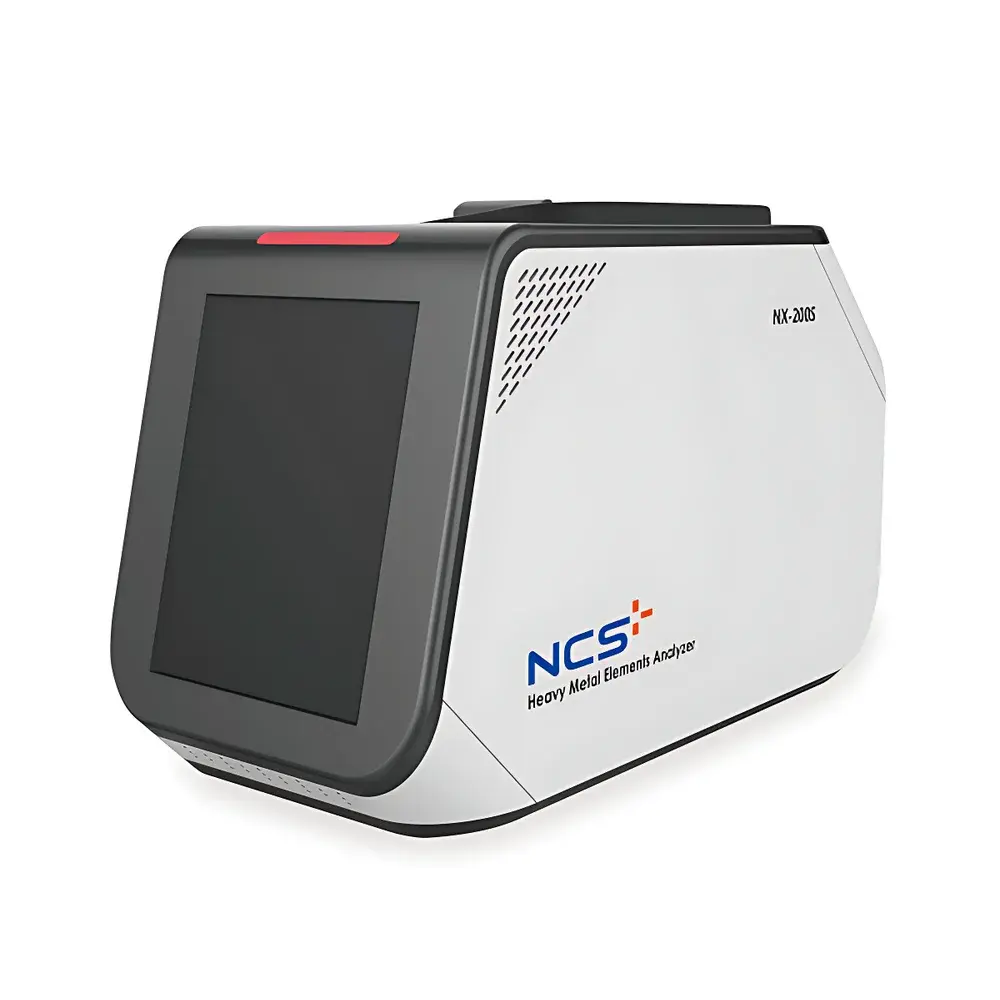
NCS NX-200S Portable XRF Soil Heavy Metal Analyzer
| Brand | NCS |
|---|---|
| Origin | Beijing, China |
| Manufacturer Type | OEM Manufacturer |
| Country of Origin | China |
| Model | NX-200S |
| Pricing | Upon Request |
| X-ray Tube | 70 kV end-window micro-focus tube |
| Detector | Imported integrated Si-PIN detector, energy resolution ≤125 eV at 5.889 keV |
| Sample Form | Dry, homogenized powder (no digestion required) |
| Detection Limits (3σ, mg/kg) | Cd 0.16 |
| Battery Life | 8–10 h per charge (removable Li-ion) |
| Operating Temperature | −20 °C to +40 °C |
| Dimensions | 260 W × 350 L × 300 H mm |
| Weight | <4.5 kg |
| Compliance | GBZ 115–2002 (X-ray safety), GB 15618–2018 (Soil Risk Control Standard) |
Overview
The NCS NX-200S Portable XRF Soil Heavy Metal Analyzer is an engineered field-deployable instrument designed for rapid, non-destructive elemental quantification in soil and sediment matrices. Based on energy-dispersive X-ray fluorescence (EDXRF) spectroscopy, the NX-200S utilizes a high-stability 70 kV end-window micro-focus X-ray tube and a factory-calibrated, integrated Si-PIN detector with ≤125 eV resolution at Mn Kα (5.889 keV). This architecture enables direct solid-phase analysis—eliminating acid digestion, solvent extraction, or plasma generation—while maintaining compliance with Chinese national standards for agricultural land risk assessment (GB 15618–2018). The system is optimized for the eight regulated heavy metals (Cd, Hg, Pb, As, Cr, Ni, Cu, Zn), with validated detection limits as low as 0.16 mg/kg for cadmium (3σ), and supports extended elemental coverage including Mn, Fe, Ti, Ba, Rb, Sr, Zr, and others relevant to geochemical profiling and regulatory screening.
Key Features
- Field-ready portability: Weighing under 4.5 kg with ergonomic carry handle and integrated 7-inch capacitive touchscreen interface; operates continuously for 8–10 hours on a single removable Li-ion battery pack—rechargeable via AC 220 V or DC 12 V vehicle adapter.
- Zero-consumables operation: Requires no gases, acids, solvents, or disposable components; fully compliant with green analytical chemistry principles and waste minimization mandates under ISO 14001-aligned laboratory practices.
- Intelligent matrix correction: Embedded multivariate algorithms compensate for particle size distribution, moisture content (<15% w/w), and organic matter variability across soil types—including loam, clay, sandy loam, and water-sediment composites—without user calibration intervention.
- Regulatory-grade hardware safety: Radiation shielding exceeds GBZ 115–2002 requirements for portable XRF devices; includes interlocked shutter, real-time dose monitoring, and automatic beam cutoff upon lid opening.
- Dual-access software architecture: Role-based permission control (Administrator / Operator modes) ensures audit-trail integrity and procedural compliance during GLP/GMP-aligned environmental monitoring campaigns.
- Reusable sample containment: Precision-machined polypropylene test cups with Mylar film windows support >500 cycles per unit; compatible with optional drying station, mortar/pestle set, and 2 mm stainless steel sieve (all field-accessory kits sold separately).
Sample Compatibility & Compliance
The NX-200S accepts air-dried, sieved (<2 mm), and homogenized soil samples without chemical pretreatment. It is validated for use with reference materials certified by CNAS-accredited labs (e.g., GSS series, GBW074xx) and demonstrates linearity (R² ≥ 0.998) across concentration ranges spanning 0.5× to 10× regulatory thresholds per GB 15618–2018. Instrument performance meets criteria specified in HJ 1057–2019 (“Technical Guidelines for Field Screening of Heavy Metals in Soils Using Portable XRF”) and aligns with ASTM D7727–22 for field-deployable EDXRF validation protocols. All firmware and calibration files are digitally signed and version-controlled to support 21 CFR Part 11-compliant data integrity frameworks when deployed within enterprise environmental QA/QC workflows.
Software & Data Management
The embedded NCS SoilQuant v3.2 software provides real-time spectral deconvolution, peak integration, and empirical coefficient-based quantification using factory-loaded soil-specific calibrations. Data export formats include CSV, PDF reports (with embedded spectra and uncertainty estimates), and XML metadata bundles compliant with ISO/IEC 17025 traceability requirements. Optional cloud synchronization enables centralized dashboard monitoring across multi-site remediation projects; local database storage retains full raw spectra, acquisition parameters, operator ID, GPS coordinates (via optional Bluetooth GNSS module), and timestamped audit logs for ≥12 months. Software updates are delivered via encrypted USB key or secure OTA channel with SHA-256 signature verification.
Applications
- Rapid field triage of contaminated sites prior to grid-based sampling and lab confirmation.
- On-site verification of remediation endpoints during soil washing, stabilization, or excavation projects.
- Compliance monitoring for brownfield redevelopment under Ministry of Ecology and Environment (MEE) supervision.
- Supporting national soil census initiatives and provincial agricultural land classification programs.
- Academic research in pedogeochemistry, heavy metal bioavailability modeling, and phytoremediation efficacy assessment.
- Emergency response screening following industrial spills, mining tailings breaches, or flood-related contaminant mobilization events.
FAQ
Does the NX-200S require annual recalibration by the manufacturer?
No—factory calibrations are stable for ≥12 months under normal field use; users perform daily verification using included NCS-certified check standards (Cd/Pb/Cu/Zn in soil matrix). Full recalibration is recommended only after physical shock, detector replacement, or exposure to extreme thermal cycling (>50 °C variation).
Can the instrument quantify total mercury in soils with high organic content?
Yes—the built-in organic-matter correction algorithm mitigates attenuation effects from humic substances; however, for Hg concentrations 20% OM), confirmatory ICP-MS analysis is advised per HJ 680–2013.
Is GPS geotagging supported natively?
GPS functionality is available via optional external Bluetooth GNSS receiver (e.g., u-blox M8T); location data is embedded into each spectrum header and report export.
What is the minimum sample mass required for reliable quantification?
A minimum of 3 g of homogenized, <2 mm fraction is required; sample cups are filled to the 10 mL mark (≈6–7 g typical density) to ensure consistent geometry and attenuation correction.
How does the NX-200S handle overlapping spectral peaks (e.g., As Kα and Pb Mα)?
The Si-PIN detector’s 125 eV resolution combined with iterative least-squares fitting (Fundamental Parameters method) resolves these interferences; spectral libraries include interference correction coefficients derived from NIST SRM 2710a and GBW07401 validation sets.






