
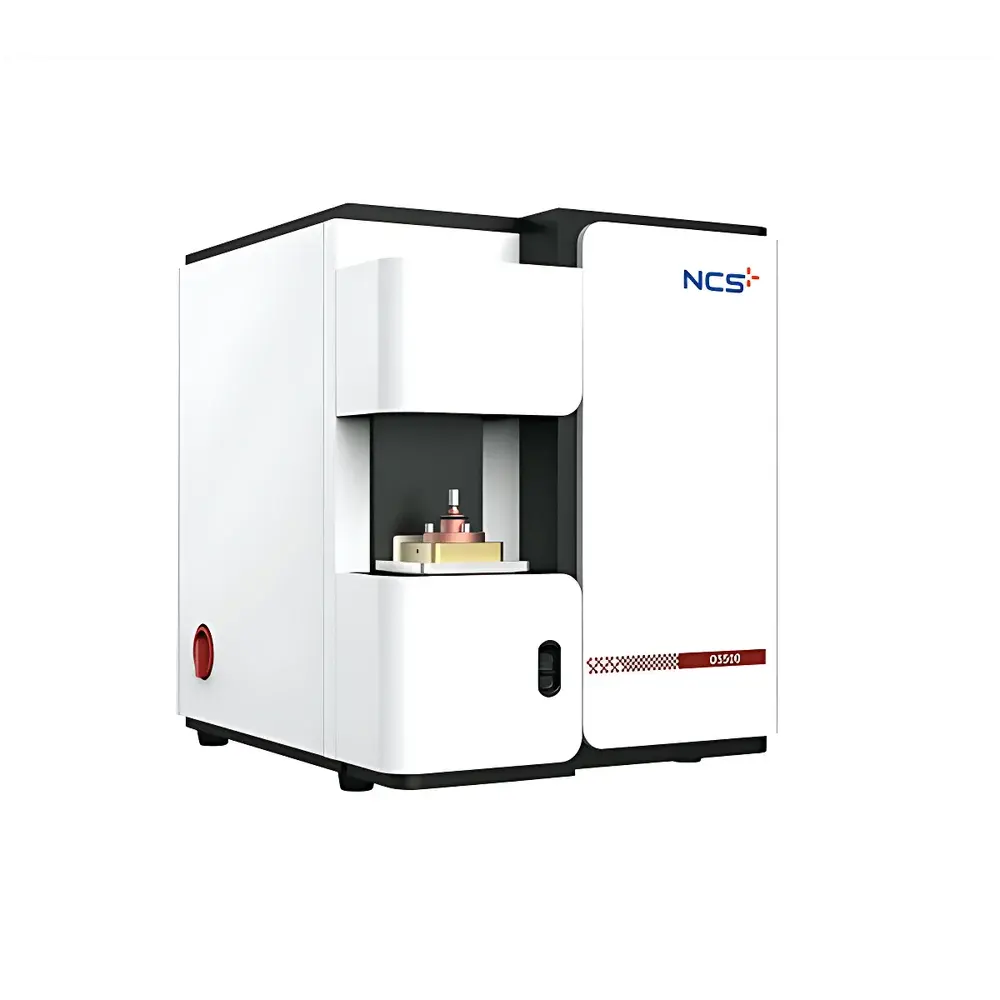
NCS O5500 Oxygen Analyzer
| Brand | NCS |
|---|---|
| Origin | Beijing, China |
| Manufacturer | NCS (Beijing Central Iron and Steel Research Institute) |
| Model | O5500 |
| Instrument Type | Oxygen Analyzer |
| Analysis Range | Low-Oxygen Mode: 0.1 ppm – 0.5% |
| High-Oxygen Mode | 0.5% – 20% (range adjustable via sample mass) |
| Precision | ±1 ppm or RSD ≤ 1.0% |
| Sensitivity | 0.01 ppm |
| Analysis Time | ~3 min |
| Pulse Furnace | 0–1500 A, 7.5 kVA, max. temperature 3500 °C |
| Sample Mass | Typically 1.0 g |
| Carrier Gas | Ultra-high-purity argon (≥99.9995%) |
| Dimensions | 63 cm (W) × 76 cm (D) × 76 cm (H) |
| Weight | ~180 kg |
Overview
The NCS O5500 Oxygen Analyzer is a high-performance, pulse-heating non-dispersive infrared (NDIR) gas extraction instrument engineered for precise quantification of total oxygen content in solid inorganic materials. Developed by Beijing Central Iron and Steel Research Institute (NCS), a state-owned research institution with over four decades of expertise in inert gas fusion analysis, the O5500 represents the culmination of continuous innovation since NCS’s first vacuum fusion gas analyzer in 1977 and its pioneering industrial-scale pulsed infrared oxygen analyzer in 1991. The instrument operates on the principle of high-temperature inert-gas fusion: solid samples are thermally decomposed in a graphite crucible under ultra-pure argon flow within a water-cooled pulse furnace capable of reaching 3500 °C. Liberated oxygen reacts with graphite to form CO, which is then quantified via NDIR detection at 4.26 µm — a wavelength highly selective for carbon monoxide absorption. This methodology ensures stoichiometric conversion, minimal memory effect, and compatibility with refractory matrices including steels, superalloys, metal powders, ceramics, and geological specimens.
Key Features
- Non-dispersive infrared (NDIR) detection system optimized for CO measurement, delivering high selectivity and long-term signal stability without optical filters or moving parts.
- High-efficiency low-flow gas circuit design reduces argon consumption by up to 40% compared to conventional systems, significantly lowering operational cost per analysis while maintaining quantitative recovery.
- Intelligent software-enabled real-time monitoring of critical parameters: furnace current/voltage, gas pressure, flow rate, detector signal baseline, and system leak status.
- Automated self-diagnostic routines including software-controlled leak testing, zero-point verification, and background drift compensation — all traceable and logged for audit purposes.
- Robust pulse furnace with digitally regulated current control (0–1500 A), 7.5 kVA power rating, and integrated thermal shielding to ensure reproducible heating profiles across diverse sample types and masses.
- Critical components — including IR source, detector, and precision mass flow controllers — sourced from Tier-1 international suppliers to guarantee extended service life and metrological consistency.
Sample Compatibility & Compliance
The O5500 is validated for use with a broad spectrum of solid inorganic materials: ferrous and non-ferrous metals (including stainless steels, titanium alloys, and nickel-based superalloys), additive manufacturing powders (e.g., Ti-6Al-4V, Inconel 718), oxide ceramics (Al2O3, ZrO2), carbides, nitrides, and mineral ores. Its analytical performance meets the technical requirements of ASTM E1019 (Standard Test Methods for Determination of Carbon, Sulfur, Nitrogen, and Oxygen in Steel, Iron, Nickel, and Cobalt Alloys), ISO 14284 (Steel and Iron — Sampling and Preparation of Samples for Determination of Chemical Composition), and GB/T 11261–2022 (Chinese national standard for oxygen determination in steel by inert gas fusion–infrared absorption). The system supports full GLP/GMP compliance through user-accessible audit trails, electronic signature capability, and configurable method locking — aligning with FDA 21 CFR Part 11 data integrity expectations when deployed in regulated QC environments.
Software & Data Management
The O5500 is operated via NCS Analytical Suite v3.2 — a Windows-based platform supporting multi-user role management (administrator, analyst, reviewer), customizable report templates (PDF/CSV/XLSX), and secure database storage with automatic daily backup. All analytical sequences — including calibration curves, blank subtraction protocols, and matrix-matched correction factors — are stored as version-controlled methods. Raw detector signals, furnace thermograms, and gas chromatograms are archived with timestamps and operator IDs. The software includes built-in uncertainty estimation per ISO/IEC 17025 guidelines, calculates expanded uncertainty (k=2), and generates calibration certificates compliant with ISO/IEC 17025:2017 Annex A.2. Data export supports LIMS integration via ODBC and HL7-compatible structured output.
Applications
- Quality control of high-purity specialty steels where oxygen content directly influences fatigue life and inclusion morphology.
- Process validation of powder metallurgy feedstocks, particularly for aerospace-grade metal powders where interstitial oxygen governs sinterability and mechanical anisotropy.
- Research-grade oxygen profiling in ceramic matrix composites (CMCs) and refractory oxides used in nuclear and thermal barrier applications.
- Trace oxygen screening in electronic-grade silicon carbide wafers and gallium nitride substrates.
- Geochemical analysis of oxygen isotopic proxies in silicate minerals using pre-calibrated reference materials (e.g., NIST SRM 690, USGS GSP-2).
FAQ
What sample forms are compatible with the O5500?
Solid metallic chips, turnings, drillings, pressed pellets, and sintered powders — all must be free of surface oil, moisture, and organic contaminants. Powders require homogenization and may need binder-free pelletization for reproducible fusion.
Is carrier gas purity critical for accuracy?
Yes. Argon ≥99.9995% purity is mandatory; lower grades introduce hydrocarbon interference and elevated baseline noise, compromising detection limits and precision.
How does the O5500 handle high-oxygen ceramics like Fe2O3 or MnO2?
By reducing sample mass (e.g., 10–50 mg) and applying high-sensitivity calibration curves, the instrument maintains linearity across the full 0.1 ppm–20% range without dilution or secondary digestion steps.
Can the O5500 be integrated into an automated lab workflow?
Yes — optional robotic sample loading modules and Ethernet-based remote command interface (TCP/IP) enable unattended operation and scheduling via external LIMS or MES platforms.
What maintenance intervals are recommended?
Graphite crucibles: replaced after every 100–200 analyses depending on matrix; IR cell purge gas filters: quarterly; furnace cooling system descaling: biannually; full system performance verification: semi-annually per ISO/IEC 17025 internal quality control schedule.




