
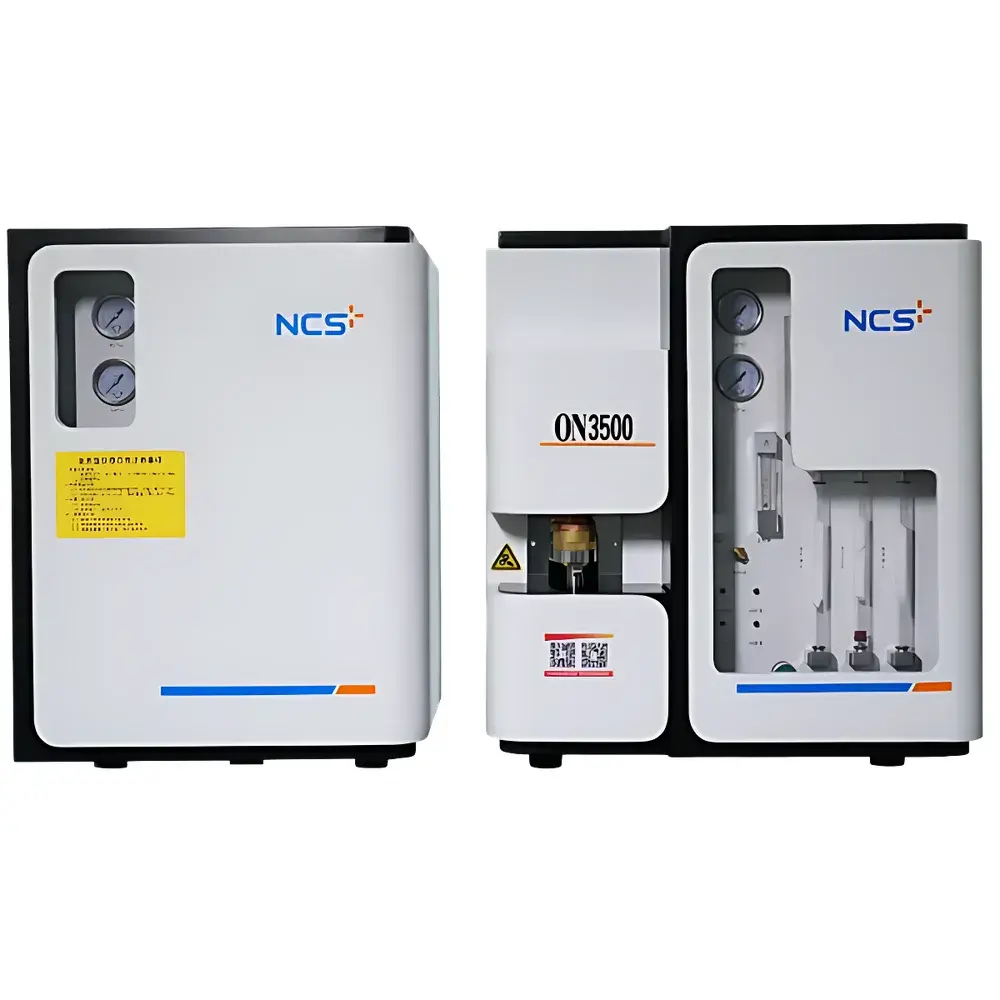
NCS ON3500 Oxygen and Nitrogen Analyzer
| Brand | NCS |
|---|---|
| Origin | Jiangsu, China |
| Manufacturer Type | Manufacturer |
| Instrument Type | Oxygen and Nitrogen Analyzer |
| Model | ON3500 |
| Oxygen Range (Low) | 0.1 ppm–0.5% |
| Oxygen Range (High) | 0.5%–20% |
| Nitrogen Range (Low) | 0.1 ppm–0.5% |
| Nitrogen Range (High) | 0.5%–50% |
| Oxygen Precision | 1 ppm or RSD ≤ 1.0% |
| Nitrogen Precision | 1 ppm or RSD ≤ 1.0% |
| Sensitivity | 0.01 ppm |
| Analysis Time | 3 min |
| Pulse Furnace Power | 8.5 kVA |
| Detectors | Dual-channel NDIR (O₂), TCD (N₂) |
| Carrier Gas | Ultra-high-purity He |
| Auxiliary Gas | Industrial-grade N₂ |
| Furnace Power Supply | 220 VAC ±10%, 50 A |
| Instrument Power Supply | 220 VAC ±10%, 10 A |
| Dimensions (Main Unit) | 58 cm × 70 cm × 68 cm (W×D×H) |
| Dimensions (Furnace Unit) | 48 cm × 70 cm × 68 cm (W×D×H) |
| Weight | 180 kg |
Overview
The NCS ON3500 Oxygen and Nitrogen Analyzer is a high-performance inert gas fusion analyzer engineered for precise quantification of interstitial oxygen and nitrogen in solid inorganic materials. It operates on the principle of inert gas fusion–infrared absorption (for oxygen) and thermal conductivity detection (for nitrogen). Solid samples are rapidly heated to temperatures up to 3500 °C in a graphite crucible within a water-cooled pulse furnace under ultra-high-purity helium atmosphere. Liberated oxygen forms CO and CO₂ upon reaction with graphite; CO₂ is measured via dual non-dispersive infrared (NDIR) detection channels—optimized separately for low- and high-concentration oxygen ranges. Simultaneously, nitrogen remains unreactive and is quantified directly using a high-stability, paired-filament thermal conductivity detector (TCD) with inert-gas-protected thermistors. This dual-detection architecture ensures trace-level sensitivity (0.01 ppm), wide dynamic range, and high reproducibility across diverse material matrices.
Key Features
- Modular two-unit design: physically separated pulse furnace and detection console minimize electromagnetic interference and thermal cross-talk, enhancing signal stability and long-term baseline integrity.
- Dual independent NDIR channels for oxygen analysis—each optimized for distinct concentration domains (0.1 ppm–0.5% and 0.5%–20%)—enabling automatic range switching during a single analysis sequence.
- High-fidelity TCD system featuring matched tungsten-rhenium filaments, breath-mode constant-current excitation, and integrated inert-gas shielding to prevent oxidation-induced drift.
- Pulse furnace with closed-loop power control and programmable ramp profiles—insensitive to crucible geometry or carbon content, ensuring consistent thermal decomposition regardless of sample mass or form.
- Optimized all-metal gas path: leak-tight stainless-steel manifolds, electropolished surfaces, and minimal dead volume reduce memory effects and background contamination.
- Advanced optical subsystem: high-output stabilized IR source, precision chopper motor with light-cone focusing optics, and pyroelectric solid-state detectors delivering superior signal-to-noise ratio and sub-ppm resolution.
Sample Compatibility & Compliance
The ON3500 accommodates a broad spectrum of conductive and semi-conductive solid inorganic materials—including ferrous and non-ferrous metals (steels, titanium alloys, nickel superalloys), powder metallurgy compacts, ceramic oxides (Al₂O₃, SiC, ZrO₂), refractory carbides, geological silicates, and electronic-grade sintered substrates. Sample mass is adjustable (typically 0.1–1.0 g) to optimize sensitivity and dynamic range per application requirement. The instrument conforms to core analytical standards governing elemental gas analysis, including ASTM E1019 (Standard Test Methods for Determination of Carbon, Sulfur, Nitrogen, and Oxygen in Steel, Iron, Nickel, and Cobalt Alloys), ISO 14284 (Steel and Iron—Sampling and Preparation of Samples for Determination of Chemical Composition), and JIS G 1211 (Methods for Determination of Oxygen and Nitrogen in Steel). Its hardware architecture and data handling protocols support GLP/GMP-aligned workflows, with audit-trail-capable software meeting foundational requirements for FDA 21 CFR Part 11 compliance when deployed with appropriate system validation and user access controls.
Software & Data Management
The ON3500 is operated via NCS Analytical Suite—a Windows-based platform offering real-time monitoring of furnace temperature, gas flow rates, detector voltages, pressure differentials, and calibration status. All critical parameters—including pulse energy, integration time, zero/span correction factors, and channel gain settings—are logged with timestamped metadata for full traceability. Data export supports CSV, XML, and LIMS-compatible formats. Calibration routines include multi-point linear and quadratic regression against certified reference materials (CRMs) traceable to NIST or BIPM standards. Software supports method templates, user-defined reporting layouts, and automated QC flagging based on RSD thresholds, blank drift limits, and recovery criteria. Audit logs record operator ID, method version, calibration history, and raw spectral/detector output files—ensuring defensible data integrity for regulatory submissions.
Applications
The ON3500 serves as a primary tool for quality assurance and process development in metallurgical R&D laboratories, foundry QA departments, aerospace component certification labs, and third-party testing facilities. Typical use cases include: verification of oxygen pickup during vacuum arc remelting (VAR) of titanium alloys; nitrogen content control in austenitic stainless steels and nitrided tool steels; impurity profiling of silicon carbide ceramics used in semiconductor substrates; specification conformance testing of rare-earth permanent magnet powders; and oxygen/nitrogen speciation in geological reference materials for geochemical standardization. Its robustness and reproducibility make it suitable for routine high-throughput analysis in ISO/IEC 17025-accredited environments.
FAQ
What types of samples can be analyzed on the ON3500?
Solid inorganic materials including metals, alloys, ceramics, refractories, and geological specimens—provided they are compatible with graphite crucible fusion and do not generate volatile halides or phosphorus species that may contaminate the gas path.
Is helium the only acceptable carrier gas?
Yes—ultra-high-purity helium (≥99.999%) is mandatory for both oxygen and nitrogen measurement to ensure baseline stability, avoid spectral interference, and maintain detector longevity.
How does the instrument handle calibration verification?
Calibration is performed using certified reference materials with certified O/N values; daily system suitability checks include blank analysis, CRM verification, and detector linearity assessment across the full dynamic range.
Can the ON3500 be integrated into an automated lab environment?
Yes—the instrument supports RS-232, Ethernet, and optional OPC UA interfaces for bidirectional communication with LIMS, MES, or robotic sample-handling systems.
What maintenance is required for long-term performance?
Routine maintenance includes monthly IR source alignment verification, quarterly TCD filament resistance checks, biannual gas path leak testing, and annual furnace insulation inspection—all documented in the included service logbook and supported by NCS field service engineers.





