
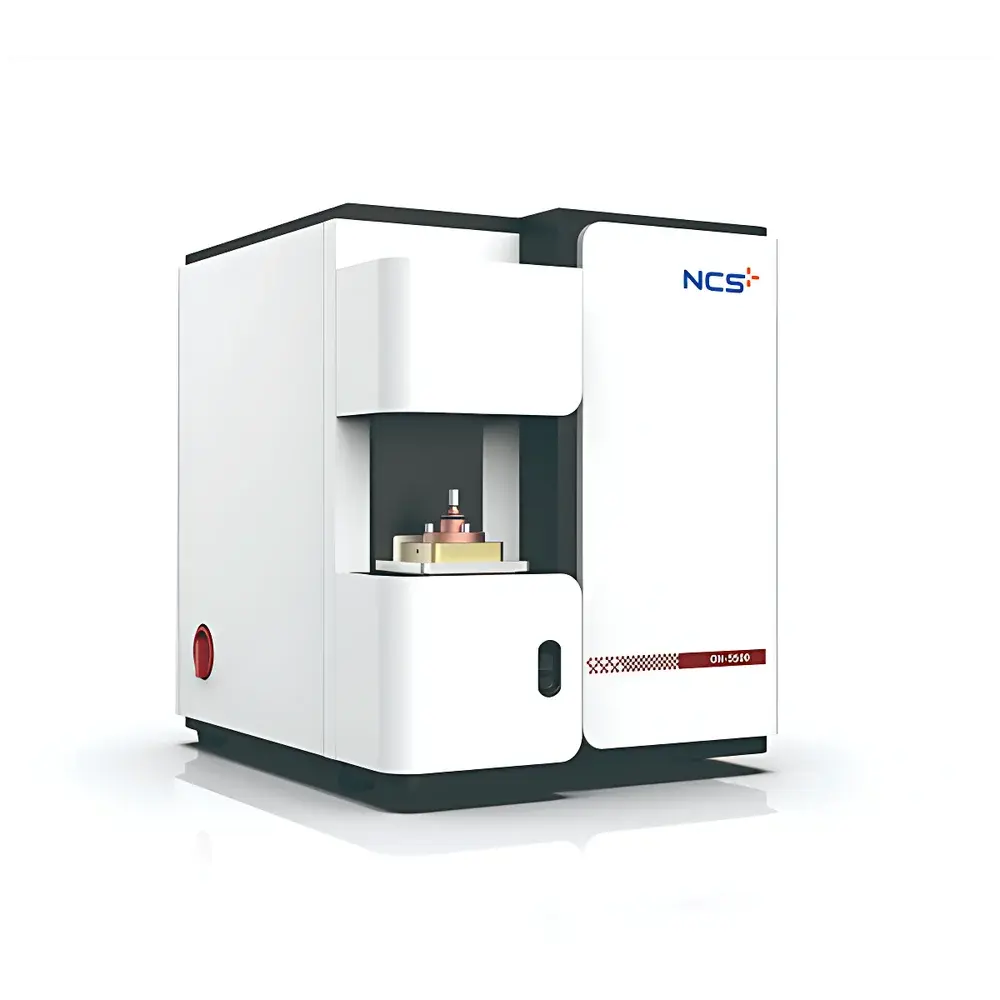
NCS ON5500 Oxygen and Nitrogen Analyzer
| Brand | NCS |
|---|---|
| Origin | Beijing, China |
| Manufacturer | NCS (Beijing) Technology Co., Ltd. |
| Model | ON5500 |
| Instrument Type | Oxygen and Nitrogen Analyzer |
| Sample Mass | 1.0 g (adjustable) |
| Oxygen Range | Low-O: 0.1 ppm–0.5 % |
| High-O | 0.5 %–20 % |
| Nitrogen Range | Low-N: 0.1 ppm–0.5 % |
| High-N | 0.5 %–50 % |
| Accuracy | ±1 ppm or RSD ≤ 1.0 % |
| Sensitivity | 0.01 ppm |
| Analysis Time | ~3 min |
| Pulse Furnace | 0–1500 A, 7.5 kVA, max. temp. 3500 °C |
| Carrier Gas | Ultra-high-purity He (≥99.9995 %) |
| Dimensions | 63 cm (W) × 76 cm (D) × 76 cm (H) |
| Weight | ~180 kg |
Overview
The NCS ON5500 Oxygen and Nitrogen Analyzer is a high-performance inert gas fusion elemental analyzer engineered for precise, trace-level quantification of oxygen and nitrogen in solid inorganic materials. It operates on the principle of inert gas fusion–infrared absorption (for oxygen) and thermal conductivity detection (for nitrogen). In this method, a precisely weighed sample is rapidly heated to temperatures exceeding 3500 °C in a graphite crucible under a controlled helium atmosphere within a water-cooled pulse furnace. The liberated oxygen forms CO (via reaction with graphite), which is subsequently oxidized to CO2 in a copper oxide catalyst; the resulting CO2 is measured via non-dispersive infrared (NDIR) spectroscopy. Simultaneously, nitrogen is released as N2 and quantified using a high-stability, low-drift thermal conductivity detector (TCD). This dual-detection architecture enables full-range analysis—spanning sub-ppm to percent-level concentrations—without manual range switching or calibration reconfiguration.
Key Features
- Integrated dual-detection system: NDIR for oxygen (0.1 ppm–20 %) and high-sensitivity TCD for nitrogen (0.1 ppm–50 %), both optimized for reproducible, matrix-independent response
- Pulse-heated graphite furnace with programmable current control (0–1500 A) and stable 7.5 kVA power delivery, achieving >3500 °C in <2 s for complete decomposition of refractory metals, ceramics, and intermetallics
- Low-flow, high-efficiency gas circuit design reduces helium consumption by up to 40 % versus conventional systems, lowering operational cost without compromising purge efficiency or baseline stability
- Real-time diagnostic software suite with automated leak-check routines, pressure monitoring, furnace current profiling, and dynamic gas flow regulation
- Intelligent range-switching algorithm that automatically selects optimal detection channels during analysis—enabling seamless transition between trace (ppm) and major-element (%) modes within a single run
- Critical subsystems—including IR cell optics, TCD filaments, and furnace thermocouple interfaces—utilize certified industrial-grade components sourced from Tier-1 European and Japanese suppliers for extended service life and minimal drift
Sample Compatibility & Compliance
The ON5500 is validated for analysis of ferrous and non-ferrous metals (e.g., stainless steels, titanium alloys, nickel superalloys), metal powders (including additive manufacturing feedstocks), ceramics (Al2O3, SiC, ZrO2), geological samples (ores, slags), and refractory compounds. Its measurement protocol aligns with ASTM E1019 (Standard Test Methods for Determination of Carbon, Sulfur, Nitrogen, and Oxygen in Steel, Iron, Nickel, and Cobalt Alloys), ISO 14284 (Steel and Iron—Sampling and Preparation of Samples for Determination of Chemical Composition), and JIS G 1211 (Methods for Determination of Oxygen and Nitrogen in Steel). The instrument supports audit-ready data integrity through time-stamped, user-logged method files, electronic signatures, and configurable audit trails compliant with FDA 21 CFR Part 11 requirements when deployed in regulated GLP/GMP environments.
Software & Data Management
NCS Analytical Suite v3.2 provides a Windows-based, role-based interface with intuitive workflow navigation, real-time signal visualization (IR absorbance vs. time, TCD voltage vs. time), and customizable reporting templates. All raw detector outputs, furnace parameters (current, voltage, temperature ramp), and gas flow profiles are stored in encrypted binary archives (.nca format) with MD5 checksum verification. Data export supports CSV, XML, and PDF formats; integration with LIMS is enabled via ODBC-compliant drivers and HL7-compliant metadata tagging. Method validation reports include precision (RSD), linearity (r² ≥ 0.9999 over 5 orders of magnitude), limit of detection (LOD = 0.01 ppm), and robustness testing across ambient temperature (15–30 °C) and humidity (30–70 % RH) ranges.
Applications
- Quality control of high-purity titanium sponge and aerospace-grade Ti-6Al-4V billets where oxygen segregation impacts ductility and fatigue life
- Process monitoring of metal injection molding (MIM) and binder jetting powders to ensure nitrogen-induced embrittlement remains below critical thresholds
- Research-grade quantification of interstitial O/N in niobium-based superconductors and zirconium nuclear cladding alloys
- Geochemical characterization of rare-earth element concentrates, where oxygen stoichiometry correlates with oxidation state and recovery efficiency
- Failure analysis laboratories verifying compliance with ASTM A1085 (structural hollow sections) oxygen limits (<0.025 %)
FAQ
What carrier gas is required, and what purity specifications must it meet?
Ultra-high-purity helium (≥99.9995 %) is mandatory. Impurities such as H2, O2, N2, H2O, and hydrocarbons must each be ≤0.1 ppm to prevent baseline noise, catalytic interference, and erroneous N2 quantification.
Can the ON5500 analyze samples with high carbon content without interference?
Yes—the integrated CO oxidation stage ensures quantitative conversion of all carbon-bound oxygen to CO2; residual CO is removed upstream of the IR cell. Carbon content up to 5 % does not affect oxygen accuracy.
Is external cooling water required for the pulse furnace?
Yes. A closed-loop chiller delivering deionized water at 15–25 °C and ≥2.5 bar pressure is required for continuous operation at rated furnace power.
How is calibration traceability maintained?
Calibration is performed using NIST-traceable certified reference materials (CRMs) such as NCS TC11101 (Fe-based O/N standard) and BCS CRM 305a (Ti-based O/N standard); certificate of analysis includes uncertainty budgets per ISO/IEC 17025.
Does the system support remote diagnostics and firmware updates?
Yes—via secure TLS 1.2-enabled Ethernet connection; remote access requires two-factor authentication and is governed by configurable IP whitelisting policies.
Related Products





