
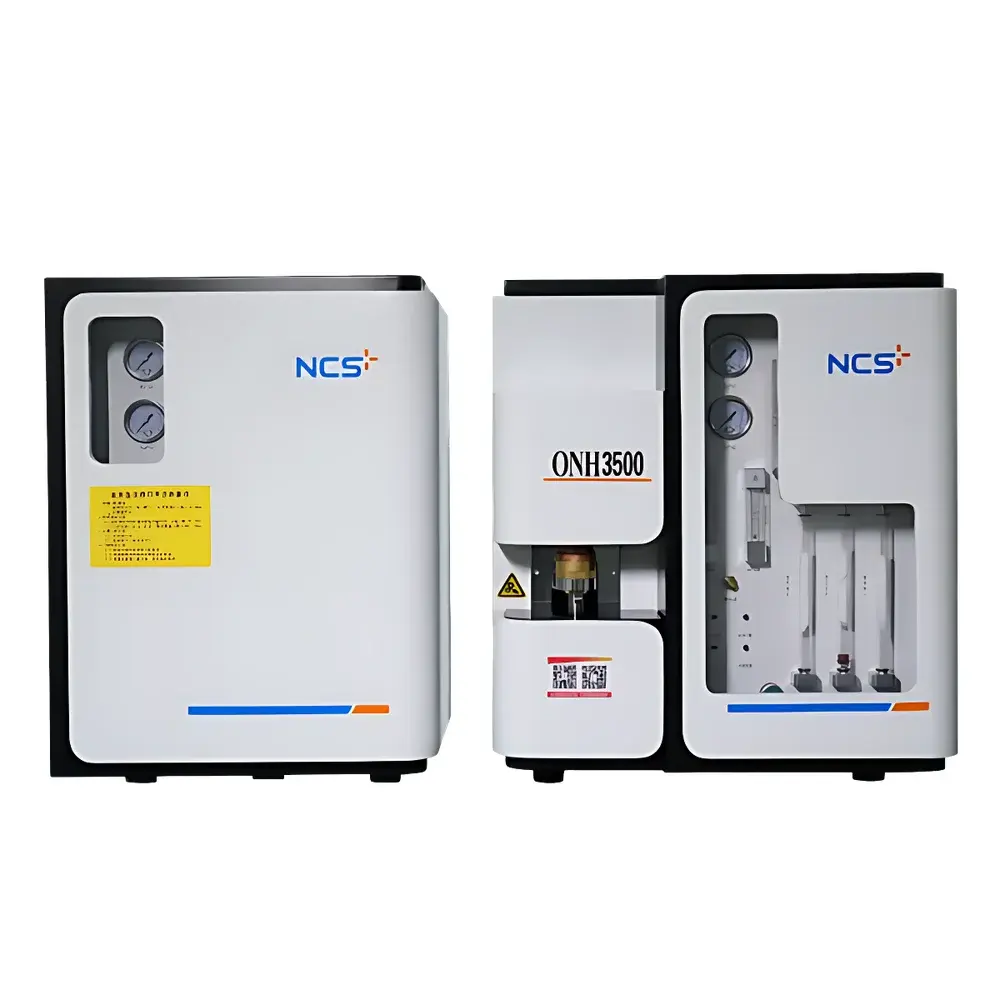
NCS ONH3500 Oxygen-Nitrogen-Hydrogen Analyzer
| Brand | NCS |
|---|---|
| Origin | Beijing, China |
| Manufacturer | NCS (Central Iron and Steel Research Institute) |
| Model | ONH3500 |
| Instrument Type | Oxygen-Nitrogen-Hydrogen Analyzer |
| Oxygen Range | 0.1 ppm–0.5% (low), 0.5%–20% (high) |
| Nitrogen Range | 0.1 ppm–0.5% (low), 0.5%–50% (high) |
| Hydrogen Range | 0.1 ppm–200 ppm (low), 200 ppm–5000 ppm (high) |
| Accuracy | O₂: ±1 ppm or RSD ≤1.0%, N₂: ±1 ppm or RSD ≤1.0%, H₂: ±0.2 ppm or RSD ≤2.0% |
| Sensitivity | 0.01 ppm |
| Analysis Time | 3 min |
| Furnace Power | 8.5 kVA |
| Detection Principle | Non-Dispersive Infrared (NDIR) for oxygen |
| Carrier Gas | Ultra-High-Purity Helium or Nitrogen |
| Power Supply | Furnace: 220 VAC ±10%, 50 A |
| Electronics | 220 VAC ±10%, 10 A |
| Dimensions (Main Unit) | 58 × 70 × 68 cm (W×D×H) |
| (Furnace Unit) | 48 × 70 × 68 cm (W×D×H) |
| Weight | 180 kg |
Overview
The NCS ONH3500 Oxygen-Nitrogen-Hydrogen Analyzer is a high-performance inert gas fusion analyzer engineered for precise quantification of interstitial elements—oxygen, nitrogen, and hydrogen—in solid inorganic materials. It operates on the principle of inert gas fusion followed by selective detection: samples are thermally decomposed under high-purity helium or nitrogen atmosphere in a graphite crucible within a water-cooled pulse furnace capable of reaching up to 3500 °C. Released gaseous species (CO, CO₂, N₂, H₂) are swept through a fully metallic, leak-tight gas path into dedicated detection modules. Oxygen is measured via dual-channel non-dispersive infrared (NDIR) spectroscopy—separately optimized for low- and high-concentration ranges—while nitrogen and hydrogen are simultaneously quantified using a paired thermal conductivity detector (TCD) with differential bridge architecture and inert-gas-protected thermistor filaments. This design ensures high signal stability, minimal baseline drift, and robust performance across multi-decade concentration spans.
Key Features
- Modular, electrically isolated architecture: Pulse furnace and analytical detection unit housed in separate enclosures to eliminate electromagnetic interference and thermal crosstalk.
- Dual NDIR oxygen detection channels—optimized independently for trace-level (0.1 ppm–0.5%) and bulk-level (0.5%–20%) oxygen quantification—enabling seamless auto-ranging without manual reconfiguration.
- High-stability TCD system featuring matched thermistor pairs, breath-mode constant-current excitation, and integrated inert-gas shielding to prevent filament oxidation and ensure long-term calibration integrity.
- Optimized optical design: High-output IR source with conical light-focusing geometry coupled to pyroelectric solid-state detectors and precision chopper motor modulation for superior signal-to-noise ratio and sub-ppm sensitivity.
- Programmable pulse furnace control with power-based heating profile management—minimizing dependence on crucible geometry or carbon content for consistent thermal decomposition efficiency.
- Full-metal gas circuitry with electropolished stainless-steel components and metal-sealed fittings, ensuring ultra-low background contamination and extended maintenance intervals.
- Real-time monitoring of critical operational parameters—including furnace temperature, carrier gas flow rate, detector voltages, and pressure differentials—accessible via intuitive graphical interface.
Sample Compatibility & Compliance
The ONH3500 accommodates a broad spectrum of conductive and semi-conductive solid matrices, including ferrous and non-ferrous metals (e.g., stainless steels, titanium alloys, nickel superalloys), powder metallurgy compacts, ceramic oxides (Al₂O₃, ZrO₂), refractory carbides, geological silicates, and electronic-grade sintered materials. Sample mass is adjustable (typically 0.1–1.0 g) to optimize dynamic range per analyte. The instrument meets essential regulatory and quality framework requirements for laboratory use: it supports audit-trail-enabled data recording compliant with GLP and GMP practices; its software architecture permits user-access level control and electronic signature functionality aligned with FDA 21 CFR Part 11 principles; and analytical methodologies are compatible with ASTM E1019 (Standard Test Methods for Determination of Carbon, Sulfur, Nitrogen, and Oxygen in Steel, Iron, Nickel, and Cobalt Alloys) and ISO 14284 (Steel and Iron — Sampling and Preparation of Samples for Determination of Chemical Composition).
Software & Data Management
NCS AnalyzePro™ software provides a Windows-based platform for method setup, sequence definition, real-time diagnostics, and comprehensive report generation. All raw detector signals, furnace thermocouple outputs, and gas flow telemetry are time-stamped and archived in vendor-neutral binary format with embedded metadata (operator ID, sample ID, calibration status, environmental conditions). Quantitative results are calculated using multi-point calibration curves validated against certified reference materials (CRMs) traceable to NIST or BIPM standards. Software supports customizable reporting templates—including uncertainty estimation per ISO/IEC 17025—and export to CSV, PDF, or LIMS-compatible XML formats. Optional network integration enables centralized instrument monitoring and remote diagnostic support via secure TLS-encrypted connections.
Applications
- Quality assurance in primary steel production: Monitoring oxygen pickup during ladle refining and vacuum degassing to control inclusion morphology and fatigue resistance.
- Powder metallurgy R&D: Quantifying residual nitrogen and hydrogen in atomized metal powders to predict sintering behavior and final part density.
- Aerospace material certification: Verifying hydrogen content in Ti-6Al-4V forgings to prevent hydride-induced embrittlement per AMS 2301 and ASTM F2885.
- Electronic ceramics manufacturing: Measuring oxygen stoichiometry deviations in BaTiO₃ or PZT dielectrics that impact piezoelectric response and aging characteristics.
- Geological research: Determining volatile element budgets in mantle-derived xenoliths and meteoritic silicates for planetary differentiation modeling.
- Third-party testing laboratories: Delivering accredited analysis services under ISO/IEC 17025 scope for contract metallurgical testing.
FAQ
What carrier gases are required for routine operation?
Ultra-high-purity helium (≥99.999%) is recommended for optimal oxygen detection sensitivity and baseline stability; high-purity nitrogen (≥99.995%) may be used as an alternative for nitrogen/hydrogen-only analyses.
Can the ONH3500 analyze non-metallic samples such as ceramics or carbides?
Yes—the pulse furnace’s graphite crucible and high-temperature capability (up to 3500 °C) enable complete decomposition of refractory oxides, nitrides, and carbides when appropriate fluxes or pre-treatment protocols are applied.
How does the instrument handle calibration verification and drift correction?
Daily calibration verification is performed using certified reference materials spanning each analyte’s full working range; software calculates drift-corrected results automatically based on bracketing CRM measurements and applies real-time slope/intercept adjustments.
Is the system compatible with automated sample introduction?
The ONH3500 supports optional robotic autosampler integration (NCS AS-300 series) for unattended batch analysis of up to 30 samples, with programmable weighing and crucible handling functions.
What maintenance intervals are recommended for the infrared and thermal conductivity detectors?
Under normal operating conditions, NDIR optical components require inspection every 12 months; TCD filaments exhibit >24-month service life with proper carrier gas filtration and regular zero-gas purging—no routine replacement is scheduled unless diagnostic alerts indicate degradation.



