
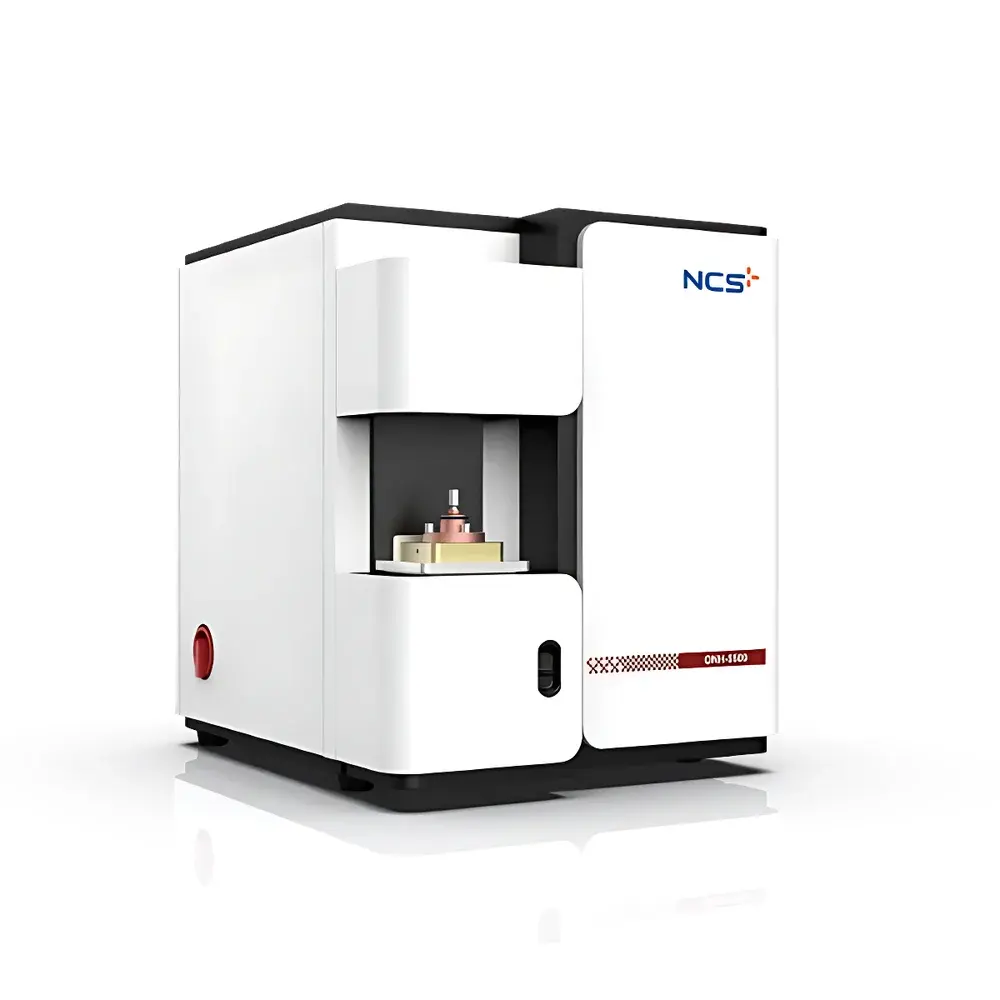
NCS ONH5500 Oxygen-Nitrogen-Hydrogen Analyzer
| Brand | NCS |
|---|---|
| Origin | Beijing, China |
| Manufacturer Type | Direct Manufacturer |
| Product Category | Domestic |
| Model | ONH5500 |
| Instrument Type | Oxygen-Nitrogen-Hydrogen Analyzer |
| Analysis Range | O (Low: 0.1 ppm–0.5 wt% |
| High | 0.5–20 wt%), N (Low: 0.1 ppm–0.5 wt% |
| High | 0.5–50 wt%), H: 0.1–2000 ppm |
| Accuracy | O/N: ±1 ppm or RSD ≤1.0% |
| H | ±0.2 ppm or RSD ≤2.0% |
| Sensitivity | 0.01 ppm |
| Analysis Time | 3 min |
| Pulse Furnace | 0–1500 A, 8.5 kVA, max. temperature ≥3500 °C |
| Carrier Gas | Ultra-high-purity He (≥99.9995%) |
| Dimensions | 63 × 76 × 76 cm (W×D×H) |
| Weight | ~180 kg |
Overview
The NCS ONH5500 Oxygen-Nitrogen-Hydrogen Analyzer is a high-precision, solid-sample elemental analyzer engineered for the quantitative determination of oxygen (O), nitrogen (N), and hydrogen (H) in inorganic solid materials—including ferrous and non-ferrous metals, metal powders, ceramics, refractories, and geological samples. It operates on the principle of inert gas fusion coupled with dual detection technologies: non-dispersive infrared (NDIR) spectroscopy for oxygen and hydrogen quantification, and high-sensitivity thermal conductivity detection (TCD) for nitrogen measurement. During analysis, a precisely weighed sample is rapidly heated to temperatures exceeding 3500 °C in a graphite crucible within a controlled helium atmosphere. This pulse-heated fusion liberates interstitial and bound gaseous elements as CO, CO2, N2, and H2. Gaseous species are then separated via selective absorption and thermal conductivity response, enabling simultaneous, independent quantification of all three elements in a single run.
Key Features
- Triple-element simultaneous analysis (O, N, H) in one furnace cycle—no manual reconfiguration or sequential runs required.
- Optimized low-flow gas circuit design reduces helium consumption by up to 40% versus conventional systems, lowering operational cost without compromising sensitivity or stability.
- Pulse-heating furnace with programmable current control (0–1500 A) and rated power of 8.5 kVA delivers rapid thermal ramping and stable plateau temperatures ≥3500 °C, ensuring complete decomposition of refractory phases including TiN, AlN, and ZrO2.
- Modular detector architecture: configurable NDIR cells (1–3 channels) for high/low oxygen and hydrogen; dedicated TCD cell for nitrogen—enabling method-specific optimization and long-term calibration stability.
- Real-time system diagnostics including automated leak detection, pressure monitoring, flow validation, and furnace current/voltage logging—all accessible via intuitive software interface.
- Intelligent range-switching algorithm automatically selects optimal detection channel (e.g., low- or high-range O cell) during analysis based on evolving signal intensity—eliminating manual intervention and preventing detector saturation.
- Robust mass-flow-controlled gas handling system ensures repeatability across multi-day sequences, meeting requirements for ISO/IEC 17025-compliant laboratories.
Sample Compatibility & Compliance
The ONH5500 accommodates a broad spectrum of solid inorganic matrices: carbon steel, stainless alloys, nickel-based superalloys, titanium and zirconium metals, tungsten carbide, silicon nitride, alumina, fused silica, and mineral ores. Sample mass is typically 0.5–1.5 g (adjustable per analyte concentration), supporting both routine QC and low-level trace analysis. The instrument complies with key international standards for elemental combustion analysis, including ASTM E1019 (Standard Test Methods for Determination of Carbon, Sulfur, Nitrogen, and Oxygen in Steel, Iron, Nickel, and Cobalt Alloys), ISO 14284 (Steel and Iron — Sampling and Preparation of Samples for Determination of Chemical Composition), and JIS G 1211 (Methods for Determination of Oxygen, Nitrogen and Hydrogen in Iron and Steel). Its audit-trail-enabled software supports GLP/GMP environments and meets data integrity expectations aligned with FDA 21 CFR Part 11 when configured with electronic signature and user-access controls.
Software & Data Management
NCS ONH5500 is operated via ONH-Studio™—a Windows-based application designed for analytical chemists and metallurgical QA/QC personnel. The software provides full method editor functionality: customizable heating profiles, gas flow sequences, integration windows, baseline correction algorithms, and calibration curve management (linear, quadratic, or multi-point non-linear). All raw detector signals, furnace parameters, and environmental logs are timestamped and stored in an encrypted SQLite database. Export options include CSV, PDF reports (with embedded spectra and calibration history), and direct LIMS integration via ASTM E1384-compliant ASCII output. Audit trail records every user action—including method edits, calibration updates, and result approvals—with immutable timestamps and operator ID linkage.
Applications
- Quality assurance of aerospace-grade titanium alloys where hydrogen embrittlement thresholds must be verified below 15 ppm.
- Process control in powder metallurgy facilities measuring nitrogen in stainless steel powders to ensure sintering consistency.
- Research on oxide dispersion strengthened (ODS) steels requiring sub-ppm oxygen detection in grain boundaries.
- Failure analysis labs quantifying interstitial H in weld zones of pipeline steels to assess susceptibility to hydrogen-induced cracking (HIC).
- Geological survey labs determining hydrogen content in hydrated minerals (e.g., kaolinite, serpentine) for provenance studies.
- Refinery catalyst manufacturers monitoring oxygen stoichiometry in supported metal oxides (e.g., V2O5/TiO2) critical to redox activity.
FAQ
What carrier gas is required, and why is ultra-high-purity helium specified?
Ultra-high-purity helium (≥99.9995%) is mandatory to prevent interference from atmospheric nitrogen and oxygen in the detection stream. Trace impurities would compromise baseline stability in both NDIR and TCD measurements, especially at sub-ppm levels.
Can the ONH5500 analyze liquids or organic materials?
No. The instrument is strictly designed for solid inorganic samples compatible with high-temperature graphite crucible fusion. Organic matrices produce excessive soot and volatile hydrocarbons that contaminate the furnace and detectors.
How does the system achieve 0.01 ppm sensitivity despite using thermal conductivity for nitrogen?
Sensitivity is achieved through optimized detector cell geometry, ultra-stable temperature regulation (±0.01 °C), low-noise electronics, and advanced digital filtering—combined with helium’s high thermal conductivity contrast against N2.
Is method validation support available for ISO 17025 accreditation?
Yes. NCS provides documented IQ/OQ/PQ protocols, certified reference material (CRM) recommendations (e.g., NIST SRM 660c, BAM Fe-1b), and uncertainty budget templates compliant with EURACHEM/CITAC guidelines.
What maintenance intervals are recommended for the graphite furnace and IR cells?
Graphite crucibles are consumables replaced after ~200–300 analyses depending on sample matrix; IR cells require annual verification and cleaning per NCS Technical Bulletin TB-ONH-02. Preventive maintenance is scheduled every 6 months by authorized service engineers.






